
#1 The upwind speed you already own... and why a bit of science is such fun if you want to win!


Dartmouth regatta 2026 - windy upwind get the start right and you were set for a good race. Photo by Ingrid Abery (C)
In brief
For readers short of time:
Most boats are not short of upwind potential. They are short of the time they spend at it. A third of a knot and two degrees is 10% more progress to windward.
A sail works by bending the wind, and that bend is the force. The old story about air hurrying round the leeward side to meet its partner at the leech is wrong. I explain below.
How the slot work? The main does far more for the jib’s air than the jib ever does for the main’s, so stop trimming two sails and trim one wing.
Twist does three jobs at once: it meets a wind that is stronger and freer at the masthead, it takes load off the top where the lever is longest, and it gives the rig somewhere to go when a wave throws it.
If one tack always wants different trim, suspect the boat before thinking win shear. Leeway the instruments never applied looks exactly like wind shear, and so does a mast that is not straight in the boat.
Close to the wind an extra newton of drag costs you almost a whole newton of drive, while an extra newton of lift buys about four tenths. Efficiency, not power. I explain this!
A completely different result with no costs
This summer I coached aboard a fairly new Sun Fast 3600 at the Dartmouth regatta. By the time I stepped aboard, the crew had already decided two things: the boat was slow, and she would not point.
Nothing was wrong with the boat, I could tell immediately, it was a mind set and set up issue, all required careful management.
What I saw when the racing started was a boat that got everything right for the first ten seconds and then went nowhere. She was on the line on time and in the right place, but at half speed. She was heeling too much, with not enough weight in the right place. The sails were over-sheeted. The helm was moving too much, correcting an overpowered boat rather than steering a fast one. The backstay was too long to be tightened properly, so the forestay could not be tensioned and the main could not be flattened. Downwind, the spinnaker trim was suspect too, but that’s another story for the coming ‘downwind master class series’.
The result was inevitable. She fell straight back into the dirty wind of the boats around her, before the first shift had even arrived. From then on she was sailing in other people’s air, and she looked slow because she was.
We sorted out the backstay so the rig could be tensioned, eased the sheets, put the weight where it worked, brought the heel down and let the helm stop chasing the boat. By the last race she was in the top three.
None of that speed cost a penny. It was aboard all along, spread thinly across the rig, the sails, the helm and the crew. Each piece looked reasonable on its own. Together they made a boat that stopped at every third wave.
That is the subject of this series. Not just sailing to a polar, but how to sail faster by understanding more about the the interaction of the sea state, the wind and how the crew and helm combine it all to sail a better average speed. This is the key to winning offshore.
How much is there to find?
Sometimes a lot. Take a boat making 6.0 knots through the water with her track 45° from the true wind. Her windward VMG is 4.24 knots. Get her to 6.4 knots at 43° and it becomes 4.68 knots. That is 10.3% more progress to windward, from a third of a knot and two degrees. That’s all great but not the real world on a race boat.
Those are illustrative inputs, not a promise. A well sailed boat may have very little left. But offshore the bigger prize is rarely the settled number. It is the wave group that stops you, the gust that lays you over before it drives you, the tack you exit too high. A small gain in settled trim can vanish in one badly handled set of waves. A slightly more forgiving mode that gives away a fraction of height, and recovers properly, can win the watch.
The FirstShift Upwind masterclass runs in three parts:
The air. What the sails are doing, and why twist matters more than sheet tension. This part.
The water and the whole boat. Keel, rudder, heel, power, polars and the seaway.
The controls and the crew. Rig tune, jib, main, tacking, double-handed sailing, the pilot and the instruments, ending with a mode card you can take sailing.
It is written for conventional offshore monohulls of 30 to 40 feet, crewed or double-handed. Where a figure needs a real boat I have used a Sun Fast 3300 or 3600: a modern fractional rig, non-overlapping jib and twin rudders, and a boat a great many double-handed crews now sail. Older masthead boats obey the same physics. Their best settings differ.
Back to basics: What the sail is asking the air to do

Sunrise JPK1180 - Top boat - look at the slot in this picture and the clew position are you happy?
Slice horizontally through a sail at any height. The straight line from luff to leech is the chord. The curve is camber; how deep it is, and where the deepest point sits, describe most of the shape. The angle between the chord and the air actually arriving at that section is the angle of attack. It is not the apparent wind angle on the display. The rig bends the air before it arrives.
A loaded sail turns the flow. Turning it creates a pressure difference, lower on the leeward side and higher on the windward side, and the sum of those pressures plus a little friction is the sail’s force. Look at the air instead and you find the same force as a change in the air’s momentum. Pressure and flow turning are two descriptions of one event, not rival theories.
What does not happen is the schoolroom version, in which air on the longer leeward side must hurry to meet its partner at the leech. Nothing obliges it to. Bernoulli connects local speed and pressure; it does not say the paths must finish together.
The trouble starts after the leeward flow has accelerated into the low pressure behind the luff. Towards the leech it has to slow down again while the pressure recovers. That is hard work for the boundary layer, the thin film of air slowed by friction against the cloth. Ask too much of it and it separates. A separated patch near the leech can be expensive long before the sail looks stalled.
So more sheet does not keep producing more useful force. Too much angle, too much depth or a closed leech asks too much of the flow. And attached flow alone is not proof of good trim. A sail with every yarn streaming can still be producing too little drive, or more side force than the boat can use.
Telltales report local behaviour, nothing more. A leeward yarn that lifts tells you about that patch of luff. A leech telltale that disappears tells you about that exit. Read several heights, the draft stripes and the boat’s response together. At this level the question is not whether every yarn streams. It is whether the loading you have chosen produces the best progress you can repeat.

The slot does not blow (speed up the flow)
Most of us were taught that the jib funnels air through the slot and blows it across the back of the main. It is a tidy picture, and it is wrong.
Arvel Gentry, an aerodynamicist at Boeing who sailed, took the slot apart in a paper to the AIAA sailing symposium in 1971. His conclusion turned the old idea on its head: “The jib develops much more lift when it is operating in a flow field created by the mainsail.”
Here is what is actually going on. The main’s circulation bends the air ahead of it, so the jib sits in the main’s upwash: it sees a freer wind, can be sheeted at a smaller angle and carries more load. The main, in turn, sits in the jib’s downwash. It is headed, and the suction peak at its luff falls. The soft bubble you see behind the mast is mostly that heading, not air blown onto the main. Gentry also found that the air flowing through the slot slows down rather than speeds up.
The jib gains one more thing. Its leech discharges into the fast-moving air on the leeward side of the main, which eases the pressure recovery on the jib and lets it carry more load before separating. Aerodynamicists call this the dumping effect.
For the crew, the consequence is practical. Inhaul is a whole-rig adjustment. Moving the jib inboard changes its own angle and shape, and it changes the air the main has to work in. If the boat points higher but will not accelerate, look at the jib’s upper leech, the main’s entry and the helm load together. Hauling the main in to kill every ripple at the luff may close a leech that was doing useful work.
The two sails want compatible loading, not identical-looking twist. Their chords, their air and their stretch are all different. A little softness at the main’s luff can be perfectly acceptable in a productive mode. A main that never seems to do anything is a reason to look at the combination, not to pull harder.

In haulers and leech tension… critical can you see it?
Twist has three jobs
Twist is how much the sail’s sections turn away from the centreline as you go up. We judge it by the leech and the battens, but each section’s angle of attack also depends on the wind arriving there and on the flow the rest of the rig induces. Twist matters for three separate reasons.

The wind aloft is stronger and freer
True wind usually strengthens with height above the sea. Add the same boat speed to a stronger wind and the apparent wind aloft is both stronger and wider. Take a boat making 6.5 knots at 45° to the true wind, with 10 knots at a low section of the sail and 12 knots at a high one. With no leeway, the low section sees 15.3 knots apparent at 27.5°. The high section sees 17.2 knots at 29.5°. Because force goes with the square of wind speed, the upper section is working in about 27% more dynamic pressure.
Two degrees of difference is not a prescription for two degrees of twist. The rig’s induced flow, the camber of each section and the load you want aloft all matter as well. Twist would still be a design variable in a perfectly uniform wind.
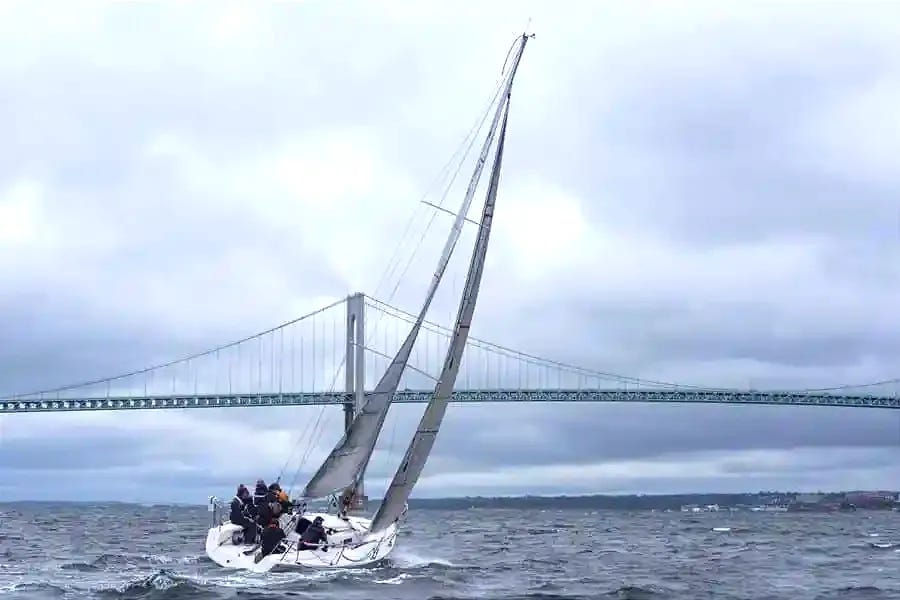
Twist - how much is enough?
Easing moves the force forward
Ease the mainsheet and the upper leech opens. The chord of each upper section rotates, and the total aerodynamic force rotates forward with it. You lose a little side force, keep most of the drive, and the boat stands up. Less heel means less leeway and less rudder, and the boat accelerates. That is why an ease so often makes a struggling boat go faster. Occasionally there is a second reason, a stalled head that starts working again, but rotation of the force is the main one.
Height matters too. Force high up has a long lever. Move 100 newtons of side force from 12 metres above the water to 6 metres and you remove 600 newton-metres of heeling moment. A real trim change alters the total force as well, but the arithmetic shows why the head of the sail is where you depower first. Once righting moment is the limit, the job is to keep the lower sail driving and let the top carry less.
The top of the mast moves
The rig is not still. Pitch and roll change the air at every height, and the higher you go the faster the sail is moving. In a short head sea, pitching through plus and minus 5° every three and a half seconds, the peak rate is about 9° a second. A point 15 metres above the pitch axis is then moving at about 2.3 metres a second, roughly four and a half knots, against perhaps 15 knots of apparent wind. The head of the sail sees a very different and constantly changing wind from the foot.
A tight upper leech leaves no margin for that. A gust or a pitch that increases incidence goes straight into heel. Some opening lets the top shed load and keep the flow; too much leaves good sail area doing nothing. Offshore, twist is a shape setting and a decision about how the rig responds to a disturbance.
That is also why “full sails for waves” is only half right. A boat short of drive may need more depth. An overpowered boat needs a flatter sail, an open top and a softer steering mode. Depth and twist are different things, even though the ropes that control them interact.
One atmosphere, two tacks
The wind changes with height in speed, in direction, or both. Sailors tend to call the speed change gradient and the direction change shear. Both are shear, and both matter.
In the Northern Hemisphere, friction with the sea means the wind usually veers with height. The effect is strongest in stable air, typically warm air over a cold sea, which suppresses mixing and lets the layers slide over each other. Cold air over warm water mixes and evens things out. In the Southern Hemisphere the wind backs with height.
A veer aloft is a lift on starboard tack and a header on port. So in the Northern Hemisphere, starboard tack usually sees the more open wind at the masthead and wants more twist; port wants less.
How big is it? Over the sea in well mixed air, the wind at the masthead is commonly something like 15 to 25% stronger than at the boom. A change of direction within the height of the mast is usually a few degrees. In stable air it can be much more, and a cold early-season sea under a warm airstream is the classic case.

Here is a deliberately strong example. Boat speed 6.5 knots, no leeway. Low wind 10 knots from 000°, high wind 12 knots from 010°. On starboard, heading 315°, the low sections see 27.5° apparent and the high sections 36.3°. On port, heading 045°, the low sections again see 27.5°, but the high sections only 22.9°. Same atmosphere, same boat, very different jobs for the top of the sail.
Before you blame the sky, eliminate the boat. Most tack-to-tack differences I see are the boat:
Leeway not applied. If the instruments do not correct for leeway, true wind angle and direction are wrong by a few degrees with opposite sign on each tack. It looks exactly like shear.
Upwash. The rig bends the air before it reaches the masthead unit, by different amounts on each tack and at each wind speed.
Heel. A heeled masthead sensor reads a narrower apparent wind angle than the true one.
The boat itself. Unequal lead positions, a mast not straight in the boat, a different sea angle on each tack.
Then look at the sail: luff telltales at several heights, the upper exit, the draft stripes and how the boat comes out of a tack. The rig changes the local flow, so telltales are clues, not an atmospheric survey. And do not rush to bury a tack difference in a permanent calibration change before you know what caused it. Part three covers the instruments properly.
When repeated observations do show different settings working on each tack, use them. Reassess as the breeze and the location change. If the top is overloaded, open it while keeping the bottom driving. If it is starved, close it. Righting moment may still force you to unload the head even where the wind profile alone would favour a tighter leech.
More lift, less progress
Lift acts at right angles to the air arriving at the sail. Drag acts along it. Neither is lined up with the boat. Resolve them into a forward part and a sideways part and you see why efficiency matters so much upwind.
For a simple upright rig, with the apparent wind angle β measured from the bow:
Drive = L sin β − D cos β
Side force = L cos β + D sin β
At 25° apparent, another 100 newtons of lift buys about 42 newtons of drive and 91 newtons of side force. Another 100 newtons of drag costs about 91 newtons of drive. Close to the wind most of any extra lift turns into heel, and almost all of any extra drag comes straight off the drive.

There is a hidden cost too. A sail of finite height leaves a swirling wake that brings its own drag, induced drag. It is easiest to understand in terms of span: at a given force, induced drag goes roughly with the force squared, divided by the effective span squared. Two consequences follow, and both are worth more than any equation:
Seal the foot. A jib whose foot sweeps the deck, and a main with no gap under the boom, use the deck as a mirror. The rig behaves as though it were much taller, and induced drag falls.
Heel shortens the rig. As the boat heels the sail’s effective height falls with the cosine of the heel angle, and the keel’s falls with it. Induced drag rises at both ends of the boat. That, more than any rule of thumb, is why excessive heel is slow.
The extra side force also has to be resisted below the waterline. The keel and rudder carry it, at a cost in leeway and drag. A harder-loaded sail plan can lose twice: once in the air and once in the water.
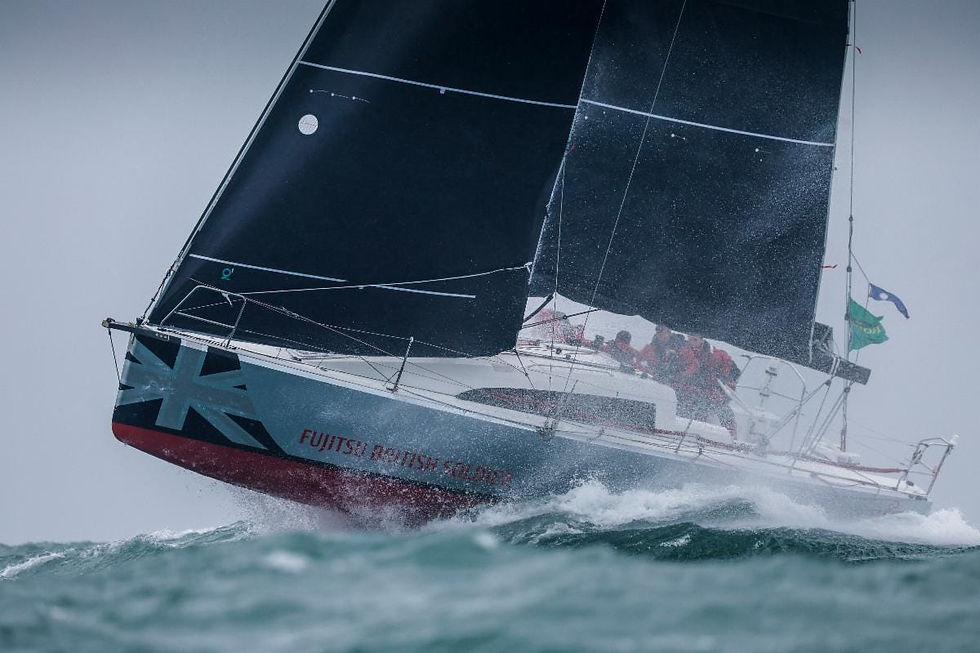
Get it right and its the best feeling ever!
That brings us to the one relationship that ties the whole boat together. The closest angle to the apparent wind a boat can sail is the sum of two drag angles, one for the rig and one for the hull and foils. Make either worse and the boat cannot point, however beautiful the sails. That is where part two begins.
Why the beat matters mostTwenty miles to windward at 4 knots VMG takes five hours. Twenty miles downwind at 8 knots takes two and a half. Improve either by 10% and you save about 27 minutes on the beat and 14 minutes on the run. The slow miles are where the hours are.

Back to Dartmouth
The crew on the Sun Fast 3600 were right about the symptom and wrong about the cause. A boat that will not point is rarely short of pointing. She is usually short of something earlier in the chain: Sail trim that is not working across the whole rig, a top that cannot cope with the motion, or a keel that has been asked for more than it can give. As a trimmer or a helmsman understanding the science will help you make your boat go faster without any costs.
This just a brief look and in part 2 and 3 I look at other key factors. None of it is the whole story but I hope its a good first shift for you!
Stuart Greenfield
FirstShift — Yacht Racing Intelligence From first shift to first place.
Offshore racing is never just about the boat, the forecast, or the routing software.
It is about decisions made under pressure, in changing conditions, by tired people trying to keep the boat moving fast and safely in the right direction.
That is where races are won and lost.
At FirstShift, my aim is simple: to help owners, skippers and crews race offshore with more clarity, more confidence, and better preparation whether that is a RORC Channel race, a Fastnet campaign, or your first serious step into offshore racing.

Comments