
#2 Why pointing is decided below the waterline and how much sail power does a boat generate?

In briefFor readers short of time. The full argument follows below.
A boat cannot point closer than the sum of two drag angles, one above the water and one below it. If she will not point, look under the boat and the sails.
The keel is a wing and leeway is how it works. Zero leeway is not a target, it is a keel doing nothing. Let a wave take 20% off your speed through the water and the keel loses 36% of its grip.
Flat is not fast. Three to five degrees of weather helm is the keel and rudder sharing the work. Much more and the rudder has become a brake.
Under ten horsepower is keeping a 40-footer at seven knots. Add 100 newtons of resistance and you have spent 5% of that, so every large rudder correction is a brake applied to a very small engine.
The expensive moment is the one just after a stopping wave. Ask a slow keel for height and the boat slides sideways. Bear away a little, rebuild the speed, then load the sails back up.
Near the optimum the polar is almost flat. 6.5 knots at 40 degrees and 6.8 at 43 are a hundredth of a knot apart, so steer to a target speed and not a target angle.
Stop measuring settled speed and start measuring what each wave costs. One knot of VMG lost for 20 seconds is 10 metres. Sixty times in a night is a third of a mile.
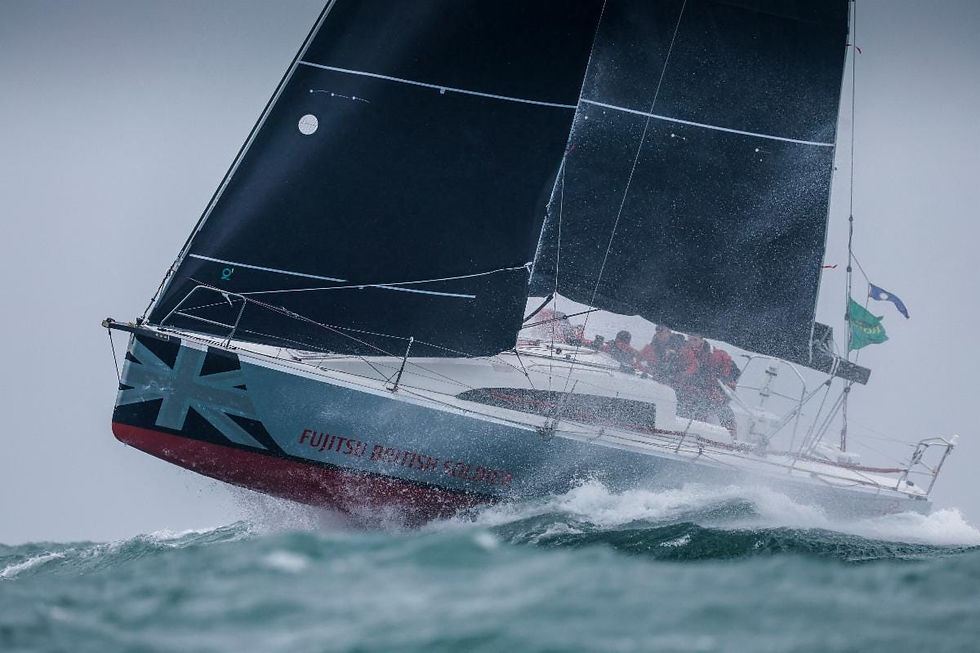
The crew of the Sun Fast 3600 I coached at Dartmouth this summer were sure she would not point. In part one I argued that the cause was rarely where the crew were looking. Here is the reason in one line: the angle a boat can sail to the wind is set as much under the water as above it.
The course theorem
In steady sailing, the angle between the apparent wind and the boat’s track through the water equals the sum of two angles.
The aerodynamic drag angle, set by the rig’s drag compared with its lift.
The hydrodynamic drag angle, set by the hull and foils’ resistance compared with the side force they produce.

That is all. It is old, it is in every serious text on yacht performance, and it explains more about pointing but what does it mean practically? Make the rig less efficient and the boat sails wider. Make the hull and keel less efficient, with weed, a slowed keel, too much heel or a rudder over used, and the boat sails wider just the same. A crew that cannot point usually searches the sails. Half the time the answer is also underneath.
The keel is a wing
A conventional keel is a submerged wing turned on its side. Its lift acts sideways, against the rig’s side force. A symmetrical section has no built-in camber, so it makes lift only by meeting the water at an angle. On a boat with a fixed keel, essentially all of that angle comes from leeway: the bow points slightly to windward of the boat’s actual track through the water.
So leeway is not a fault. It is how the keel works. Upwind it is typically a few degrees, often somewhere around 3 to 5°, and it climbs steeply as the boat slows. Zero leeway is not a target for a fixed symmetrical keel; it is a keel doing nothing.
The rudder is a wing too. Its angle of attack comes from leeway plus whatever the helm has applied, in water already disturbed by the hull and keel. A centred rudder is not necessarily unloaded, and taking away every trace of weather helm is not necessarily fast. North Sails’ explanation of foil loading puts it plainly: “The keel (or centerboard) and rudder should both contribute to the boat’s side-force to counteract the sail’s side-force.”
Why can such small foils balance such a big sail plan? Density. Seawater is about 1,025 kilograms per cubic metre; air at sea level about 1.225. Water is roughly 840 times denser. Lift depends on density, area, the lift coefficient and the square of speed, so a small foil in dense water can match a large sail in thin air.
The square of speed is the catch. Let a wave knock 20% off the speed of the water past the keel. At the same lift coefficient the keel loses 36% of its lift. To hold the original side force it needs about 56% more lift coefficient, which means more angle of attack, which means more leeway and more drag. The sail loads change during the encounter too, but the arithmetic shows why pinching straight after a stopping wave is so expensive. You ask a slow keel for more than it can give, and the boat slides sideways.

Heel and helm
Heel changes everything the sails and foils work on. Too much and the rudder loads up, the hull’s shape in the water changes, the effective span of both rig and keel shortens, and the boat becomes hard to accelerate. But flat is not fast either.
A little weather helm is the keel and rudder sharing the work. A commonly quoted starting point upwind is 3 to 5° of rudder angle. Much more and the rudder has become a brake; much less and you have unloaded half your underwater wing. Where the right heel lies depends on the hull. A wide, chined boat with twin rudders, like the Sun Fast 3300 used in this series’ figures, is designed to sail at a particular heel with the leeward rudder immersed and the windward one partly clear. Take the heel target from the designer, the class or your own measured trials, not from another boat.
The first clue is usually the gust. If a puff produces heel and rudder load before it produces speed, you are already late. See it coming, unload the top of the sail, and do not add a large rudder correction to an overloaded boat. The answer may be less sail, a different shape, a different angle, or several small changes together.
Helm pressure is information, not a diagnosis. Hull form, heel, sail load and the foils all contribute. The textbook drawing with two dots labelled “centre of effort” and “centre of lateral resistance” cannot describe the three-dimensional balance of a heeled yacht.
The helmsman also has to say which mode he is in. Building speed, holding VMG and buying a little height for tactical reasons need different trim. Change between them silently and the trimmers are chasing a target nobody has told them about. Short, predictive calls work: “Steep set coming, build speed.” “Speed’s back, building height.” “Too much helm, ease the top.” Each one ties a rope to a result.
Where the crew sit
Crew weight is the righting moment you can move, and offshore it is also pitch.
Fore and aft. Forward in light air to lift the transom clear and reduce wetted area. Centralised as the sea builds.
Out of the ends. Weight in the bow and stern increases the boat’s pitch inertia. In a head sea that is one of the most expensive things you can do. Keep people and gear near the middle of the boat.
To windward and hiking. On a boat where righting moment is the limit, every kilogram on the rail is drive.
Double-handed boats stack sails and gear instead. Part three deals with that, including the rule that governs it.
Ten horsepower
The loads on a 40-foot racer feel enormous. The power actually keeping her moving is modest. Force and power are different things. Useful power is the resistance along the track multiplied by the speed through the water.
Take an illustrative boat at seven knots, about 3.6 metres a second, with 2,000 newtons of total resistance. That is 7.2 kilowatts, or about 9.7 horsepower.
Under ten horsepower. The 2,000 newtons is an assumption for the example, not a measured figure for every 40-footer.
The 40 horsepower diesel under the companionway measures something else: its output at the crankshaft at rated revolutions. Gearbox, shaft, propeller and the way the propeller works behind the hull all take their share before any of it becomes useful thrust. If, purely for illustration, half the engine’s output became useful towing power, the boat would need about 19.3 horsepower from the engine to match the sails. (For illustation every boat is different of course)

Now add 100 newtons of resistance at seven knots. It costs 360 watts, about half a horsepower, which is 5% of the whole budget in this example. That does not mean 5% less speed; the change depends on the resistance curve. It does mean the rig has to find 5% more drive just to stand still.
That is why a clean bottom, fair foils and less windage repay attention. It is why surplus weight hurts, although crew placed to add righting moment may earn their passage. And it is why large rudder corrections matter: each one is a brake applied to a ten horsepower engine.
Hull speed belongs here too. The familiar estimate, 1.34 times the square root of the waterline length in feet, comes from the speed of a wave whose length equals the waterline. A ten-metre waterline gives about 7.7 knots. It marks where wave-making resistance rises steeply for a displacement hull. It is not a governor. Slender hulls exceed it, light hulls plane, and anything can surf.
The ‘polars’ are a prediction
A velocity prediction programme finds the speed and attitude at which the boat’s forces and moments balance: drive against resistance, heeling moment against righting moment. The polar is its output.
IRC crews need to remember one thing. IRC is not rated from a published VPP. Your targets therefore come from somewhere else: an ORC certificate, a designer’s VPP or your own logged data. Each carries assumptions, and each is dated: the ORC VPP is revised annually, so note which year’s documentation your numbers came from. Before you trust a target, check the crew weight, the sail inventory, the displacement, the wave allowance, and whether the angles are measured from the heading or the track through the water. A fully crewed target is not automatically achievable with two people aboard. So you can build your own polars, all the top boats do, taking on board data in real tim to constantly check, verify and update.
My earlier pieces on building and correcting polars cover the method. The point here is the shape of the optimum.

Upwind, 6.5 knots at 40° gives 4.98 knots of VMG. 6.8 knots at 43° gives 4.97. Two very different modes, a hundredth of a knot apart. If the faster, wider mode recovers better after waves, it wins offshore. If the high mode stays settled, it may be just as good.
After the Morgan Cup one of my crew produced tables showing how much extra boat speed would be needed to justify bearing away by different amounts. That is exactly the right question, because near the optimum the curve is flat and small errors in angle cost very little. It also means steering to a target boat speed is usually more robust than steering to a target angle. Speed tells you whether the boat is in the groove. A degree of angle mostly tells you about the instruments.
Keep the original prediction as a reference and build a separate record of what you actually achieve. Quietly lowering the polar after every disappointing session turns a trim or calibration fault into an accepted limit. Chasing a target the boat cannot reach drives her into a narrow, stalling mode.
In a seaway, measure the recovery
Offshore the boat is almost never in the steady state the polar describes. She pitches, the air over the sails changes, water speed drops and the foils need a new balance. The fastest mode is the one that performs through that whole sequence.
The air does not respond instantly either. A sail’s circulation and its wake have a history. Research at Chalmers by Persson, Larsson and Finnsgård in 2024 found that a model which allowed for this unsteady behaviour predicted sail forces better than one that treated each instant as steady, while still having limitations. It does not tell you when to ease. It does tell you that a sail frozen in time is an incomplete picture.
Read the wave groups. Choose a path that avoids the worst impacts, arrive with enough speed to stay in control and leave room to recover. A compulsory “up every face, down every back” ignores the direction, spacing and steepness of the sea and how your hull responds to it. Sometimes the right input is tiny.
After a stopping wave, demanding height loads the slow keel just when it needs relief. A small bear-away with the trim to match rebuilds speed. A large bear-away in an overpowered boat produces a heel spike instead. The helm and the main trimmer are solving the same problem and need to do it together. And as the boat accelerates at a fixed true wind angle, the apparent wind moves forward. Load the sails back up progressively. Do not hold the final high-mode settings through the slow phase.

The measure that matters is the windward distance lost during each event. Lose an average of one knot of VMG for 20 seconds and you have given away about 10 metres. Do that sixty times in a night and it is 617 metres, a third of a mile. Those are illustrative numbers. They show why shortening the slow intervals is worth more than a small gain in settled speed.
This is where I come back to the Three S’s: Sea, Sails, Speed. Read the water and choose the path. Arrange a force the boat can use. Check that speed and recovery confirm it, then look at the sea again. Heel and helm pressure connect all three.

There is a limit. Driving harder into damaging impacts is not performance. Offshore, judgement includes managing the crew as to finish first - first you have to finish!
Back to Dartmouth
A boat that will not point is often a boat whose keel is being asked to work too slowly, too heeled or too soon after a wave. Fix that and the sails get the credit.
In part three we turn to the ropes: rig tune, the jib, the main, tacking, the double-handed crew, the pilot and the instruments, and how to turn all of it into a mode you can repeat at three in the morning.
Stuart Greenfield FirstShift — Yacht Racing Intelligence From first shift to first place.
Offshore racing is never just about the boat, the forecast, or the routing software.
It is about decisions made under pressure, in changing conditions, by tired people trying to keep the boat moving fast and safely in the right direction.
That is where races are won and lost.
At FirstShift, my aim is simple: to help owners, skippers and crews race offshore with more clarity, more confidence, and better preparation whether that is a RORC Channel race, a Fastnet campaign, or your first serious step into offshore racing.
Thanks for reading Firstshift - yacht racing intelligence!
This post is public so feel free to share it.


Comments