
When the season heads west... what are the options?


Palanad 4 (FRA), owned by RORC Member Olivier Magre and skippered by his son Antoine Magre, is the overall winner of the 2026 RORC Transatlantic Race on IRC corrected time.
As the British offshore season closes and the trophies come out for the annual dinners, our attention starts to move west. There is another season waiting across the Atlantic: warm water, trade winds, island regattas and the possibility of spending the winter somewhere rather more inviting than a cold British boatyard.
Getting there is part of the attraction. For some sailors, the Atlantic is the main event. For others, it is the opening race of a Caribbean campaign. For many cruising crews, it is the passage that makes a winter among the islands possible.
They share an ocean, but their crossings can have remarkably little in common. A solo skipper on a giant trimaran, a crew racing for an IRC trophy and a couple sailing their home to Saint Lucia have different resources, different pressures and different reasons for choosing a route. Even the word success means something different aboard each boat.
My own memory of crossing in 2006 is of proper trade-wind sailing: 20–25 knots almost every day, squalls coming through and full-on racing. It was exciting sailing, and it left a strong
impression of what an Atlantic crossing could be.
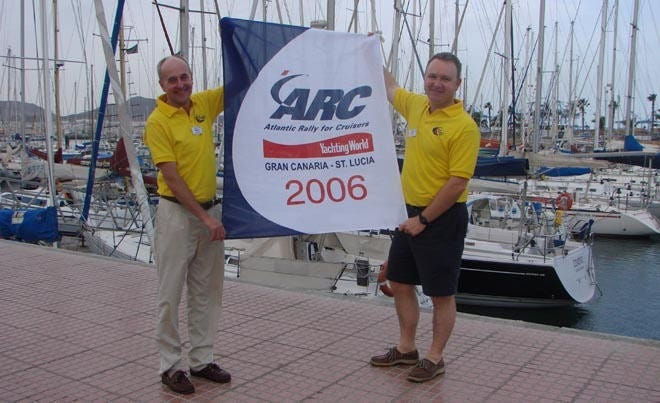
The ARC company directors at the start in Gran Canaria 20 years ago
Twenty years later, that memory raises a question. How much has the experience changed—and how much depends on the particular year, the yacht and what its crew wants from the passage?
Three ways to go west
The Route du Rhum is scheduled to leave Saint-Malo on 1 November 2026 for Guadeloupe. It brings together solo monohulls and multihulls across six classes, from the largest ocean-racing trimarans to much smaller boats. It is first and foremost a transatlantic contest; we should not assume that its professional fleets are all arriving for an island-regatta holiday. [1]
The ARC follows on 22 November, from Las Palmas to Saint Lucia. Its approximately 2,700-mile crossing is a rally with several ways to participate, including a separate IRC Racing Division. Describing it as simply the slow fleet misses the point: its participants choose different balances of competition, support and enjoyment. [2]
Then, on 10 January 2027, the RORC Transatlantic Race leaves Lanzarote for Antigua. The approximately 3,000-mile event brings together IRC monohulls, multihulls and other eligible classes. For crews continuing to race in Antigua, the finish places them conveniently for the next part of their campaign. [3]
This is a winter migration with several purposes. Some boats are chasing a record, some a corrected-time result, and others the satisfaction of getting themselves and their home safely across an ocean. Their landfalls also differ: Guadeloupe, Saint Lucia and Antigua are not interchangeable finishing marks.

The trade winds are a system, not a promise

The familiar Atlantic picture has the subtropical high to the north and the northeast trades on its southern side. But the Azores High is not fixed over a spot on the chart. Its position, extent and pressure vary, while depressions and fronts reshape the route into the trades. [4]
The Route du Rhum organiser describes the strategic alternatives as going north of the high, making a substantial detour south to reach the trades, or finding a compromise between the two. A high positioned further south can push the useful trade-wind belt further south as well. Each option exchanges distance for a different combination of wind and sea conditions. [5]
That matters because the navigator is solving a moving problem. A forecast shows how the atmosphere is expected to evolve; the boat’s performance determines when it reaches each part of that forecast. Two yachts leaving together can encounter the same stretch of ocean days apart.
The quickest boat may be able to exploit a weather opportunity before it closes. A slower yacht may arrive after the useful wind has moved or a ridge has developed. Equally, additional speed does not automatically make the northern route best. The sea state, sailing angles, crew capacity and reliability of the forecast all belong in the calculation.
What recent tracks actually show

Actual recorded YB positions, plotted on the same geographic bounds. Selected boats are highlighted; other destination-reaching tracks are grey. The RORC races shown finished in Grenada, whereas the 2027 race finishes in Antigua. ARC tracks finish near Saint Lucia. These are different dates and fleets, not a controlled climate comparison.
In January 2024, the prospect of two deep depressions prompted RORC to remove the requirement to leave the Canary Islands to port. Race management cited the possibility of winds above 40 knots and waves reaching eight metres on the established route. The amendment gave competitors the option to turn south immediately after the first mark. Those were forecast hazards, not measurements of what every boat subsequently experienced. [6]
Warrior Won’s southern track is particularly striking. The PAC52 won overall under IRC. In the published debrief, strategist Stu Bannatyne explained that an initially promising northern route carried concerns about sea state and the later transition south. The crew decided they could push their boat harder on the southern route. Owner Chris Sheehan reported sailing more than 4,000 miles. [7]
The lesson is not that the longest route wins. Their assessment joined the forecast to the performance they believed they could sustain aboard that particular yacht.
RORC’s 2025 event report describes a crossing with excellent trade winds, although squalls and sail damage still featured. Lucky took monohull line honours and set a new race record to Grenada. The 2025 tracks give a visibly different picture from the deep southern routes of 2024. [8]
The ARC panels add another perspective. Across both years, tracks spread over a broad band of latitude. They reveal where the boats went, but not every reason why. Without matching each passage to weather, sail choices, motoring declarations and onboard events, a bend in the line cannot reliably be labelled a tactical masterstroke or an error.
The 2022 Route du Rhum provides a further caution against imagining one uninterrupted trade-wind run. On 15 November, IMOCA’s report described the leaders approaching the trades after an opening six days involving three active fronts. The class’s archived tracker remains available for replay. [9]
Are the trades changing?
My 2006 recollection is a useful starting point, but it cannot establish a climatic trend. Nor can four sets of yacht tracks. A season with an awkward ridge and disrupted trades followed by a season of fast downwind sailing demonstrates variability; it does not, by itself, show a long-term weakening or displacement of the winds.
There is, however, evidence of change in the larger atmospheric system. A 2022 study in Nature Geoscience used observations, climate simulations and proxy evidence to investigate the winter Azores High. It found that winters with an exceptionally large high had become more frequent during the industrial era, with expansion consistent with human-driven warming. Its principal implications concerned western Mediterranean and Iberian rainfall. [10]
That is relevant background, but it does not establish that November-to-January sailing conditions across the whole Atlantic have become steadily lighter, stronger or less dependable since 2006. Size, position, pressure gradient and timing all matter. A larger high is not simply another way of saying weaker trades.
For this article, the defensible distinction is between a changing climatic background and the weather that decides a particular crossing. The Met Office describes North Atlantic pressure variability operating from daily weather systems through seasonal and longer timescales. A broad seasonal tendency still leaves room for very different conditions on the actual race dates. [4]
A different wind problem for each yacht
The effect of those changes depends on what the boat can turn into useful progress.

One forecast, different priorities. The useful route depends on the speed, angles and workload the particular yacht and crew can sustain. Yacht illustrations are representative, not drawings of named boats.
A useful example comes from VPLP’s assessment of the 2022 Route du Rhum. The designers acknowledged that their downwind-oriented Class40 design had paid a price in the earlier sailing with the wind forward of the beam. They also reported that better protection for skippers helped sustain performance. Both observations concern the whole passage, rather than the maximum speed the boat might reach once established in the trades. [11]
This is where the weather discussion returns to the human one. The relevant speed is what the boat and people can keep producing, with the sails and systems they still have working.
Who is making the decisions?
Different rules distribute the work differently. In the 2026 Route du Rhum, shore-based weather routing is permitted for the multihull classes and prohibited for the monohull classes. One sailor aboard therefore does not necessarily mean one person developing the weather strategy. [1]
Automation also changes the sailor’s job. In an IMOCA interview before the 2023 Ocean Race, Sam Goodchild and Will Harris described almost continuous autopilot use alongside continual adjustments to pilot settings and sail and boat trim. Their account was of a demanding change in the work, rather than the removal of it. [12]
The ARC offers another set of choices. Its cruising and multihull divisions allow limited motoring with a declared time penalty, while the separate Racing Division prohibits propulsion by engine. An Open Division allows participation without a competitive handicap. The same ocean passage can therefore be assessed under quite different arrangements. [2,13]
Even a single race can have several legitimate winners. In the 2026 RORC crossing, Raven took monohull line honours while Palanad 4 won overall under IRC. One result records the fastest monohull passage; the other applies the rating system. Neither, on its own, tells the whole story of preparation, judgement or teamwork. [14,15]
The season waiting at the other end

Antigua: an Atlantic landfall and a base for the racing season ahead.
For many crews the Atlantic finish is a beginning. Antigua’s RORC Nelson’s Cup Series runs from 16–19 February 2027, followed by the Caribbean 600 start on 22 February. The Nelson’s Cup is a standalone series; the 600 is the non-stop offshore challenge around eleven islands. [16]
The Caribbean 600 is now an established race, first held in 2009. It should not be mistaken for a gentle extension of the crossing: an island course adds repeated changes of angle and the effects of land to the offshore problem. [17]
There are then choices across the region. The St. Maarten Heineken Regatta runs from 4–7 March, Antigua Racing Cup from 17–21 March, and the BVI Spring Regatta and Sailing Festival from 29 March–4 April. Antigua Sailing Week follows on 21–25 April. These are selected opportunities, not a single compulsory circuit. [18–21]

The changing emphasis is especially clear in Antigua. Sailing Week has adopted a more relaxed, point-to-point format, blending sailing, different destinations and time ashore. Antigua Racing Cup provides a separate, performance-focused programme. The organisers explicitly describe that distinction. [20,21]
That is stronger evidence than a general claim that Caribbean sailing has become less competitive. In one place at least, the programme has diversified: crews can seek intensive racing, a sociable sailing journey or a mixture of the two.
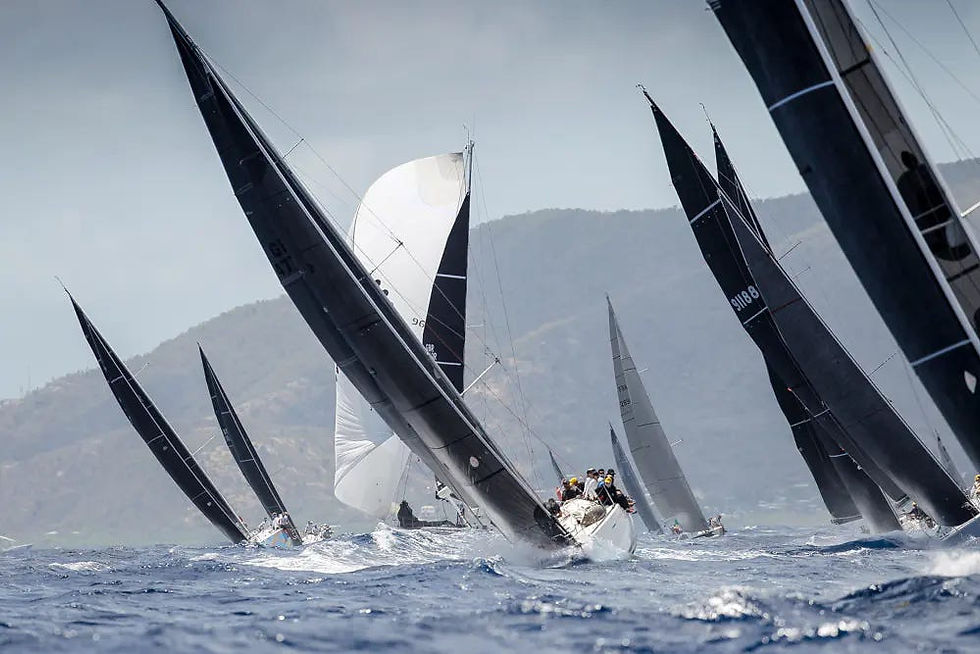

Warm wind, big seas and great fun
What do we want from the crossing?
The Atlantic does not offer a uniform test, and the Caribbean does not offer a uniform reward. Boat speed, departure date, assistance rules and crew priorities all shape the experience. The weather then supplies its own complications.
Perhaps that is the attraction of looking west as the British season closes. There is serious racing ahead, but there is also room for a different pace and a different definition of a good season. What matters is being clear about the challenge we have chosen—and preparing honestly for it.
Could you help with your views?
I would like to hear from sailors who have made these crossings: solo and double-handed racers, fully crewed teams, rally participants, navigators and shore-based routers. What made the passage successful for you? Have the conditions differed from earlier crossings, and what do your logs show? Which decision remained yours even when technology or outside help was available?
Please identify the event, year, yacht type and your role, and share a specific example if you can. If enough substantive replies arrive, I will return to the subject in a follow-up. I will ask permission before quoting anyone and can leave names out if preferred. These contributions will be individual experiences, not a representative survey.
Stuart Greenfield FirstShift — Yacht Racing Intelligence From first shift to first place.
Offshore racing is never just about the boat, the forecast, or the routing software.
It is about decisions made under pressure, in changing conditions, by tired people trying to keep the boat moving fast and safely in the right direction.
That is where races are won and lost.
At FirstShift, my aim is simple: to help owners, skippers and crews race offshore with more clarity, more confidence, and better preparation whether that is a RORC Channel race, a Fastnet campaign, or your first serious step into offshore racing.
10. Cresswell-Clay et al., Nature Geoscience (2022), DOI 10.1038/s41561-022-00971-w; WHOI research explanation.
13. ARC 2026 handbook, Rally at Sea, pp.14–15. Brief factual paraphrase only; handbook not reproduced in this package.
17. RORC — Caribbean 600 history. Historical source; its older Nelson’s Cup format is not used for 2027.
Downloaded track data and map base
- ARC 2024 KML.
- ARC 2025 KML.


Comments