
Clipper Race: What does £66,500 plus training and insurance deliver?


New Clipper RX, new boat, new branding, twelve to be launched for the 2027/8 race. I went onboard- my first look notes below
In brief
Price: Clipper’s race pages list the 2027 to 2028 berth at £66,500, up 29 per cent on 2025 to 2026, plus a compulsory training and kit package. With the information pack’s £7,195, the bill to start is about £73,695.
Delivery: real ocean miles, and a structured route in for people without a boat or a network. Clipper publishes no particular learning outcomes, which is perhaps something they could review?
Racing: Clipper says Level Three covers strategy and tactics, and a 2016 skipper’s account has watch leaders making decisions. How far crews are given responsibility is not measured in public.
Competence: “offshore racer” covers four different tests. The useful question for an owner is what a Clipper alumnus can recognise, decide and do. This article offers a way to ask a potential crew who as the Clipper experience and wants to join your crew.
Safety: three deaths in 14 editions led to MAIB reports and changes to manning. It is a history, not a risk rate.
I spent one week, as second mate, on a Clipper 68 in the Solent. I went because I am interested in becoming a training skipper, and wanted to see what is requited, what Level One looks like from the deck and whether it was something I could enjoy doing.
What follows is what that week showed me, set against the published numbers.
First impressions
The boom and mainsail on a Clipper 68 weigh, by my estimate, close to a ton between them. That is the first thing you learn aboard, and the reason the first morning is spent alongside the dock, learning how not to get hurt.
The 68s are the boats the race used before the current 70-footers, and they are the training boats. Anyone who wants to become a training skipper does a Level One week unpaid, so that the training staff can assess them. They then go on to a range of training and assesents, final taking command with another senior skipper as your firts mate, if you pass that test then you may be asked into the training team. I started like everyone elses as a commercially endorsed Yachtmaster Offshore, assisting the skipper and first mate as second mate after a careful check I had all the correct qualifucations.
Level One, as a potential RTW crew, assumes you know nothing about sailing. It is the course for anyone who wants to race a single leg or the whole lap, and it starts with the boat rather than the sea: how to sleep on one, how to cook on one, how to live on one. We spent a great deal of the week on dry skills alongside. The winches are large. The safety routines around the winching, the ropes, the boom and the mainsheet exist because letting go of anything at the wrong moment on a boat that size hurts someone. Then the knots: bowline, clove hitch, running hitch, Admiralty stopper. A lot on safety, man overboard and systems, as you would expect. Every maneouvre is detailed in a little water proof flip book give to every member of the crew. Well thought through and pretty neat I thought.
Out in the Solent it was calm, careful and run by very experienced people, going through each step in turn. Raise the main. Secure the staysail. Hoist the staysail and the Yankee, and bring them down again. Come alongside. Etc etc. The weather gave us everything: no wind and a lot of fog, then about 25 knots true on the last day.
There are three training levels, then a fourth week with your own skipper and mate and as many of your leg crew as possible: 26 days in all before a crew member starts a leg. Level Two takes you on. Level Three is the first where anyone talks about real racing and spinnakers. The fourth week is where you meet most of your team and go out with your actual skipper and mate.
What I did not see, and did not expect to see in Level One, was offshore racing. Clipper says Level Three adds strategy and tactics, so I cannot judge that from one week. My own expectation is that navigation, tactics and routing sit mainly with the skipper and the mate, who have a huge amount on their plate already, and that a paying crew member who wants a hand in those decisions will have to build the relationship to get one. Whether that makes it racing by numbers is a question this piece tests.
That is the product, and it is a well run one. The boats are sturdy, the organisation is careful and the instructors are very experienced. This is an observation from one week, not a verdict on the people who run it, and it cannot tell me what happens in later training or on the race itself. The race is advertised as the way to learn offshore racing, and as the ultimate offshore race. So the questions are what it costs, what it delivers, and what an owner should infer from a sailor who has done it.

The Clipper Race fleet leaving Portsmouth Harbour under sail at the start of the 2025 to 2026 race. (C) Sean Ryan with thanks
The Clipper Round the World Yacht Race puts up to 22 paying crew aboard a 70-foot yacht with two paid professionals, and sells them up to eleven months of ocean sailing. It has done this for 14 editions since 1996. From the 2027 to 2028 edition it will use a new 72-footer, the Clipper RX, and a full lap is priced at £66,500. Add the compulsory training and kit package, which Clipper’s information pack puts at £7,195, and the bill to start is about £73,695, a provisional figure until Clipper confirms the training charge. (You also need to add cost of personal insurance).
So this piece asks three questions. What does the money buy? What does it teach, and how would you tell? And what should an owner make of a Clipper alumnus?
What the money buys
Start with the invoice. Clipper’s race pages give the 2027 to 2028 prices. Its information pack gives the 2025 to 2026 prices and a set of guidance figures for the next edition.

The lap berth price rose 29.1 per cent between editions. Berth plus training rose 26.6 per cent, and the eight legs added together rose about 21 per cent. The saving for committing to the whole circumnavigation has fallen from about 15 per cent to about 9 per cent.
A caution on the numbers. The pack on Clipper’s site lists the 2027 to 2028 lap at £56,795, but says its figures are for guidance and based on previous editions.
The fee covers the yacht, a skipper and first mate, maintenance, medical support, a lifejacket, an AIS beacon and safety equipment, and clothing the pack values at more than £2,400 at retail. The pack does not price travel, insurance, visas, port costs or the 20 to 30 kilos of personal kit you pack yourself. The largest cost is not on the invoice at all. Eleven months out of a working life is eleven months of income and, for many people, a job.
Is it good value? Relative to what? Cost per mile or per day is easy to calculate and tells you little, because miles are an output of the voyage, not a measure of what anyone learns. Better comparators are other ways to learn. Anarchy Sailing advertises a 2026 to 2027 campaign at £5,725, with training weekends, and the 2027 Fastnet. It is a different product, and its own page gives two values for the package, but it shows that cheaper routes into racing exist.
What Clipper sells is the platform, the training and the safety net. The useful question is what that platform delivers.
What the money delivers
Every crew member completes three levels of training and then a fourth week with their own skipper and mate, 26 days in all according to the pack, before racing. The pack says no previous sailing experience is required. Clipper’s figures for newcomers vary by source: almost 30 per cent with no previous sailing experience, according to its own FAQ, and some 40 per cent who had never sailed before signing up, according to an il Nautilus report of May 2026.
The Fastnet course has been 695 miles since 2021. One Clipper lap is about 40,000 nautical miles, more than 55 Fastnets end to end. The 2025 to 2026 leg from Tongyeong to Seattle was 5,500 miles, about eight Fastnets, and the fleet was expected to need about 30 days for it. Miles, weather and watchkeeping cannot be faked. Someone who has done that has done something most sailors never will.

But miles are an output. A mileage total cannot tell an owner whether someone can lead a watch, recognise a deteriorating situation or contribute to a routing discussion. That is the question the rest of this piece pursues.
Here the evidence runs out in an awkward place. I could not find published measures of what crew learn: no assessment criteria, and no figures for how many go on to lead watches, race elsewhere or qualify. The organiser points to a pathway from crew to first mate to skipper and names Heather Thomas, who sailed as bursary crew in 2015 and was a skipper in 2025 to 2026. This would seem a very good way for Clipper to develop skippers.
What Clipper does claim is specific. Level Three, it says, is where racing is added, by “learning how to navigate effectively, including planning for strong currents”, changing weather and tides. Those are marketing claims, not independent proof of teaching quality, but they are the claims to test.
There is also first-person evidence that crews are given decisions. In Basic Training, published in Sailing World in June 2016, the Clipper skipper Greg Miller wrote that he went nearly 48 hours without sleep on Leg Three, from Cape Town to Albany, before he rested and the crew made the calls, the watch leaders going straight into spinnaker mode. His conclusion: “They can, however, make decisions, which wouldn’t have been possible at the beginning of the race.” It is one skipper, one team and a decade old, and it predates today’s two-professional arrangement, which I feel is the best solution.
Delivery is also not only measured in seamanship. Retief Jordaan, who sailed the full lap in 2023 to 2024, called it “the happiest I have ever been”.
Safety: what the record shows
Safety is where delivery has a hard edge, and the record needs precise handling. Three crew have died in 14 editions. That is a historical count, not a risk rate: it has no exposure denominator and spans different operating arrangements.
Andrew Ashman died on 4 September 2015 aboard IchorCoal during a reef in a series of uncontrolled gybes. The MAIB could not establish exactly how he was injured. It judged the most likely cause a fall, either from being struck by a rope or because of the yacht’s motion, with a heavy impact against the starboard deck coaming. Sarah Young died on 1 April 2016, also aboard IchorCoal, after being swept overboard untethered. The MAIB reported on both in April 2017. It found that shore-based oversight was limited and difficult once the race had started, and it recommended changes to manning and shore management, including consideration of a second employed or contracted seafarer. A coxswain arrangement under an exemption the MCA had issued in 2013 had let Clipper meet the second-person requirement without a second professional.
On 31 October 2017 the yacht Greenings grounded on the Cape Peninsula, South Africa. The MAIB found that the skipper was the only professionally qualified person aboard, with a Clipper coxswain as the second person and crew members as navigators, and that this did not provide adequate safe manning for the race. It also found that the pre-race training syllabus contained no specific requirement for crew to be trained in navigation.
Simon Speirs died on 18 November 2017 aboard Great Britain. He fell from the foredeck after an accidental gybe in very rough seas, while the headsail was being lowered. He was tethered, but his tether hook caught under the starboard forward mooring cleat, distorted and released. He was recovered 32 minutes later. The MAIB’s 2019 report examined tether configuration, recovery, damage and fatigue.
The MCA revoked the coxswain agreement when the fleet reached Fremantle at the end of Leg 3, and mates were appointed on each yacht from Leg 4, which started on 2 December. A second seafarer was recommended for consideration in April 2017 and was in place by December, after a third death. To be fair to the organiser, Sir Robin Knox-Johnston said the first report acknowledged that Clipper had been proactive in mitigating the risks, and I found no report of a further death since 2017. Absence of a report is not proof that every weakness has been resolved.

Darrell Nicholson put the underlying problem in Practical Sailor in December 2016: “The more experienced and capable the crew, the less luck one needs.” The Clipper model removes the experience requirement and replaces it with training and professionals. Greenings shows what happens when there are too few of them. Its finding on navigation should also be read beside Clipper’s current Level Three description, which includes navigation.
Experience, competence and responsibility
FirstShift starts from one idea: offshore results come from hundreds of slightly better decisions, not one masterstroke. Preparation, decisions, execution. So the test for the Clipper is not whether it gives you miles. It does. The test is what it teaches you to recognise, decide and do.
That depends on what you mean by an offshore racer, and the phrase hides four different tests.

By the first test a Clipper crew member is an offshore racer, and has taken part in more offshore racing than most. The second and third tests are where the evidence is thin, and the fourth is not what a paying crew member is buying. It would also be wrong to say the decisions that matter belong only to the afterguard. A trimmer does not stop being an offshore racer because the navigator chooses the route. A bowman’s call on what the bow is doing, or on when a sail is ready to hoist, is a consequential decision, and it sits inside a skipper’s command on an owner’s boat just as it does on a Clipper. Delegation is normal offshore practice: an owner carries final responsibility without making every sailing decision.
So the useful question about the Clipper is how far, and how consistently, a paying crew member moves from taking part, to competence in a role, to responsibility for decisions. The evidence cuts both ways. Clipper’s Level Three page promises navigation and tactics, and Miller’s account shows watch leaders deciding. Against that, the Greenings report shows the programme once left navigation out, and a skipper and mate remain in command. My own expectation, from one Level One week, is that how far a crew member is brought into the decisions depends on the skipper and on the crew member’s willingness to build the relationship.
An owner’s boat is not automatically better. An IRC berth does not guarantee access to the navigator, good explanations or a useful debrief, and some crews leave people doing the same narrow job for years. The fair comparison is between teaching practices, not ownership structures.
My firstShift article:
The case for the Clipper
Clipper offers a structured route into demanding sailing for people without a boat, a network or the experience to be offered a berth elsewhere. “Find an owner and work with the navigator” sounds simple from Cowes. It is much harder for a newcomer.
There is also continuity: repeated watches, changing conditions, repairs, sail handling and living with the consequences of earlier mistakes, over weeks and months. A season of weekend races rarely offers that. Two professionals may, in principle, give more capacity to teach and delegate safely, not less. And adventure, teamwork and sporting participation are legitimate things to buy. Someone can knowingly pay for them without expecting a command qualification.
The criticism that stands is narrower: a possible mismatch between a specific promise, learning to race offshore, and what is delivered. The evidence for that mismatch is not public.
A single leg limits the commitment. At the live prices a leg costs £8,295 to £10,295, so roughly £15,500 to £17,500 with the pack’s training figure, against £73,695 for the lap. But the compulsory training cost is concentrated into a shorter experience, and a full lap may allow much more progression into watch leadership. Which is better value depends on what you want. A leg shows you how big the ocean is, how complicated it gets and how rough the sea can be, and how you cope when you are tired. You may well enjoy it.
How to read a Clipper alumnus
This is where the Clipper question becomes a FirstShift question. An owner deciding whether to take on a Clipper alumnus, or a skipper deciding how to develop one, should not read a mileage total as competence.

None of these questions is specific to the Clipper. They work equally on a sailor who has spent twenty years racing round the Channel.
Who pays
The only full demographic breakdown I could find is the organiser’s for 2017 to 2018. It covers all crew, including people on a single leg, not just those who bought the full lap.

Clipper says 55 per cent of the professionals leading teams in 2025 to 2026 were women.Price and time do some of the selecting: £66,500 plus training, and up to eleven months away from work and home, is easier for some people than others. Beyond that I draw no conclusion about who the crew are or why they go. Nobody publishes their motives, and the organiser’s profiles, which are marketing, range from a 19-year-old student in 2019 to a 69-year-old retired band teacher who climbed the mast as a rigger in 2015 to 2016.
The Clipper venture as a business
I draw no conclusion about whether the business is sound. That would need revenue, discounting, sponsorship, variable costs, overheads and financing, which the public record does not give. Here is what it does show.
Clipper is replacing its fleet. The 2025 to 2026 race used ten Clipper 70s; the first 70-footers launched with twelve, and the new Clipper RX fleet returns to twelve. If the RX carries the same maximum of 22 paying crew as the 70s, which Clipper has not yet published, that is up to 264 berths on every leg. Capacity is not break-even occupancy, and I cannot say how many must sell.
The accounts give partial clues. Clipper Ventures plc reports staff down from 98 to 76 and shareholders’ funds of £5.26 million at 31 January 2025. The Holdings company reported cash of £2.14 million, down from £4.28 million. That year includes part of the 2023 to 2024 race, and a fall in cash does not by itself show deterioration. Eighteen charges were created against Clipper Ventures plc on 23 December 2025 and delivered on 29 December; a count does not show how much was borrowed or why. The accounts to January 2026 are due by 30 October 2026 and were not on the register when I looked.
The Global Challenge, Chay Blyth’s earlier amateur round-the-world race, went into administration on 9 October 2006 after failing to secure a title sponsor. That shows the kind of risk such a model can carry.
The Clipper RX
The RX replaces the Clipper 70s from the 15th edition, due to start in late summer 2027, and Clipper calls it the fourth generation of yacht in the race. Sir Robin Knox-Johnston coordinated the project. Nigel Irens drew the hull lines, and Fish Marine Design | Composites (MDC) produced the final design. The twelve hulls are being built in Qingdao, China, and YACHT reported on 26 September 2026 that Clipper had taken delivery of the first.

The design changes concentrate on the foredeck and on moving about the boat in heavy weather. A fuller, wider reverse bow, which Clipper calls a dreadnought bow, brings the forestay inboard and gives more deck and more buoyancy for headsail changes; the headsails stay hanked on. Deck cuddies sit over two watertight companionways, sheltering the watch and the helm and cutting the distance crew travel along the deck. Twin transom-hung rudders have a break-away fuse, so they kick up if they hit debris at speed, and are easier to repair or replace. Nigel Irens, on Clipper’s own RX page: “The Clipper RX enhances crew safety while improving overall racing performance whether beating up wind or powering downwind.”
Clipper has not published a sail area or the number of crew per yacht. YACHT reports that the RX is planned to serve six editions, with the older boats refitted for youth training or charter.
On training for the RX, I expect it to be short, perhaps a single fourth week aboard to learn the boat, though I found no published familiarisation plan. In my view the systems will be much like the 68’s and the 70’s, and the cuddies over the companionways should give real shelter on the harder legs. None of that is proven until the fleet races.

RX Dreadnought Bow

RX flip up twin rudders and liferaft stowage
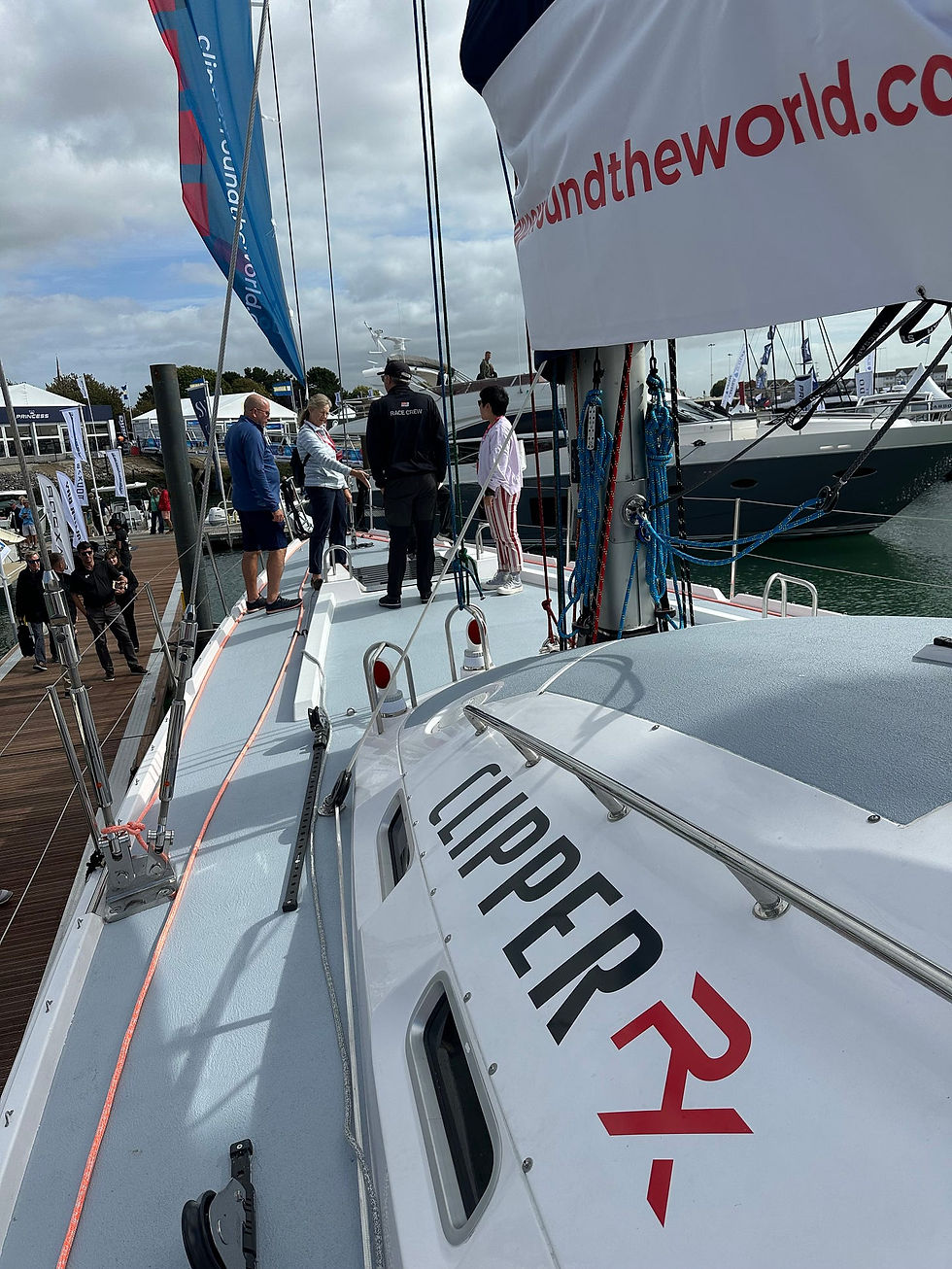
RX fordeck

RX Galley - very basic finish on all surfaces

RX engine room with generator - easy access
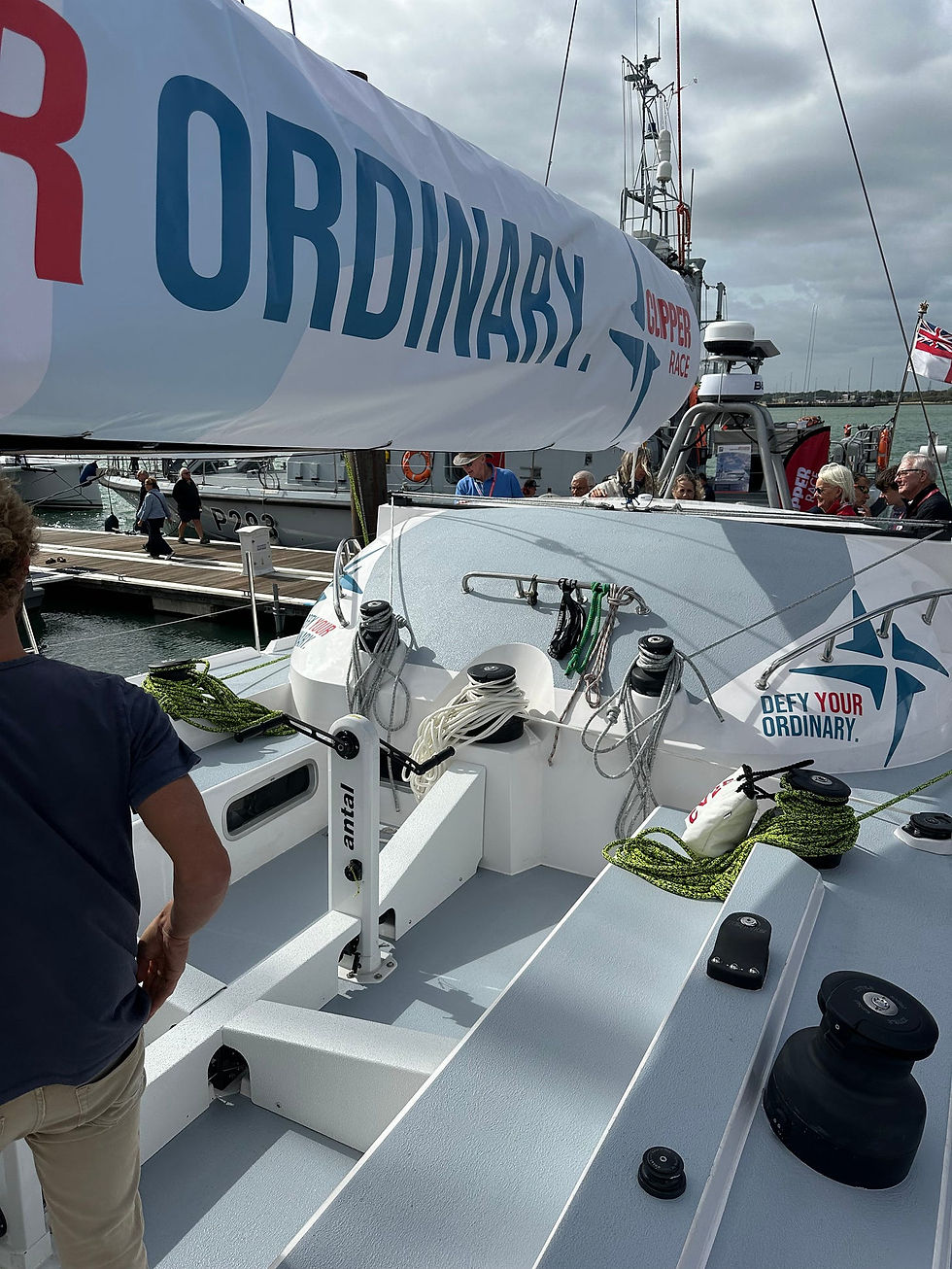
Well protected deck working space - and the main traveller is well out the way
My view of the RX
I went aboard the Clipper RX at the Southampton International Boat Show in September, and I liked her. She is solid, and very basic below. I think many of the tried and tested systems used on the earlier yachts, over the years, will be repeated on this new yacht as they have been proven to work well and her below deck layout reflects this.
The skipper and mate’s accomodation are where you would expect, in the stern, with quick access to both helms. The twin helms sit behind a raised area that carries the mainsheet traveller. That is much safer than on the earlier boats, and it gives the helm real shelter.
My one reservation is communication between the helm, the skipper, the working area and the foredeck. The working area has twin grinder pedestals for the Yankee and the staysail and a well protected pit, but a raised area separates it from the mast. Moving about the deck quickly while tethered, as is normal, may still be as slow as it is on the older yachts.
Below, the accommodation is spartan: There is no crew seating area. With 20 or more crew it will be tight, and they will hot bunk, as they do now. The engine room has its own room where all the main systems are including water maker and generator - this is definetely an improvement.
She looks powerful, with twin rudders that kick up and a substantial fixed bowsprit. I would expect a quick and exciting ride downwind. On past circumnavigations that is where most of the miles are sailed: by my reckoning, 65 to 70 per cent of them.
A quick SWOT of the Clipper RTW race

Verdict
Three questions, three answers.
On cost against delivery, the price buys supervised ocean miles, a team, a finish and a structured route in. It is fair for that. Whether it is good value for learning to race offshore depends on how far you are brought into the decisions, and Clipper does not publish enough to say.
On competence, a lap makes you someone who has taken part in offshore racing, and may make you competent in a role. Responsibility for decisions depends on the skipper and on you. Judge an alumnus, as you would any sailor, on what they can recognise, decide and do.
An owner’s crew answers to the owner. A Clipper crew answers to a professional skipper and mate. In both, the sailor who learns most is the one who is given decisions and asked to explain them afterwards. Ask for those, whichever boat you are on.
Stuart Greenfield FirstShift — Yacht Racing Intelligence From first shift to first place.
Offshore racing is never just about the boat, the forecast, or the routing software.
It is about decisions made under pressure, in changing conditions, by tired people trying to keep the boat moving fast and safely in the right direction.
That is where races are won and lost.
At FirstShift, my aim is simple: to help owners, skippers and crews race offshore with more clarity, more confidence, and better preparation whether that is a RORC Channel race, a Fastnet campaign, or your first serious step into offshore racing.
Thanks for reading Firstshift - yacht racing intelligence! This post is public so feel free to share it.
Sources
Clipper Race 2027 to 2028 circumnavigation and leg pages (Legs 1 to 8), checked 9 and 22 October 2026
Clipper Race information pack: 2025 to 2026 prices and guidance figures for 2027 to 2028
Clipper Level Three training; Clipper RX page and launch release, 15 January 2026 (as carried by Press Mare and Afloat); YACHT, 26 September 2026, on the first delivery; crew statistics for 2017 to 2018; August 2025 announcement on women professionals
MAIB reports: IchorCoal, CV21 (2017); Greenings, CV24 (2018); GREAT Britain, CV30 (2019)
Greg Miller, Basic Training, Sailing World, 9 June 2016
Darrell Nicholson, Practical Sailor, Risk Management and Renting Adventure, 13 December 2016, updated 2 March 2020
Companies House: Clipper Ventures plc filings and charges
RORC history (Fastnet course 695 miles from 2021); Anarchy Sailing Fastnet 2027
Yachting Monthly, 10 October 2006, on the Global Challenge administration
Clipper FAQ: four training levels, crew numbers, newcomers
Yachting World, 19 January 2018, on mates from Leg 4
Boating Industry, Sir Robin Knox-Johnston on the CV21 report
Sailing Scuttlebutt, 19 August 2025 on women leaders, full-lap crew and Heather Thomas; 27 March 2026 on Tongyeong to Seattle
il Nautilus, 19 May 2026, Retief Jordaan and newcomers
Companies House, Clipper Ventures plc filing history


Comments