
Real food at sea, is it possible?

Why Cooking Offshore Is Not Optional
There is a difference between fuelling a crew and feeding one. One keeps them going. The other keeps them human.
It was somewhere off the west coast of Scotland, late afternoon, cloudy, damp beating hard before a building north northwesterly, when the four of us smelled it. Not the sea. Not the diesel. Bread.
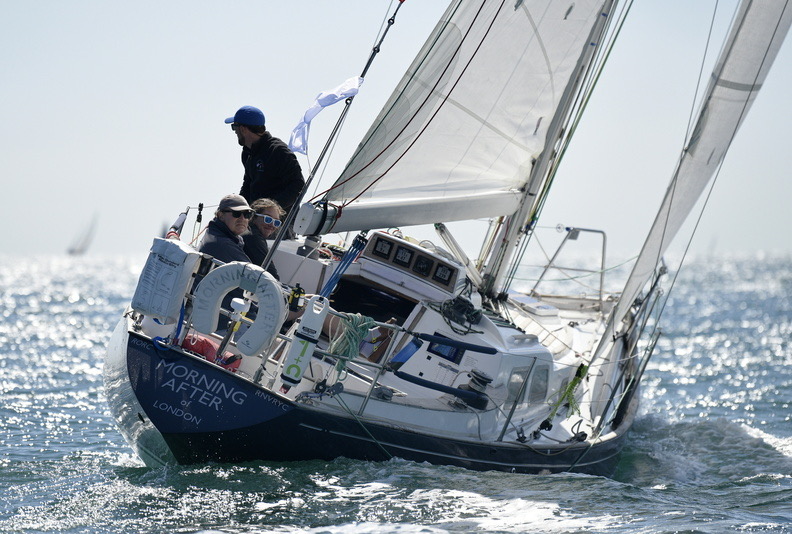
Morning After off on the Round Britain and Ireland race in the last edition in 2022 - nearly 16 days - we had frozen food packs, expertly prepared by a crew member, which lasted well; it was a cold and wet race however and I baked fresh bread!
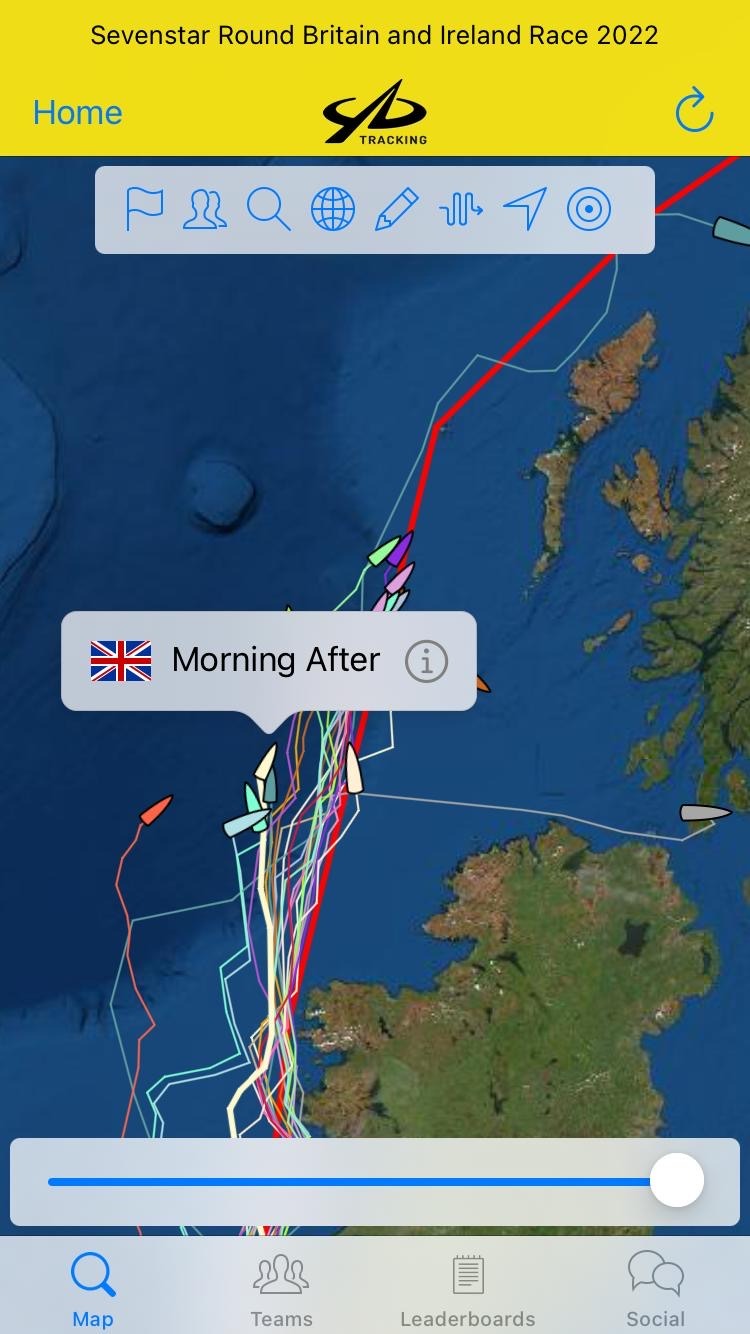
Morning After was winning the race on handicap for almost 8 days whilst we were beating towards Muckle Flugga, the most northerly point of the British Isles and the turning point of the race.
Fresh bread, on a damp leaking race boat, in the late afternoon in a steady 25 knots with the thought of another 10 days of it, lifted our spirits … a bit, even if we knew it was another groundhog day!
I was racing Morning After, a classic S&S 34 yacht that I, with help, had spent rebuilding during Covid in a barn on the Isle of Wight. With 4 crew we were in the latest Round Britain and Ireland Race, one of the most demanding offshore events in the British calendar, 2,000 miles of open coast, tidal gates, and weather systems stacking up off the Atlantic like freight trains. We were in full race mode, 4 on 4 off watches running, no stopping, we had issues, a leak, a dodgy engine but we were determined. I decided we needed a ‘heart starter’ (normally a tot of the hard stuff) but I had taken on board a few bags of bread mix and now was the moment to boost morale. I mixed the ingredients, flashed up the oven then proved the dough in the warmth of the engine compartment, and put it in the oven.
What came out forty minutes later was not a masterpiece of artisan baking. It was dense, slightly lopsided, and had a faint aroma of bilge. We ate every last piece of it, with butter and tinned anchovies, all four of us in wet gear, in the rain in 25 knots with 30 degrees of heel and the mood at that moment changed completely. We were a crew again, not just a watch system.
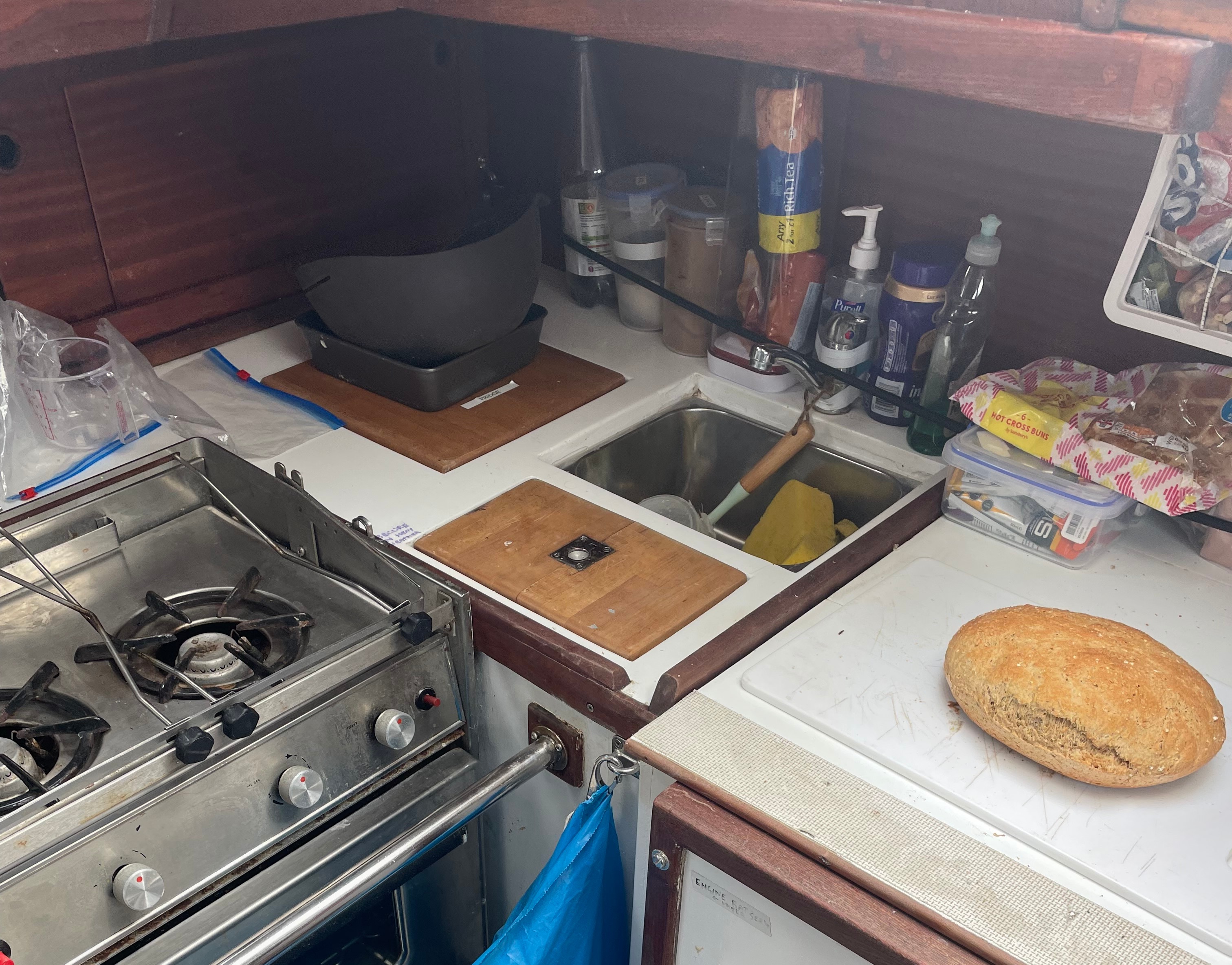
Hot bread emerges from the oven onboard Morning After
That’s what food does offshore. Not the energy bars. Not the isotonic drinks. Not the freeze-dry pouches, however good the marketing. Real food, cooked and shared, is one of the most powerful performance tools available to any offshore racing skipper.
THE CALORIE REALITY
Before I talk about what to cook and how to cook it, we need to talk about numbers, because most offshore crews are operating on a chronic calorie deficit without knowing it.
In sail sports, calorie consumption runs between 150 and 300 calories per hour, and in severe conditions — depending on the boat and sea state — can exceed 500 calories per hour. That is the active work: the headsail changes, the spinnaker drops, the grinding, the bracing. But offshore racing is not just active work. It is cold, it is wet, it is sleep-deprived, and the body burns significant energy simply maintaining core temperature and cognitive function through the night.
In cold conditions, demanding offshore sailing can push calorie requirements beyond 4,500 calories per day for a physically active male crew member. To put that in context: a standard adult male consuming a normal diet ashore takes in about 2,500. In the Volvo Ocean Race, each sailor was burning approximately 6,000 calories per day — nearly three times the average — equivalent to about twelve rump steaks, 35 jacket potatoes, or 78 hard-boiled eggs.
Research from the 1993–94 Whitbread Round the World Race found that despite consuming what seemed like substantial food, energy turnover during offshore sailing was higher than expected at 18 to 20 megajoules per day, with crew members in negative energy balance throughout all three legs studied — meaning they were losing weight and condition even while eating.
For a 600-mile offshore IRC race lasting four to six days with a crew of six, this matters. A crew in calorie deficit by day two is a crew making worse decisions, responding more slowly, making mistakes on the foredeck, and losing the will to push hard when the race is won or lost. Feeding them properly is not a luxury. It is race preparation.
Individual meals should be heavy on carbohydrates, light on fat, with protein in between — and eating four smaller meals across the day rather than two or three large ones helps sustain energy levels and avoid the sluggishness that follows a big feed.
One other thing nobody talks about enough: fibre. Constipation on a yacht is not just uncomfortable for the individual — it is uncomfortable for everyone. A diet high in processed foods, energy bars, and freeze-dried meals with minimal fresh vegetables will produce a crew who are, within 48 hours, distinctly unhappy in ways that affect morale profoundly. Porridge, dried fruit, and proper meals with vegetables are not just good nutrition. They are essential plumbing maintenance.
A BRIEF HISTORY OF GETTING IT WRONG
The offshore sailors who came before us are instructive as much for what they got wrong as what they got right.

Shackleton provisioned well and some products stood the test of time
Ernest Shackleton provisioned his 1907 Nimrod Expedition with genuine ambition: the packing list for 15 men over up to two years included 1,600 pounds of finest York hams, 1,260 pounds of sardines, 1,470 pounds of tinned bacon, and 25 cases of whisky. The whisky, at least, sounds defensible. But the calorie mathematics were brutal. By modern estimates, Shackleton and his contemporaries were consuming roughly one third of the calorie intake their journeys actually required. When the Endurance was crushed by ice and rations ran out, Shackleton led all 27 of his men to survive on a diet of sled dogs, penguins, seals, seaweed, and the occasional piece of elephant seal snout. Leadership of the highest order — but it might have been less desperate with better provisioning mathematics at the start.
Robert Falcon Scott’s Terra Nova expedition fared worse. Scientists estimate his party was up to 3,000 calories short of the daily intake required for Antarctic travel. The entire expedition perished from exhaustion, cold and hunger, two months after reaching the South Pole. The tragedy was partly meteorological and partly logistical. But starvation was a contributing factor.
Sir Robin Knox-Johnston, circumnavigating solo aboard Suhaili in 1968–69, took the practical approach of the merchant mariner he was: monotonous rations supplemented by fishing. He made it round. Sir Francis Chichester, on Gipsy Moth IV the year before, reportedly considered the day he ran out of gin to be his lowest point of the voyage. Both men survived on tinned food and determination, in an era before freeze-drying, before Huel, before any of the tools available to the modern offshore crew.
The lesson of history is consistent: the people who thought carefully about food performed better, survived longer, and kept their crews together. The ones who treated food as an afterthought suffered for it.
THE MODERN ARSENAL AND WHAT IT ACTUALLY COSTS
Today’s offshore sailor has more options than any previous generation, spanning a spectrum from complete meals in a pouch to powdered nutrition science, with everything in between.
Freeze-Dried and Dehydrated Meals
The backbone of most offshore race provisioning. The quality has improved dramatically in the last decade. Firepot, made in Dorset using 100% natural ingredients, are widely considered among the best-tasting options — their posh pork and beans and dal and rice with spinach regularly top blind taste tests, at around £6.95 to £8.82 per meal. Expedition Foods, a UK brand favoured by sailors and rowers, offers high-energy versions delivering 800 or 1,000 kilocalories per pouch — the chicken tikka at 809kcal weighing just 140 grams is among the best calorie-per-gram ratios on the market.
At the budget end, Trek’n’Eat average 600 calories per pouch at lower prices, with a five-year shelf life that makes them useful emergency locker stock. The honest verdict from sailors who’ve eaten them regularly is that they’re functional rather than enjoyable — which matters more than it sounds on day four of an offshore race.
Military Ration Packs
British Army Operational Ration Packs (ORP) deserve more attention from the sailing community than they get. Each 24-hour pack delivers around 3,800 to 4,000 calories across multiple meals and snacks, is ruggedised for extreme conditions, and costs around £20 to £25 per person per day through surplus suppliers. They’re not gourmet, but they are genuinely comprehensive and built around the same physical and cognitive demands that offshore sailing places on a crew.
Huel and Powdered Nutrition
Huel represents the newest category: nutritionally complete powdered food. Founded in 2014, it’s made from oats, rice protein, pea protein, sunflower, flaxseed, and coconut oil MCTs, providing all 26 essential vitamins and minerals in every serving. At roughly £1.50 to £2.50 per 400-calorie serving, it is the cheapest complete nutrition available. For offshore use it has genuine advantages: no cooking required, no water beyond what you’d drink anyway, no waste, no smell, no washing up. The disadvantages are the ones that don’t show up on the nutrition label: it does nothing for morale, it provides none of the warmth and comfort that real food delivers at 0300 in a Force 6, and eating Huel for five days in a row while wet and tired and short on sleep is, by all accounts, a profoundly joyless experience. Use it as a supplement, particularly for overnight watches when cooking isn’t practical, not as a replacement for meals.
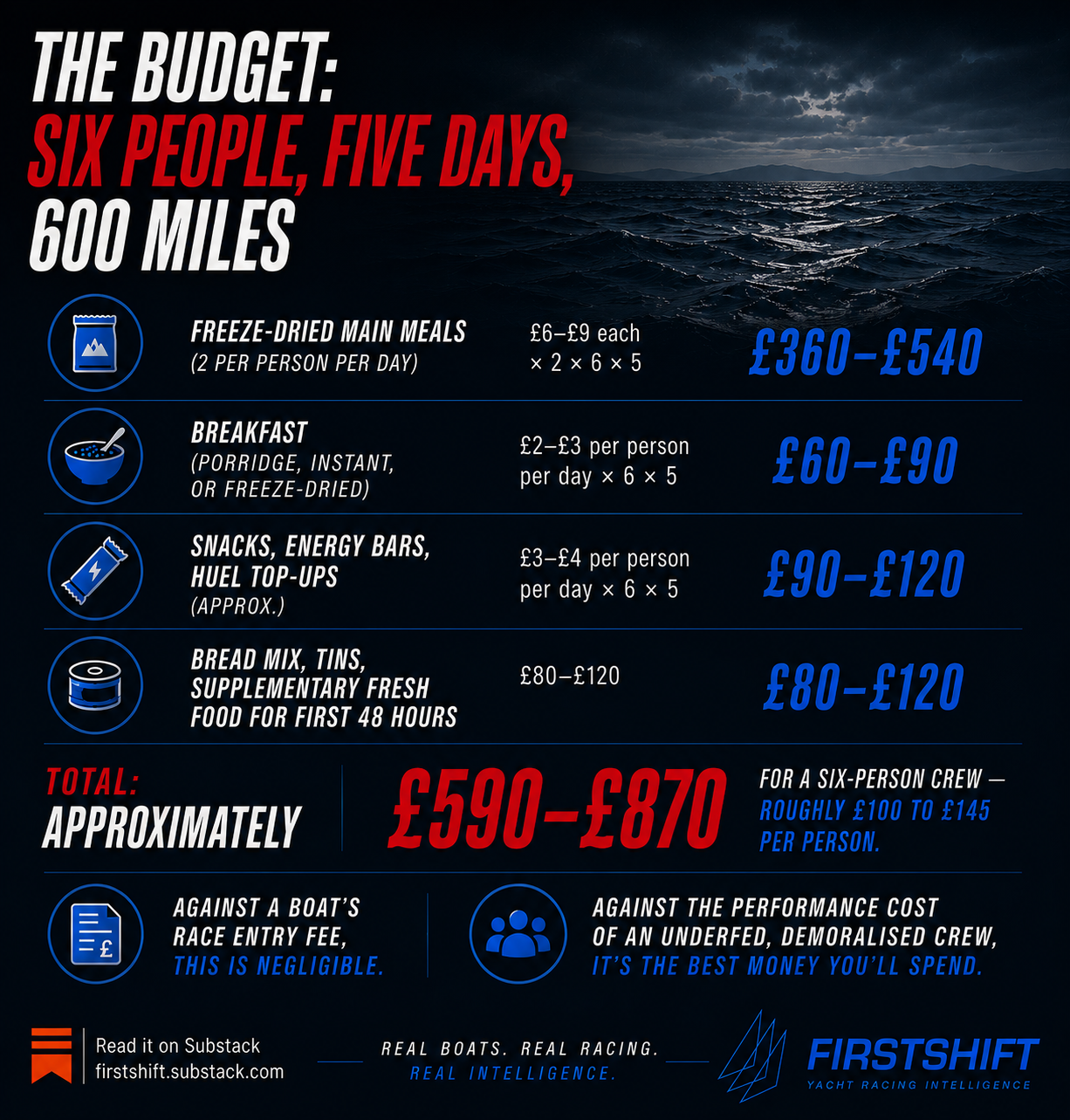
Depending on your estimate of race duration, it is a substantial part of the budget and freeze-dry main meals are costly — but pre-prepared frozen food can reduce costs significantly.
WATER — THE CALCULATION NOBODY DOES PROPERLY
Water is food. It enables food. Without enough of it, everything else in this article is irrelevant.
Most offshore crews think about water as a passive issue: you’ve got a tank, you’re careful, it’ll be fine. This is wrong, and it gets more wrong the harder the race and the more people you put on the boat.
The non-negotiable baseline is drinking water. Men require around 2.5 litres per day, women around 2 litres, and that increases by 15 to 20 percent in temperatures above 28°C, and another 15 to 20 percent if you’re physically active. On a hard offshore race, you’re physically active and possibly cold and wet, and the body burns hydration processing stress and maintaining temperature even when you don’t feel thirsty. Thirst is a lagging indicator of dehydration. By the time a crew member feels thirsty, they are already measurably less sharp.
Water Budget by Zone
North Atlantic / UK offshore waters (Fastnet, Round Britain, RORC races): Cool to cold, low sweating rate. Drinking requirement 2 to 2.5 litres per person per day. Cooking and basic hygiene adds another 2 to 3 litres. Dishes washed in saltwater. No showers. Minimum: 5 litres per person per day. Comfortable: 7 to 8 litres.
Mediterranean or tropical passages: Heat pushes drinking requirements to 3 to 4 litres per person per day. A basic deck rinse becomes desirable. Minimum: 8 litres per person per day. Comfortable: 12 to 15 litres.
For a six-person crew on a five-day 600-mile UK offshore race, that means carrying a minimum of 150 litres of fresh water with no margin, or 240 litres with sensible contingency for a passage that runs long. A standard 40-footer carries 150 to 200 litres in fixed tanks. You can see immediately why water management is a real calculation, not an assumption.
The freeze-dry food model changes this arithmetic significantly. Every freeze-dried meal requires 400 to 500ml of boiling water per pouch. Multiply that across two meals per person per day and your food provision alone is consuming 5 to 6 litres of fresh water daily for a six-person crew — roughly a full day’s drinking allocation. This is the hidden cost of freeze-dry provisioning that the packaging never mentions.
Watermakers: The Case for Fitting One
For races of five days or more, a watermaker stops being a luxury and starts being a water security system. A watermaker running for two hours a day can generate enough water to cover the entire crew’s needs, freeing tank capacity for contingency.

The Spectra Newport 400C — one of the most popular units in the offshore racing community — operates on as little as 15 watts per gallon, making it viable for solar-supplemented electrical systems without running the engine. The Cape Horn Extreme is a favourite for ocean races including the Vendée Globe and The Ocean Race, producing up to 56 litres per hour with dual pumps — if one pump fails, it continues at half capacity. Rugged, proven, expensive. Budget from £3,500 to £8,000 for a properly specified race-grade unit.
For the IRC offshore racer on a tighter budget: a 12V system drawing 16 to 19 amps, producing 20 litres per hour, needs about 2.5 to 3 hours of running to generate 50 litres, consuming roughly 45 to 55 amp-hours, well within range of a 300-watt solar setup even in cloudy conditions. Entry-level 12V units from makers like Rainman or LEDI start around £1,500 to £2,500 and are genuinely capable for a six-person crew on a five to seven-day race.
The portable option — the Katadyn PowerSurvivor 40E — draws just 4 amps, weighs 11.3kg, and produces 30 litres per hour. It stows in a locker, requires no permanent installation, and can go on any race boat as emergency water security. Around £1,200 to £1,500.
The critical rule: never run a watermaker in harbour, marina approaches, or near shipping channels. Reverse osmosis membranes are sensitive to fuel contamination and biological load. Run them offshore in clean water only, and flush the membrane with fresh water before switching off for more than a few days.
The Alcohol Policy
We ran a nearly dry ship on Morning After. (Enough gin for one tot per person per day.) The reasons are partly safety and partly performance: alcohol is a diuretic, increasing fluid loss at the very time you’re managing a finite water supply carefully. Dehydrated crew make worse decisions. A tired crew on a dry ship makes better decisions than a tired crew with a couple of beers inside them.
The exception — and I mean this as a genuine offshore tradition worth preserving — is a small hip flask of brandy stowed away. Not opened until the finish line is crossed or the anchor is down. There is something deeply satisfying about a small measure of brandy when the race is done and the boat is safe, that no amount of isotonic drink can replicate. It’s not about the alcohol. It’s about the ritual of completion.
THE COOKING QUESTION
Most offshore IRC race boats operate with a single gimballed gas burner or a two-burner setup, and a proportion have a full oven. The gas versus alternatives debate is worth addressing briefly.
LPG is heavier than air and fumes can settle in the bilge, creating potential for explosion if proper installation, usage and safety protocols aren’t followed. A gas locker that drains overboard, solenoid isolation valves, and regular hose inspection are not optional safety theatre — they are the difference between a cooking system and a bomb. On an offshore race boat with a tired crew, corners get cut. Do not cut gas safety corners. Ever.
JetBoil-style stoves are widely used in the offshore racing community: they boil water in an astonishingly short time using minimal gas, and can be safely bracketed for use on a heeled boat. For a race boat without a full galley setup, two JetBoils can feed a watch system with hot food faster than a full galley on a boat that’s slamming upwind.
Induction cooking is increasingly viable as battery technology improves, but it remains an option primarily for well-specced boats with large solar arrays and significant battery capacity. The advantages are real: only the pan heats, not the cabin, no condensation from burning gas, and the safety implications of open flame are eliminated — but the power draw means it doesn’t suit most IRC race boats unless they’re already running a substantial electrical system.
The engine compartment proving trick for bread works on any diesel with a warm engine space. Bread mix, proved for an hour in the warmth of the engine bay, baked in a gas oven: total active time about ten minutes, total elapsed time ninety. Fresh bread for the watch change. Simple, transformative.
THE PRESSURE COOKER, AN OFFSHORE GALLEY IN A POT
The pressure cooker is the most underrated piece of kit on a race boat. On a boat with a single gas burner and no oven, it is not a supplementary tool — it is the galley. If you have one and know how to use it, you can produce food that will genuinely astonish your crew.
The principle is simple: sealed pressure forces the boiling point of water higher, meaning food cooks faster at lower fuel cost. A whole chicken that would take 90 minutes in a conventional pot is ready in 25. A dense stew that needs an hour on the hob is done in 15. Gas consumption drops dramatically. And a sealed pressure cooker on a heeled, moving boat is considerably safer than an open pot.
But here is the thing most sailors don’t know: a pressure cooker can bake. Not quite like an oven, but close enough to change the character of an offshore passage completely.
Three Recipes Worth Knowing
1. Pressure Cooker Chocolate Cake
Morale weapon. Deploy on day three when spirits are at their lowest.
You need: 135g plain flour, 50g cocoa powder, 125g icing sugar, 1 tsp baking powder, ½ tsp bicarbonate of soda, 125g long-life yoghurt, 50g melted butter, 1 egg, pinch of salt, 1 tsp vanilla extract.
Mix the wet ingredients with the sugar. Sift in the dry ingredients and fold together gently — don’t overwork it. Grease a smaller round tin or heatproof bowl that fits inside the pressure cooker. Pour a cup of water into the bottom of the cooker and place a trivet or scrunched foil ring to keep the tin off the base. Put the batter in the tin, cover loosely with foil, lower into the cooker, seal and bring to pressure over medium heat. Cook at pressure for 35 to 40 minutes. Release pressure slowly.
The result is a dense, moist, genuinely delicious chocolate cake that requires no oven, no temperature control, and costs almost nothing in gas. Serve in watches. The impact on crew morale at 0300 on day three is out of proportion to the effort involved.
2. Stew with Drop Dumplings
The cold weather watch-warmer.
Make a basic stew first: tinned beef, tinned tomatoes, stock cube, potatoes, whatever vegetables you have. Bring it to pressure and cook for 12 minutes. Release pressure. Meanwhile mix: 200g self-raising flour, 100g suet (or cold butter, grated), a pinch of salt, enough cold water to bring it to a sticky dough. Drop tablespoon-sized lumps of dough onto the surface of the simmering open stew. Put the lid back on — not sealed for pressure this time, just covered — and simmer for 20 minutes without lifting the lid.
The dumplings steam and swell into dense, doughy, deeply satisfying rounds. This is the offshore equivalent of a Sunday roast. Your crew will talk about it for years.
3. Steamed Golden Syrup Sponge Pudding
The end-of-race treat that nobody expects.
You need: 150g self-raising flour, 100g caster sugar, 100g melted butter, 2 eggs, 3 tbsp golden syrup, splash of milk. A pudding basin or heatproof bowl that fits in the cooker.
Put the golden syrup in the bottom of the greased basin. Mix the butter and sugar, beat in the eggs, fold in the flour with enough milk to make a dropping consistency. Spoon into the basin over the syrup. Cover tightly with foil. Place on a trivet in the cooker with 500ml of water. Seal and cook at low pressure for 45 to 50 minutes. Release slowly. Turn out onto a plate — the golden syrup pours over the sponge like a glaze. Serve with tinned custard, warmed in a pan.
On a cold night passage, three days from shore, this is not just food. It is civilisation.
A 6-litre stainless pressure cooker costs £30 to £60. A small heatproof insert tin adds another fiver. The investment is negligible. The return is enormous.
THE ONE RULE
From Shackleton’s seal meat to Chichester’s gin to fresh bread proved in a diesel engine bay off the Outer Hebrides, the history of offshore food resolves to a single principle:
Hot food, shared, changes everything.
The freeze-dry pouches are fine. The Huel is nutritionally adequate. The energy bars will keep people on their feet. But none of them do what a proper meal does to a crew at sea — which is to remind them that they are people, not machines, and that the people around them are worth feeding properly.
That is not sentiment. That is race management. The crews who eat well offshore outperform the ones who don’t, because they recover faster, make better decisions, stay warmer, maintain morale longer, and finish races in better condition.
The skipper who feeds their crew properly — who plans the water, controls the gas, bakes the cake at 0300 — has a boat that races harder, longer, and better than the one that ran out of ideas at the freeze-dry pouch stage.


Comments