
Should you stop trusting Lee Bow until you know which wind your instruments are showing?

It is 0215, in an offshore beat, foul tide. The boat is heeled, the leeward rail is alive, and the tricolour is throwing a small halo into the dark. Below, someone is trying to sleep badly. On deck, the watch is trying to work out why one tack feels as if it climbs and the other feels as if it slides sideways into a different race.
The navigator has one eye on the plotter, one eye on the numbers, and half an eye on the next tidal gate. The helm says the boat feels better on this tack. The trimmer says the jib seems happier. Somebody, inevitably, says;
“It’s the lee bow effect”
Because the feeling is real. Any sailor who has raced offshore in tide knows it. On one tack the boat seems to bite, lift, climb and make sense. On the other she feels dull, wide, and slightly betrayed by the ocean. So I’m going to have a go of explaining in a way that I hope makes sense.
So starting with some basics. The tide does not pile into the lee bow and lift the boat to windward like some secret extra foil. What the tide really changes is more useful, more important, and more dangerous if misunderstood. It changes the boat’s track over the ground. It changes the wind the boat experiences relative to the moving water. Offshore, where the next decision point may be twenty miles away, that can be the difference between sailing the race well and merely being carried through it.
The tide does not lift the boat. It changes the wind over the water and the track over the ground.
The old story
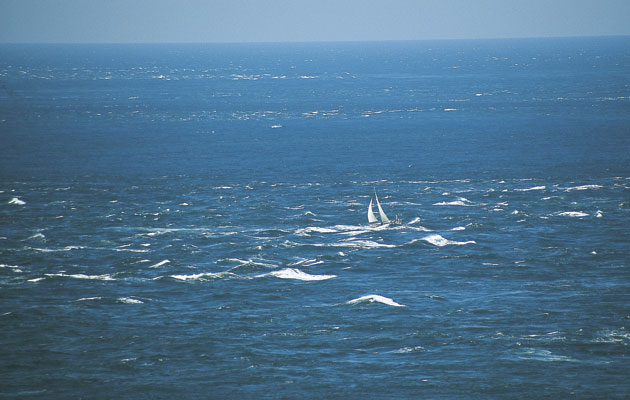
The old lee-bow story goes something like this: if you are beating in tide and the tide is hitting the lee bow, the water somehow pushes the boat to windward. The boat points higher. The tide is “lifting” you. Therefore, when in doubt, tack so the tide is on the lee bow.
Some truth but…
A sailing boat is not standing still in a river while the current smashes into one side of the hull. It is floating in the moving water. The hull, keel and rudder are carried by that water. They do not feel the tide as a separate shove. They feel the flow created by the boat moving through the water, that’s all.
Think about a leaf in a stream. The stream carries the leaf downstream, but the leaf does not feel a special force from being carried. It shares the water’s movement. A yacht in tide is different in scale, weight and complication, but the reference-frame point is the same. The keel and rudder do not know where the land is. They know the water flowing past them.
So, if by “lee-bow effect” we mean a mysterious hydrodynamic lift from tide pressing on the lee bow, we should throw that idea over the side. But if by “lee-bow effect” we mean the combined effect of current, wind-over-water, heading, COG and VMC, then we are talking about something very real.
That is the distinction that matters.
A racing boat lives in two worlds
A racing boat lives in two worlds at once. It sails through the water, but it races over the ground. This is the source of much tactical confusion.
Your log speed, polar targets, sail charts and feel on the helm are mostly about the boat moving through the water. Your GPS, COG, SOG, laylines and distance to the next mark are about the boat moving over the ground. Tide sits between those two worlds.
If the boat is making six knots through the water, and the tide is running two knots across the course, the boat’s track over the ground is not the same as her heading. The tide vector is added to the boat-through-water vector. That is the first part of the story.
The second part is less often explained properly. The water is moving under the air, so the wind experienced by a boat floating in that moving water is not necessarily the same as the wind experienced by someone standing on the land. The meteorological wind has not changed. The GRIB wind has not changed. The wind at the lighthouse has not changed. But the wind over the moving water has changed.
The wind used in polar diagrams is wind relative to the water, while ground wind is wind relative to the fixed earth, the wind used in forecasts and model output. This distinction matters in areas with notable current. In practical navigation language: forecast wind is ground wind, but the sailing-performance true wind is relative to the water, and if the water is moving, those two winds are not the same.
That is the bit many crews miss. They think tide only changes where the boat goes. It also changes the wind the boat sails in.
The helm sails water wind. The navigator uses ground wind.
The two winds
Imagine the true wind over the ground is from the north. Now imagine the tide is carrying the whole body of water sideways, from east to west. A person standing on a cliff still feels the wind from the north, but a boat floating in that moving water experiences a slightly different wind over the water. The air has not moved. The water has. The boat, being carried by the water, now lives in a different moving frame.
This gives us two useful winds. Ground wind is the wind relative to the earth. It is what the forecast, GRIB and weather chart are describing. Water wind is the wind relative to the moving water. It is what the boat sails in, what the sails feel, and what the polar is built around.
Modern systems can display or derive both, depending on setup. Expedition’s documentation distinguishes COG and SOG from GPS, boat speed relative to water, and current set and drift. Its older help documentation is particularly clear that true wind direction is “the wind is coming from over the water”, while GPS gives course and speed over the ground.
That is not academic. It is tactical.
If the water-referenced wind has shifted because the tide is running across the course, the heading you need to sail your target TWA may also change. The boat may feel lifted or headed, even though the actual atmospheric wind has not shifted at all. That is why a boat can appear to “climb” on one tack.
Not because the tide is lifting the lee bow. Because the tide has changed the wind over the water and the boat’s track over the ground at the same time.
Heading is not track
Offshore sailors should tattoo this somewhere discreet: heading is not track.
Your heading is where the bow is pointing. Your COG is where the boat is actually travelling over the ground. In tide, those two numbers can be a long way apart.
On one tack, the tide may rotate your COG towards the next waypoint. On the other, it may rotate your COG away from it. If you only look at the bow, or only listen to the helm’s feeling, you can easily pick the tack that feels clever but loses the race.
That is why the cockpit question should not be, “Have we got the lee bow?” It should be, “What is our COG and VMC to the next decision point on each tack?”
There is a difference. The first question invites folklore. The second question invites race intelligence.
The offshore version
Inshore, the classic lee-bow discussion usually happens on a short beat, between two buoys, in relatively flat water. There is time to argue about the geometry. Someone can point at the mark. Someone can shout about the tide. Someone else can look wise and pretend they knew all along.
Offshore is different.
Offshore, the “mark” may be a headland, a traffic separation scheme, a tidal gate, a waypoint off a bank, or a corner in the routing where you need to be in the right water six hours later. The tide may not be one clean arrow. It may be bending around a headland, accelerating over a bank, shearing near a front, or setting differently offshore compared with inshore. The GRIB may be slightly wrong. The sea state may be punishing one tack. The crew may be tired enough to accept any phrase that sounds like certainty.
That is where “we need the lee bow” becomes dangerous, because it sounds like a decision. It is not a decision. It is the beginning of a calculation.
You need to know where the next mark or decision point is relative to the wind axis. You need to know where the tide is coming from, and where it is going. You need to know your COG on this tack, the likely COG on the other tack, and your VMC to the next decision point. Then you need to ask the question the clean diagrams often ignore: what happens to boat speed and pointing in the actual sea state?
That final question matters offshore more than almost any textbook admits. A clean vector diagram assumes the same boat speed and pointing on both tacks. Offshore, that is often fantasy. One tack may slam. One tack may be wetter. One tack may load the helm, flog the leech, shake the trimmer awake every wave, and knock half a knot off the boat. One tack may give you a kinder angle to the sea and let the boat breathe.
Do not sail the tack that sounds clever. Sail the tack that takes the boat, at speed, towards the next decision point.
When lee bow helps
Lee bow usually helps when the next mark or decision point lies on the side the tide is coming from. In that case, the tide and the water-wind shift can both work in your favour. Your ground track may rotate towards the mark. Your water-referenced wind may make the tack feel better. The boat may genuinely appear to climb.
This is the case that built the reputation of the lee-bow rule. A crew tacks, gets the tide on the lee bow, the COG improves, the boat feels lifted, and suddenly everyone on board believes they have discovered an ancient secret.
But they have not discovered magic. They have sailed the correct geometry.
The danger comes when they generalise that experience into a law. Because the next time the mark is on the other side of the wind axis, or the tide bends, or the sea state changes, the same phrase may send them the wrong way.
Lee bow is useful when the geometry supports it. It is expensive when the geometry does not.
When lee bow hurts
Now take the opposite case. The next mark or decision point lies downtide of the wind axis, on the side the tide is carrying you towards. In this case, the so-called weather-bow tack may actually produce the better COG and VMC. It may look wrong to the old rule. It may feel less satisfying to the helm. It may not give that comforting sense of climbing.
But it may be the tack that takes you to the mark.
This is the situation where cockpit folklore does real damage. Someone feels the boat lifted on the lee-bow tack and assumes that must be good. But the lift is only useful if it takes you towards the thing you are trying to reach. A lift away from the next decision point is not a gift. It is a beautifully disguised mistake.
Offshore this matters because the losses are not measured in boat lengths. They are measured in miles, tidal gates, sail changes and hours of compound error.
A wrong tack inshore costs a place. A wrong tack offshore can cost the race.
A lift away from the next decision point is not a gift. It is a beautifully disguised mistake.
The instrument trap
Modern instruments help, but only if the crew understands what the numbers mean.
A basic sailing system may calculate true wind from apparent wind, heading and boat speed through the water. That gives a water-referenced true wind. That is useful for helms and trimmers because the polar lives in that world. Add GPS, and the system can also work with COG and SOG. That gives access to ground-referenced wind and current calculations. That is useful for navigators because the routing, forecast and racecourse live in that world.
The problem is that many crews see the words “true wind” and assume there is only one truth.
There is not.
There is true wind over water. There is ground wind over the earth. In no current, they are effectively the same. In real tide, they separate.
To compute true wind for polar diagram and target speed tables, use speed through water and course through water.
That is the point every offshore navigator should brief before a tidal race. The helm needs water wind. The navigator needs ground wind. The tactician needs to know which one is on the screen. If you do not know which wind your instrument display is showing, you do not yet know what your instruments are telling you.
A “shift” on the instruments may be a real wind shift, or it may be the tide changing the wind-over-water. Know which one you are looking at.
The standard offshore check
This is the practical version I would use offshore, not because it is mathematically perfect, but because it is usable at 0215 when the boat is wet, the watch is tired, and nobody wants a lecture on reference frames.
First, locate the next decision point, not just the next mark. That might be the weather mark, a headland, a tide gate, a shipping lane, a bank, a layline, or the point where you need to choose whether to stay offshore or come in. Ask whether it is uptide, dead upwind, or downtide of the wind axis.
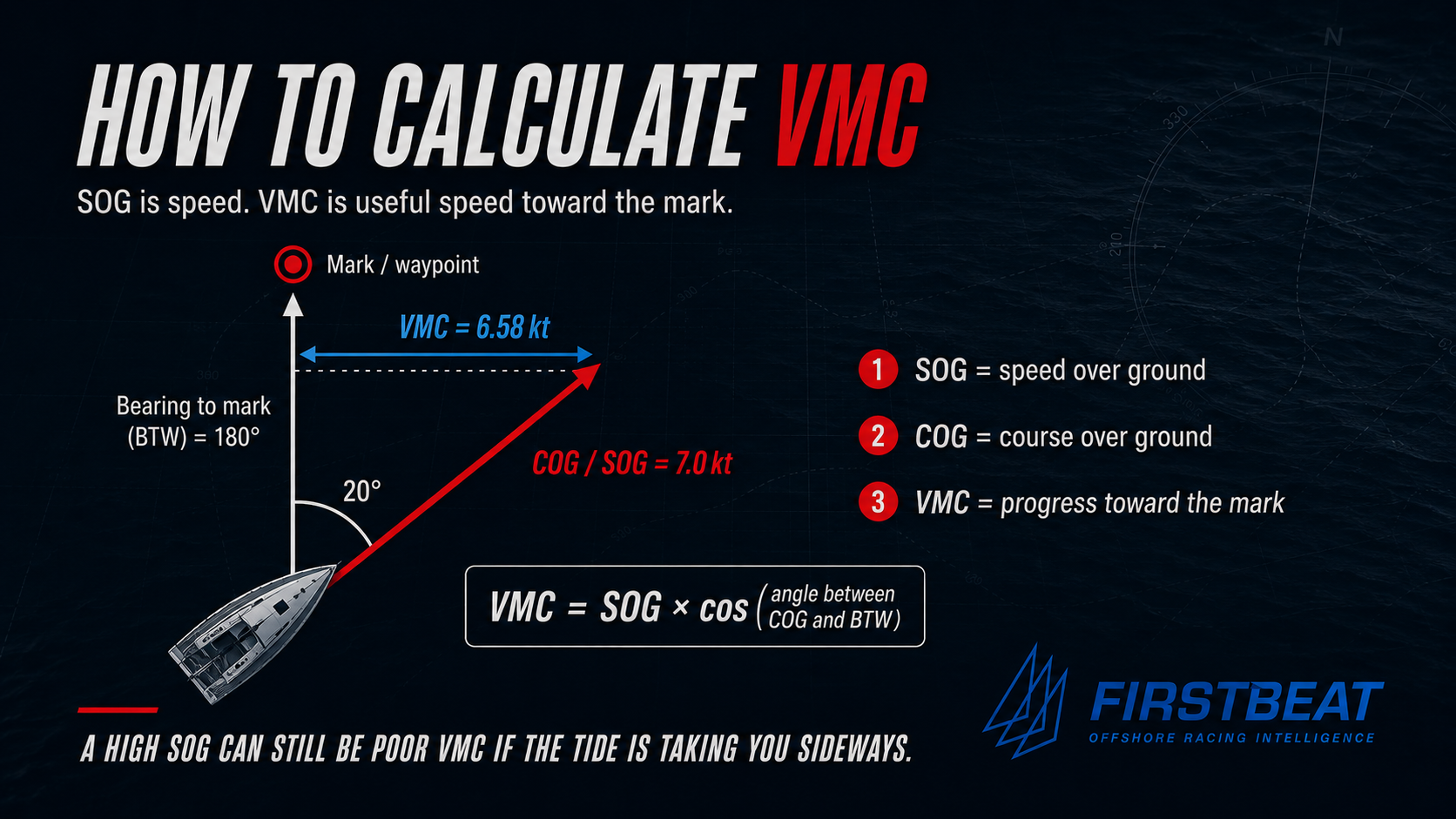
Second, compare COG, not just heading. Look at where the boat is actually going. If you are on starboard, what is your COG and VMC? If you tack, what is the likely COG and VMC on port? This is not difficult with modern instruments, but it does require the discipline to look. For instruments to display VMC the course must be inputed correctly on the plotter and the next waypoint activated. The plotter will then show you lay lines to the waypoint based on your boat speed, and heading at that moment but will not account for the changes in tide as time progresses. That information is calculated in the routing software which is generally seperate to the plotter display.
Third, separate water wind from ground wind. The helm and trimmer sail to the water-referenced TWA and targets. The navigator compares ground wind with the forecast, GRIB and routing. Do not mix those two worlds without knowing you are doing it.
Fourth, include sea state. If one tack is slamming, slow, noisy and loaded, the vector diagram is lying politely. A boat that is half a knot slower because she is being hammered by the sea is not sailing the theoretical solution. She is just proving that paper is flat and oceans are not.
Finally, re-check after every tide, wind or mode change. The answer is local. A five-degree wind shift can change it. A knot of tide can change it. A bend around a headland can change it. A reef, a cracked sheet, a flatter sea, or a new watch on deck can change it.
Lee bow is not something you decide once. It is something you keep testing.
A better cockpit language
I would stop saying, “We need the lee bow.” It is too vague.
I would say, “The tide is setting us west. On this tack our COG is taking us towards the waypoint. On the other tack it will set us away. Hold.”
Or, “The lee-bow tack feels lifted, but our VMC is poor because the waypoint is downtide. We need the other tack.”
Or, “The water wind says we are lifted, but the ground track says we are losing the gate.”
That is much better cockpit language. It separates feeling from fact. It lets the helm describe the boat. It lets the navigator describe the racecourse. It gives the skipper a decision that can actually be challenged.
That is important, because offshore racing is not a game of private genius. It is a crewed system under pressure. The best calls are often the ones the whole watch can understand well enough to execute properly.
What this means for routing
Routing software is useful here, but it can also hide the thinking.
Expedition, Adrena, PredictWind, NavimetriX and the rest can all make tidal routing look wonderfully clean. The danger is that the crew starts believing the coloured line has done the seamanship for them.
The software is only as good as the wind model, the tide model, the polar, the calibration, the assumptions and the person interpreting the output. If the boat is sailing in two knots of tide across a long beat, the routing needs to understand both the movement of the water and the wind over that water. If the navigator then compares instrument wind against GRIB wind without knowing whether the display is water-referenced or ground-referenced, the wrong conclusion can follow very quickly.
That is how a boat ends up “chasing a shift” that is partly tide. Or rejecting a tack that is slow through the water but good over the ground. Or following the routing line while the sea state quietly removes half a knot from the chosen mode.
The software is not wrong. But the navigator must know what world each number belongs to.
Water world. Ground world. Weather world.
Confuse them, and the lee-bow effect becomes another place where technology makes a bad assumption look official.
The conclusion
The lee-bow effect is not nonsense, however,
There is no magic pressure on the lee bow. There is no hidden lift from tide striking the hull. There is no secret trick that lets one tack break the laws of geometry. But there is a real tactical effect.
The tide changes your track over the ground. The tide changes the wind over the water. Those two effects alter what the boat feels like and where the boat actually goes. That is why lee bow has survived as a phrase. Sailors felt something real. They simply gave it the wrong explanation.
The better explanation is not harder. It is cleaner.
The boat sails through water. The race is scored over ground. The wind the sails feel is not always the wind the GRIB describes.
Once you understand that, lee bow stops being a superstition and becomes a test. Does this tack improve our COG and VMC to the next decision point? Does the water-referenced wind support the mode we are sailing? Does the ground-referenced wind agree with the forecast and the routing? Does the sea state allow the boat to sail the numbers?
Lee bow is not a rule. It is a test.


Comments