
How to win the start, Part 1: Why the favoured end won’t always be yours

In brief
The start is the first execution of a plan for the first beat. Choose the end for the wind you expect when the boats next cross, not only for the wind at the starting signal.
Each degree of bias is worth roughly one sixtieth of the line length in upwind separation. On a short line it barely matters; on a long one it matters a great deal.
A crowded end has a cost. A clean lane a little way from the favoured end often beats a second-row start at it.
A uniform stream moves the whole fleet, but it also changes the wind over the water. Check both.
Know your own boat: time to full speed, the cost of a tack and the launch settings, in today’s breeze. Plan the escape before you commit.
The port-tack pin start is a specific opportunity, not a style.
Well over a thousand starts
I have done somewhere between twenty-five and thirty starts a year since 1980. That is well over a thousand. I have made every mistake in this series at least once, and a few times I have done well. What follows is the order in which I would now think about a start, for a helm who wants to skip some of the mistakes.
Much of the structure of this part follows a starting seminar Peter Isler gave for North Sails One Design, published as Race Start Strategy with Peter Isler. The starting challenges, the weight given to density, burn time and the low-risk start near the committee boat are his framing. The Solent emphasis, and any errors, are mine.
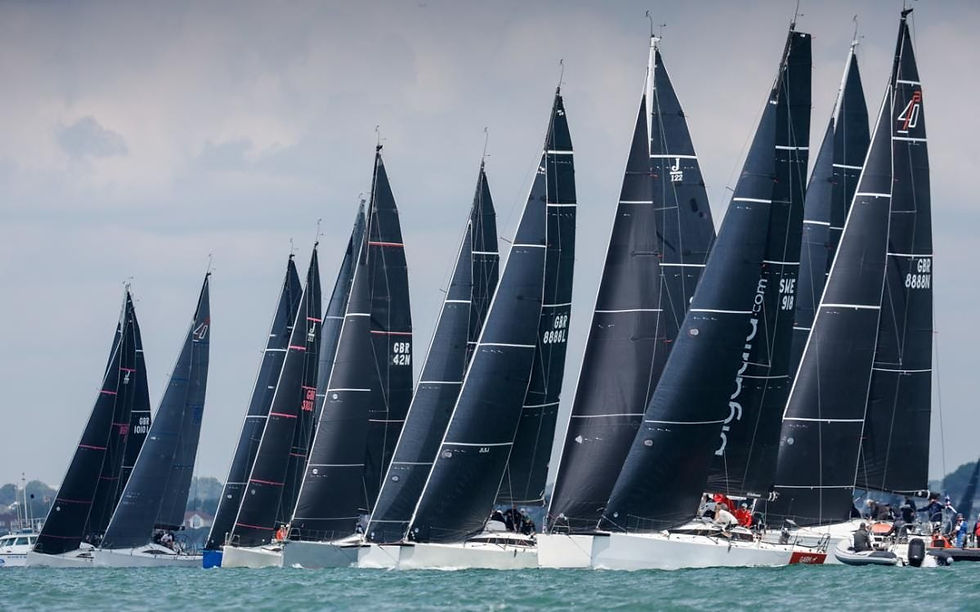
The RORC bills its Easter Challenge as the start of the season, and it is a good place to watch starting decisions made and remade. In 2026 it ran from 3 to 5 April: three IRC classes, seven races including a round-the-cans race on the last day, coaches on the water and video debriefs ashore, in conditions that ran from spring tides and gusts over 30 knots to much lighter patches. David Franks, whose J/112 Leon won IRC Two, summed up racing of that kind: “In the end, it often comes down to the team that makes the fewest mistakes.”

Easter Challenge 2026 - I was coaching the all girls team on a SF3600 - I think I got away with it!
That is the argument of this series. A start is not a separate contest. It is the first execution of a plan for the first beat. Get the plan wrong and a good start can take you to the wrong place quickly. Get it right and an ordinary start is often recoverable.
This part covers the plan and the line. Part 2 covers what creates gains on the first beat. Part 3 covers the other boats and the approach to the windward mark.
Why read this first
If you are new to the helm, start here. Most of the races you sail will begin upwind, and the first few minutes set the lanes, the sides and the pecking order for what follows. Recovery is possible. It is also expensive. Get the start and the first beat right and you spend the race racing the boats around you. Get them wrong and you can spend it in their dirty air, looking for a speed problem that is not there.
The one idea underneath everything: the ladder
Imagine the course overlaid with rungs, like a ladder, each rung drawn at right angles to the wind. Upwind, you are trying to climb rungs. Two boats on the same rung are level for upwind position, however far apart they are and whichever tack they are on.
Remember; the ladder has limits, and it is worth knowing them from the outset. It measures upwind position relative to one wind direction. It does not measure boat speed, the cost of a tack, access to pressure, freedom to manoeuvre or the effect of tide on your track over the ground. It explains the geometry. The boat, the crew and the conditions decide how quickly you climb it.

Which end? The starting challenges
Start with the top three challenges.
They are worked scenarios, deliberately simplified: no other boats, no tide, a steady wind, both ends of the line inside the laylines, equal speed on both tacks, and tack losses ignored. They are simple. They are also key to know and remember be it a windward leeward Solent race or the Myth of Malham!
Challenge one
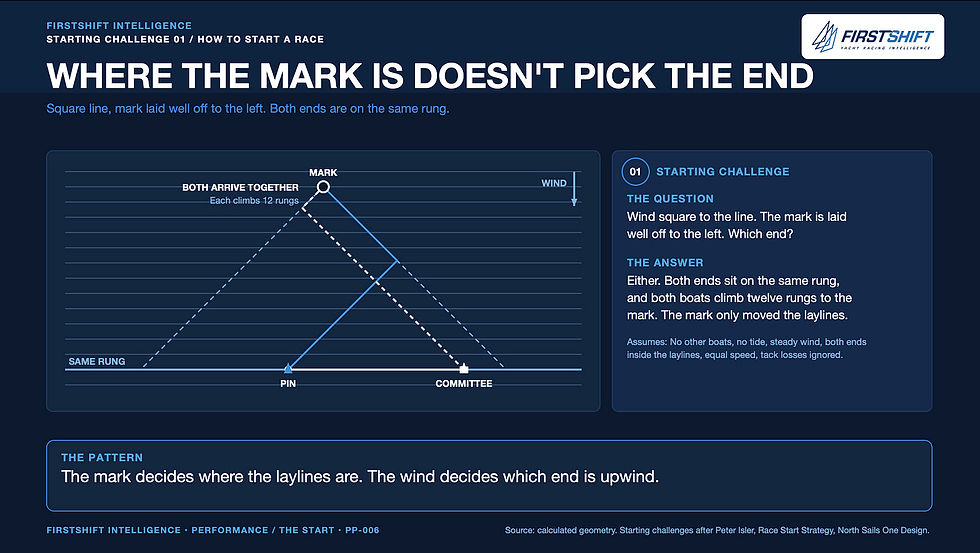
The wind is square to the line. The windward mark has been laid off to the left, though both ends are still inside the laylines. Which end? Many crews say the pin, because it is physically closer to the mark. Under these conditions it does not matter. Both ends sit on the same rung. A boat from the pin and a boat from the committee boat each sail to a layline and tack, and they sail the same distance. The mark’s position decides where the laylines are. It does not decide which end is favoured. The wind does that.
Challenge two
Same mark, but the line is skewed so the pin is further upwind. Now the pin is favoured, because a boat starting there begins on a higher rung. Nothing about the mark has changed.

Challenge three
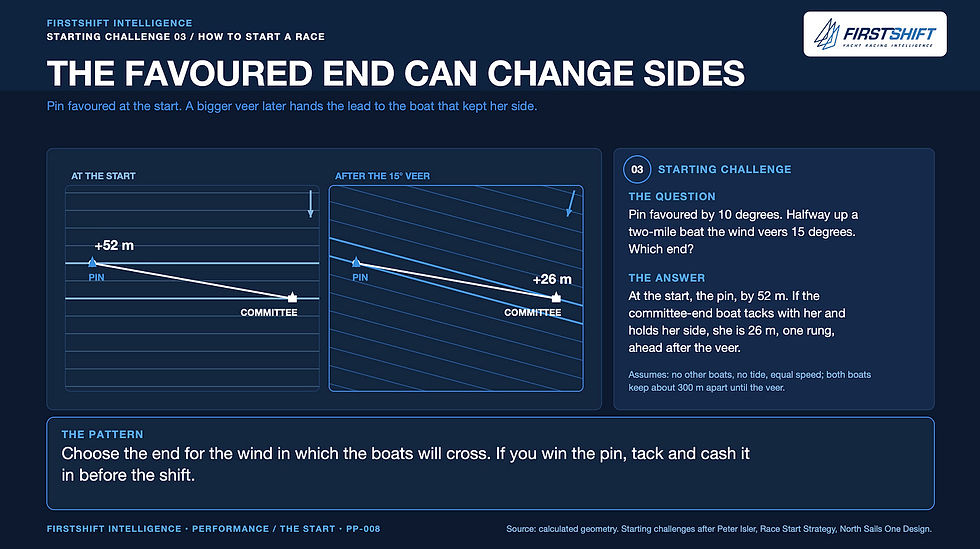
A 300-metre line, the pin favoured by 10 degrees at the start. Halfway up a two-mile beat the wind veers 15 degrees. The pin boat starts about 52 metres further upwind. If she tacks and crosses the committee-end boat before the veer arrives, she banks that gain. But the committee-end boat has an answer. If she tacks at the same time, she keeps her position to the right, and the pin boat cannot get across. Now the veer arrives and the rungs rotate. If the two boats have kept roughly the 300 metres of lateral separation they started with, the committee-end boat is now about 26 metres ahead in the new wind: the five degrees by which the shift exceeded the bias, applied to the line.
That third challenge is the whole game in miniature. Choose the end for the wind in which you expect the boats to come together, not only the wind at the starting signal. If you do win the favoured end, tack and cash some of it in before a rival can protect her side.
Line bias as distance, not degrees
Degrees of bias mean little until you turn them into metres and boat lengths. The upwind separation between the two ends is the line length multiplied by the sine of the bias angle.

These are metres of upwind height, not metres sailed. The distance along a close-hauled track is larger. For a 12-metre boat, five degrees on a 300-metre line is about two boat lengths of upwind separation. On a short line with a handful of boats, a few degrees of bias hardly matters. On a long line in a big mixed fleet, the same bias is worth several lengths, and most of the fleet knows it.
The quickest way to find the bias:
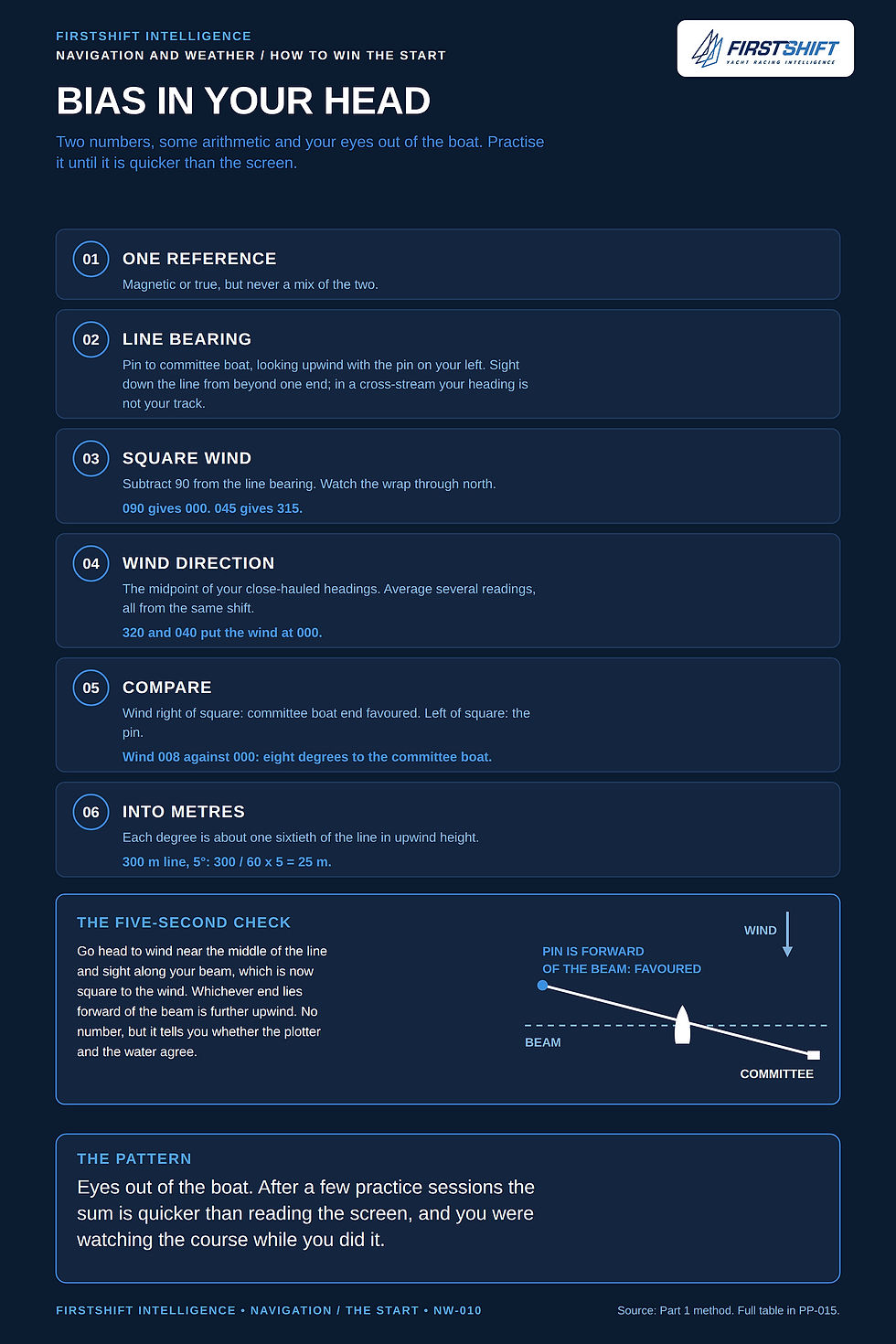
You need two numbers: the bearing of the line and the direction of the wind. The rest is arithmetic you can do in your head.
Use one reference throughout. Magnetic or true, but never a mix of the two.
Get the line bearing. Take it from pin to committee boat, looking upwind with the pin on your left. Sight down the line with a hand-bearing compass from beyond one end. If you steer along the line instead, remember that in a cross-stream your heading is not your track, so the compass will not give you the line bearing.
Find the square wind. Subtract 90 from the line bearing. A line bearing of 090 gives a square wind of 000. Watch the wrap through north: a line bearing of 045 gives 315, not minus 45.
Get the wind direction. Go head to wind and read the compass, treating it as an estimate because the boat will still be moving. Better, take your close-hauled headings on each tack and find the midpoint: 320 on starboard and 040 on port puts the wind at 000. Take several readings and average them, and do not compare a reading taken in one shift with a reading taken in another.
Compare. If the wind is to the right of square, the committee boat end is favoured. If it is to the left, the pin is. The difference is the bias. Wind at 008 against a square of 000 is eight degrees to the committee boat.
Turn it into metres with the 1 in 60 rule. Each degree of bias is worth about one sixtieth of the line length in upwind separation. Five degrees on a 300-metre line: 300 divided by 60 is 5, times 5 is 25 metres. The table above, calculated properly, says 26.
There is a quick visual check. Go head to wind near the middle of the line and sight along your beam, which is now square to the wind. Whichever end lies forward of that beam line is further upwind. It will not give you a number, but it will tell you in a few seconds whether the plotter and the water agree.
The plotter, and why you should also learn to do without it
Pinging both ends of the line into the navigation software is the best tool on the boat. It gives you the line bearing and length, and with the true wind direction it calculates bias, distance to the line and time to burn.
It has weaknesses. The ends are only as good as the position fixes: GPS error, the distance between the antenna and the bow, and a committee boat or pin that has dragged or been moved all creep in. The bias is only as good as the true wind direction behind it; if the heading or wind sensor is a few degrees out, so is the answer, and on a long line that can be the wrong end. Burn time depends on assumptions about how your boat accelerates. I covered calibration in How I set up race instruments for offshore racing (properly). And the plotter pulls heads into the boat at exactly the moment the helm and tactician need to be watching the water.
So in training, turn the screen away. Do the bias in your head, eyes out of the boat, and check the answer against the plotter afterwards. After a few sessions the mental sum takes less time than reading the screen, and you have been watching the race course while you did it. On race day, use both. If they agree, you can commit. If they disagree, trust neither until you know why. Whichever method you use, check it more than once: the wind in the last ten minutes matters more than the wind at the warning signal.
Density/traffic: the bias you cannot see on the plotter
The plotter tells you which end is further upwind. It does not tell you how many boats have worked that out too.
The more boats on a line, and the shorter the line relative to the fleet, the harder it is to get a clean launch anywhere near the favoured end. Crowded ends breed early starts, protests and second-row lanes. A boat a few lengths down the line from the favoured end with clear air can be ahead of the boat that won the end and then spent two minutes pinched in someone’s backwind. Treat density as a cost to be weighed against bias. The larger the bias, the more a crowded end is worth paying for, but the price is paid in your launch, not only in metres.
The same logic applies in the middle. Boats near the ends can judge the line; boats in the middle often cannot, so the middle tends to sag back. A crew with a reliable transit, sighted from beyond one end of the line onto something fixed ashore, can start further forward than a sagging midline and have a lane to itself. Take the transit before the warning signal.
Tide on the line
In a tidal venue such as the Solent, the stream can reshape the start as much as the bias does.
If the stream is carrying you over the line, every second you hang near it costs distance. Set up further back than feels comfortable and time the run in. If it is carrying you back from the line, you can sit closer, but you will arrive later than you think. With the stream running along the line, the up-tide end is easier to hold and the down-tide end easier to reach, and the fleet will often gather at whichever end is easier.
There is a subtler effect. A spatially uniform stream adds the same drift to every boat, so on its own it does not create separation between boats. It does change the wind over the water, which is the wind the boat sails in, and it changes the route to a mark that is fixed to the ground. Two knots of cross-stream in ten knots of wind shifts the water wind by roughly eleven degrees, and that shift behaves on the ladder like any other. If the stream on the first beat differs from the stream on the line, the end that is favoured at the starting signal may not be the end that is favoured for the beat. My essay Should you stop trusting Lee Bow until you know which wind your instruments are showing? sets out the water-wind and ground-wind distinction in full.
The starting sequence: know which rules you are starting under
Under rule 26 of the Racing Rules of Sailing, the standard sequence is a warning signal at five minutes, the class flag; a preparatory signal at four minutes, flag P, I, Z, Z with I, U or the black flag; the one-minute signal, when the preparatory flag comes down with one long sound; and the starting signal, when the class flag comes down. Times are taken from the visual signals. A missing sound signal is disregarded.
The preparatory flag matters because it changes your options in the last minute. Under P, a boat over early can return and start. I requires a boat on the course side in the last minute to go back round an end of the line. Z brings a 20% scoring penalty for being in the triangle formed by the line and the first mark in the last minute. U and the black flag mean disqualification without a hearing, and under the black flag that stands even if the race is restarted. An individual recall is flag X; a general recall is the First Substitute.
The notice of race and sailing instructions can change the sequence, and at regattas they often do. Read them before you leave the dock. The rules of the start itself, including what port and starboard boats may do near the ends, are in We All Know the Rules… Until It Gets Complicated.
Time, distance and burn time
The pre-start homework is short and always the same. Where are the laylines to each end? How long is the line in time, on starboard at full speed? How long does this boat take to reach full speed from half speed in this breeze? How many seconds does a tack cost today? How far back from the line do you want to be with a minute to go?
Burn time turns much of that into one number. Instead of fifty seconds to go and twenty-five seconds of sailing to the line, say twenty-five to burn. Twenty-five to burn three lengths from the line is a problem for most keelboats. The same twenty-five eight lengths back gives you room to work, but only if you know how quickly your boat slows and accelerates. Isler’s point, and a good one, is that the ratio of distance to time to burn is the number to watch.
The launch matters more than the precise spot. Agree a launch setting with the trimmers, distinct from the open-course setting. On many boats that means the traveller up, a little more twist, the backstay eased, so the boat accelerates on a slightly higher angle and holds its lane. Treat those as settings to test on your boat, not rules. The sooner the boat is back to its open-course settings after the start, the better the start turns out to have been.
Who does what
A helm who is counting down, judging the line and watching for traffic is doing none of them well. Allocate the jobs before the warning signal.
Time and burn: navigator or pit, calling the countdown and the time to burn, not only the time to go.
Distance to the line and the transit: bow, or the crew member in the middle of the boat with the clearest view of the range.
Traffic ahead and to leeward: helm and bow.
Traffic from astern: one named crew member watching for boats coming in fast from behind on starboard, and port tackers looking for a hole.
Launch trim: main and headsail trimmers, on an agreed call.
The first-beat plan: tactician or navigator, with the favoured end, the first shift expected and the tide, all agreed before the one-minute signal.
Light air starts
In light air, most things take longer and cost more. Acceleration can take a long time; some boats need the best part of a minute to reach target speed. A tack costs more than it does in a moderate breeze. Clear air is often worth more than position, because a boat in someone’s backwind in six knots can simply stop.
So in light air, keep your options open and your speed up. Stay further from the line than you would in breeze, because you cannot build speed in the last few seconds. Be wary of the busy end. Value a lane you can hold on starboard for several minutes over a few metres of bias. And watch the tide closely: it is a larger fraction of your speed, so its effects are magnified.
Heavy air starts
In heavy air the boat accelerates quickly, and the risk moves from being slow to being early or out of control. A tack may still cost less than it did in light air, but as waves, heel and handling losses rise it can become expensive again. Measure it on your own boat rather than trusting anyone’s figure. Leeway is larger too. On a starboard approach, a slow boat slides sideways to leeward, down the line towards the pin and onto the boat below, so leave room beneath you.
Keep steerage way; a stalled boat in 25 knots is a passenger. Keep the boat flat and the crew hiking before the start, not after it. Have the mainsheet or traveller ready to keep the boat on its feet in the gusts, and an agreed escape if a lane closes.
The mixed fleet
From IRC series to the Admiral’s Cup, which returns to Cowes in July 2027, many starts put boats of different sizes and ratings on the same line. That changes the calculation. The larger boats will usually be ahead within minutes, and their wind shadow reaches well down the line. For a smaller boat, the best start is often the one that avoids starting close to leeward of a larger, faster, higher-pointing yacht, even at the cost of some bias. For a larger boat, the risk is being held up by smaller boats already established to windward. Look at who you are starting next to, not only where.
The port-tack pin start
This is the high-risk start, and it earns its reputation in both directions.
A boat leaving the pin on port is heading right, looking upwind. The attraction is that it combines the pin’s upwind advantage with immediate access to the right-hand side. A port-tack pin start is worth considering when the pin advantage and the fleet’s geometry give you a credible chance to cross, and a port-tack departure serves your first-leg plan. An empty pin and a fleet bunched towards the committee boat make it more likely; they are favourable circumstances, not requirements.
The mechanics are unforgiving. You approach on port, timed to arrive at full speed as the starting signal goes, and you must keep clear of every starboard boat. So decide, while there is still room, the point at which you will abandon the attempt. Your options are limited. Ducking one starboard boat may reveal several more behind her. Tacking beneath a starboard boat near the pin may be impossible, because the mark and the boats approaching it can leave you no room to complete the tack legally. Read We All Know the Rules… Until It Gets Complicated before trying this in a fleet, and practise it first where the only cost of failure is a laugh.
The opposite start deserves as much respect. A low-risk start on a crowded line is near the committee boat, a length or so late, at full speed. If you do not win the boat end, you are often among the first boats able to tack onto port and take a clear lane to the right. From deep down the line, a poor start can mean a sequence of ducks and tacks before you find clear air. Near the committee boat, the escape is usually shorter.
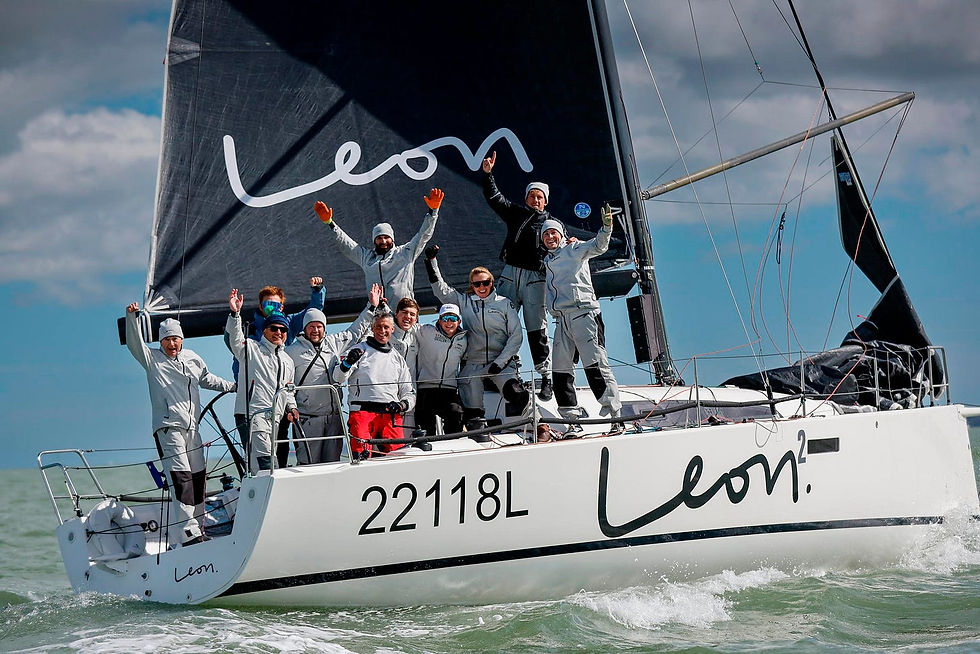
Well sailed and Leon wins Easter Challenge in 2026
The checklist before the warning signal
Sailing instructions read: the sequence, the preparatory flag and any changes to rule 26.
Wind direction and trend, checked at least three times.
Line bias in degrees and in upwind metres.
Tide on the line and on the beat.
The first-beat plan, and which end serves it.
Density: where the fleet is likely to stack up.
Transit for the middle of the line.
Time on the line, time to full speed and the cost of a tack in this breeze.
Launch setting agreed with the trimmers.
Jobs allocated, and an escape planned for the chosen spot.
None of it is clever. All of it has to be done before the start, because afterwards there is no time. The start is where your plan meets the fleet. It should not be where you make the plan.
Stuart Greenfield FirstShift — Yacht Racing Intelligence From first shift to first place.
Offshore racing is never just about the boat, the forecast, or the routing software.
It is about decisions made under pressure, in changing conditions, by tired people trying to keep the boat moving fast and safely in the right direction.
That is where races are won and lost.
At FirstShift, my aim is simple: to help owners, skippers and crews race offshore with more clarity, more confidence, and better preparation whether that is a RORC Channel race, a Fastnet campaign, or your first serious step into offshore racing.
Thanks for reading Firstshift - yacht racing intelligence! This post is public so feel free to share it.


Comments