
How to win the start, Part 3: Why winning the crossing can lose you the race

In brief
Every crossing is a strategic decision first. Decide where you want to go, then choose duck, lee-bow or early tack.
Dirty air runs downwind of a boat along the apparent wind. Treat any position near another boat as conditional, not safe.
Cover to limit a rival’s chances to gain while keeping your own route to the mark. The next shift adjusts the cover; it does not replace it.
In a handicap fleet, cover the boats that matter on corrected time. A bigger boat that owes you time may be exactly that boat.
Plan the windward mark approach before you reach the layline: where to join it, how much margin for tide, and the next leg’s manoeuvre.
The slam dunk is an advanced move. A clean early duck and a quick escape matter more.

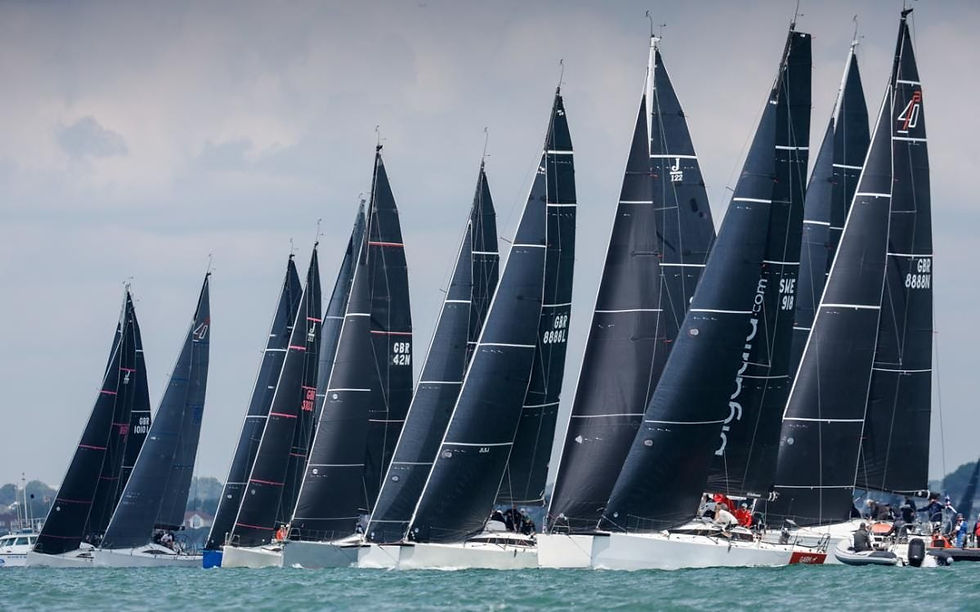
J109 Jukebox winner IRC 3 RORC Easter Challenge 2026 Picture with thanks Paul Wyeth (C) /RORC
The boat beside you
John Smart, whose J/109 Jukebox won IRC Three at this year’s Easter Challenge, singled out “the quality of the racing that close boat on boat element pushes everyone to improve.” That close element is where much of the first beat is decided: not by one clever strategy, but by a string of small encounters in the first ten minutes, each of which either keeps you on your plan or pushes you off it.
The argument of this part is simple. Every crossing is a strategic decision in tactical clothing. Duck, tack or cover: the right answer depends first on where you want to go and where the next shift and pressure will come from, and only second on the other boat.
Dirty air, and where it reaches
Three different things are going on around another boat, and it helps to keep them apart.
Wind shadow. Downwind of a boat’s sails is a wake of slower, disturbed air. It runs along the apparent wind, which is well forward of the true wind when beating, so the shadow falls to leeward and behind her. A boat inside it sails in less wind and, often, a header.
Disturbed flow near the sails. Close to leeward and slightly ahead of another boat, your sails bend the air that reaches hers. A boat just behind and to windward of you sails in air you have already deflected, which heads and slows her. This is what crews mean by backwind, and it is why the position close to leeward and just ahead is so valued.
The practical zones. Put together, the places you usually struggle are directly downwind of a boat along the apparent wind, and close behind and to windward of a boat that is slightly ahead and to leeward of you.
Whether any position is comfortable depends on the separation, your relative speed and pointing ability, and the sea state. Clear ahead, well to windward, or far enough away on either side are usually workable. None of them is unconditionally safe. The disturbance reaches several boat lengths downwind, further in light air and further still behind a large boat with a tall rig, which is why a small boat in a mixed IRC fleet has to think hard about which bigger boats it lets get upwind of it.\
A quick clue on the water: look up at the boats to windward. If a mast lines up with you along the apparent wind, you may well be in her air. It is a clue, not proof. Check the numbers and the feel of the boat, and move before you have to.

Port meets starboard: duck, tack or cross
You are on port. A starboard boat is coming and you cannot cross. Your choice comes from your plan, not from the moment.
Duck if you want to keep going right, the right is paying, or port is the lifted tack. A good duck, started early with the bow brought down smoothly and both sails eased to keep the boat powered, then brought back up behind her stern, can cost very little and may even leave you with extra speed. A late duck, with a sudden bear-away and sails still set for upwind, costs far more.
Tack to leeward, a lee-bow, if you want the left, or starboard is the lifted tack. Tack close to leeward and slightly ahead of her so that your disturbed air works on her, not hers on you. Tack too far back and you land in her shadow. Tack too close and the rules are against you: you must keep clear while you tack, and when you gain right of way you must initially give her room to keep clear. A marginal lee-bow is usually a lost protest.
Tack early and away if neither works. If you cannot reach the lee-bow position and do not want the right, tack before you reach her, while you still have clear air.
The starboard boat has choices too. If she wants to go left and fears a lee-bow, she can wave the port boat across rather than risk being pinned. Letting a boat cross you to go the way you do not want to go is not generosity. It is strategy.

Covering
Once you are ahead, the question becomes how to stay there. Dave Dellenbaugh’s Speed & Smarts sets out the choice cleanly: “Put a tight cover on a boat that is a) headed toward the favored side of the course; or b) headed away from the rest of the fleet.” And the corollary: “Put a loose cover on a boat that is a) headed toward the wrong side of the course; b) going toward the other boats; or c) headed toward a layline.”
A tight cover puts the other boat in your wind shadow and makes staying on that tack expensive for her. A loose cover keeps you between her and the mark and the side you favour, while leaving her clear air, so you avoid giving her an extra reason to split.
The principle underneath both: reduce a rival’s opportunities to gain while keeping your own route to the mark and the conditions you favour. Limiting separation is the core of it, for the reason Part 2 gave: separation is what a shift turns into gain. The expected shift adjusts the cover. If you believe the next shift will come from one side, you lean your cover towards that side, and you tack with her when she tacks on a header so that you are both on the same shift. It refines the cover; it does not replace it.
In a handicap fleet there is one more layer. Cover the boats that matter on corrected time, not simply the nearest boat. Being owed time by a larger boat does not make her irrelevant; she may be your principal rival. The questions are whether you are ahead of or behind her on projected corrected time, whether the conditions later in the race will change that, and what engaging her costs you against the other boats that matter. Know your rivals’ ratings before the start.
Forcing a tack
You cannot order another boat to tack, but you can make staying on her tack uncomfortable enough that she chooses to.
Tight cover. Tack close ahead and to windward, on her wind, and her speed suffers until she tacks away. Use it to push a rival away from the side you think is favoured.
Lee-bow. Tack into the position close to leeward and slightly ahead, so your disturbed air works on her. She sails slowly behind you or tacks.
Geography. A layline, a shoreline, an exclusion zone or a strong adverse stream will force her to tack at a moment you can predict. Be where her forced tack lands her behind you.
The approach to the windward mark
The first beat is not over until you have rounded, and the approach is where many good first beats are given back.
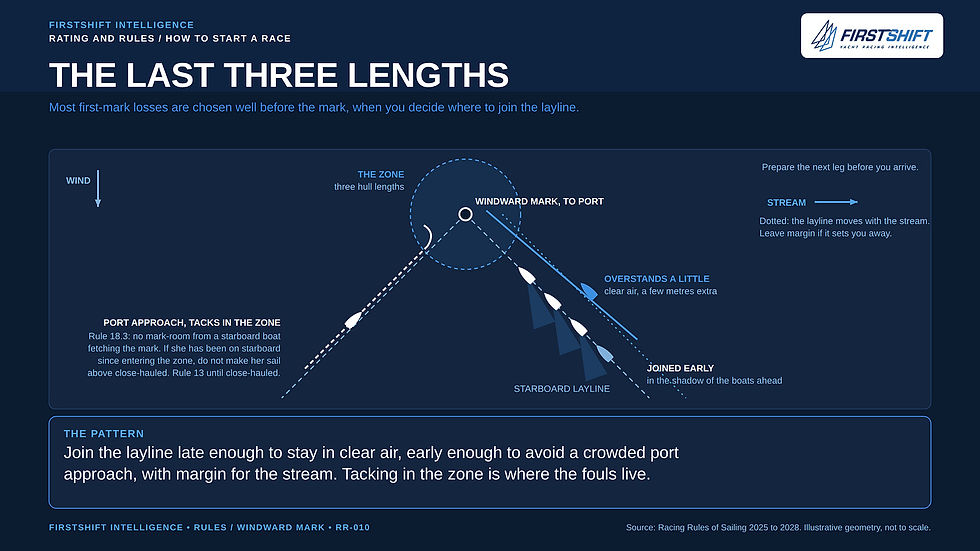
Choose where to join the starboard layline. Join too early and you are exposed to every shift for longer, and in a fleet you will often be sailing in the wind shadow of boats already on the layline ahead of you. Join too late and you risk a crowded arrival on port.
Allow for current and waves. Laylines move with the stream. If the stream is setting you away from the mark, leave margin; if it is setting you towards it, you can tack earlier. In a sea, allow for extra leeway and for the speed lost pinching the last few lengths.
Treat the port-tack approach with care. Arriving on port into a stream of starboard boats means ducking, finding a gap or tacking close to the mark. The zone is three hull lengths from the mark, measured by the boat nearer to it. If you tack from port to starboard inside it, rule 18.3 says the mark-room rule, 18.2, does not apply between you and a starboard boat that is fetching the mark: you are not entitled to mark-room from her. If she has been on starboard since entering the zone, you must not cause her to sail above close-hauled to avoid contact, and you must give her mark-room if she becomes overlapped inside you. Rule 13 binds you until you are close-hauled. It is a common place for a foul. The rules detail is in We All Know the Rules… Until It Gets Complicated.
Consider overstanding slightly in a crowd or in foul tide. A few metres of overstand in clear air can be cheaper than a layline in someone’s shadow.
Prepare the next leg before you arrive. Decide on bear-away or gybe set, have the kite and crew ready, and have the navigator know the next course and the tide on it before the bow reaches the mark.
Advanced: the slam dunk
This is an aggressive covering move. It belongs after the duck, the lee-bow and the approach to the mark in any helm’s list of priorities.
A port-tack boat ducks behind you on starboard. As her bow passes under your stern, you tack onto port close ahead and to windward of her, so she sails into your wind shadow. It works best when you are only just ahead, she has committed to her duck, and you want to go right with her beside you rather than let her split. Timing is everything. Tack too early and she may be able to lee-bow you or cross. Tack too late and she has already come back up with speed beside you. Do not assume she will be slow: a well-executed duck can leave her faster than you. And the rules apply throughout. Under rule 13 you must keep clear until you are close-hauled. If you finish the tack overlapped to windward of her, you must keep clear under rule 11. If you finish clear ahead and so acquire right of way, rule 15 requires you initially to give her room to keep clear.
The defence starts before the duck. If you suspect a dunk, duck early and with speed, so that as she tacks you have a lane to leeward and the pace to hold it. If you can reach the lee-bow position instead, take it and do not give her the chance. Whether you may then luff her is a rules question, not a tactic, and it depends on how the overlap arose. If her tack leaves you already overlapped to leeward, rule 17 does not limit you. If she finishes clear ahead and you then become overlapped to leeward from clear astern within two of your hull lengths, rule 17 applies: you must not sail above your proper course while you stay on the same tack and overlapped within that distance, unless in doing so you promptly sail astern of her. Whatever the case, rule 16.1 requires you to give her room to keep clear when you change course. Failing all of that, tack away as soon as you are clear, accepting the side you did not plan for over a long spell in her air.

When to give up a fight
The hardest skill is knowing when to stop. A boat locked in a luffing match or a tacking duel early in the beat can win one battle and lose to the fleet. If you are in dirty air on the lifted tack, you can try to foot clear. If you are in dirty air on a header, the decision is usually easy: tack. If you are pinned and neither works, take the cheapest escape, usually an early duck, and go and find clear air on the side you wanted in the first place.
The thread through all three parts
Part 1 said the start is the first execution of a plan. Part 2 said the plan is about the wind and the water, with the mark only setting the box. This part says that every encounter with another boat, and the approach to the mark itself, is a chance either to stay on that plan or to be pushed off it.
None of this is about being the most aggressive boat on the water. It is about making fewer mistakes than the boats around you, in the right order, before the first mark.
Stuart Greenfield FirstShift — Yacht Racing Intelligence From first shift to first place.
Offshore racing is never just about the boat, the forecast, or the routing software.
It is about decisions made under pressure, in changing conditions, by tired people trying to keep the boat moving fast and safely in the right direction.
That is where races are won and lost.
At FirstShift, my aim is simple: to help owners, skippers and crews race offshore with more clarity, more confidence, and better preparation whether that is a RORC Channel race, a Fastnet campaign, or your first serious step into offshore racing.
Thanks for reading Firstshift - yacht racing intelligence! This post is public so feel free to share it.


Comments