
How to win the start, Part 2: Why the first shift could be worth first place

In brief
The ladder explains the geometry of upwind gains. Boat speed, pressure, tide and manoeuvring decide how quickly each boat climbs it.
Lateral separation is leverage. A shift turns it into gain or loss: 10 degrees on 200 metres of separation is about 35 metres of upwind height.
In steady, uniform conditions, routes inside the laylines are the same length. The mark sets the box; the wind and water create the gains.
Tack on headers past the median, but only when the shift is worth more than your boat’s tack costs today.
Tide changes the wind over the water and your track over the ground. It does not push on the lee bow.
Height and speed are a trade. Sea state decides which is cheaper.
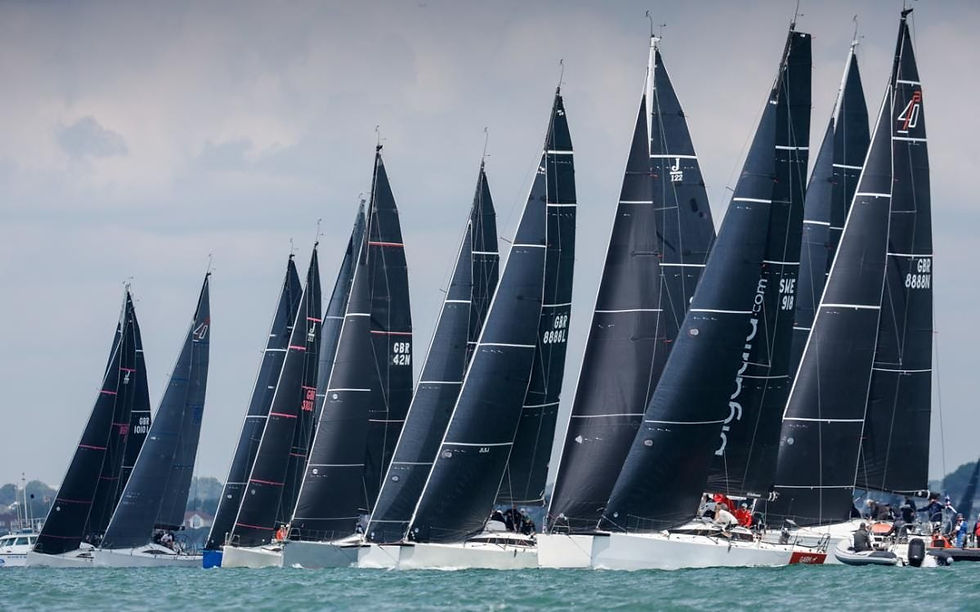
Once you’ve started start thinking about the first shift!
Let’s look at the example:
Take two boats of near identical speed, level off the line, 200 metres apart across the course. Neither crew does anything better than the other. Then the first shift arrives: the wind veers ten degrees. The boat on the right is now about 35 metres further upwind, three lengths for a 12-metre boat. Nothing about the helming changed. Only the rungs moved. On a short inshore course, three lengths at the first mark can decide the race. You cannot make the wind shift. You can decide which side of the boats around you to be on when it does, and that is what the rest of this part is about.
That is the argument of this part. The ladder explains the geometry of the first beat. The wind moves the rungs; pressure, tide, boat speed and manoeuvring decide how quickly each boat climbs them. The windward mark matters less than most crews think.
The ladder - keeps it simple (KISS)
Dave Dellenbaugh, publisher and author of the racing newsletter Speed & Smarts, describes the mechanism precisely: “The amount of gain or loss depends on two things: 1) the size of the shift; and 2) the lateral distance (i.e., ‘leverage’) between the boats.”
The geometry is simple. For two boats initially level, the new upwind separation after a shift is roughly their lateral separation multiplied by the sine of the shift: 200 metres times the sine of ten degrees is about 35 metres. Double the separation and you double the gain, or the loss.
Dellenbaugh also offers a rule of thumb: “As a rule of thumb, a wind shift of Z degrees produces a gain that is roughly 2 x Z % of the separation between boats.” That gives a slightly larger figure, because it expresses the gain in a different way. Both are useful. Do not mix them, and when you convert a gain into boat lengths or decide whether you can tack and cross, know which one you are using.
That is leverage, and it is the least respected number on the first beat. Every metre you sail away from the boats you are racing is a bet on the next shift, and the stake grows with every metre.

Why the windward mark is not the point
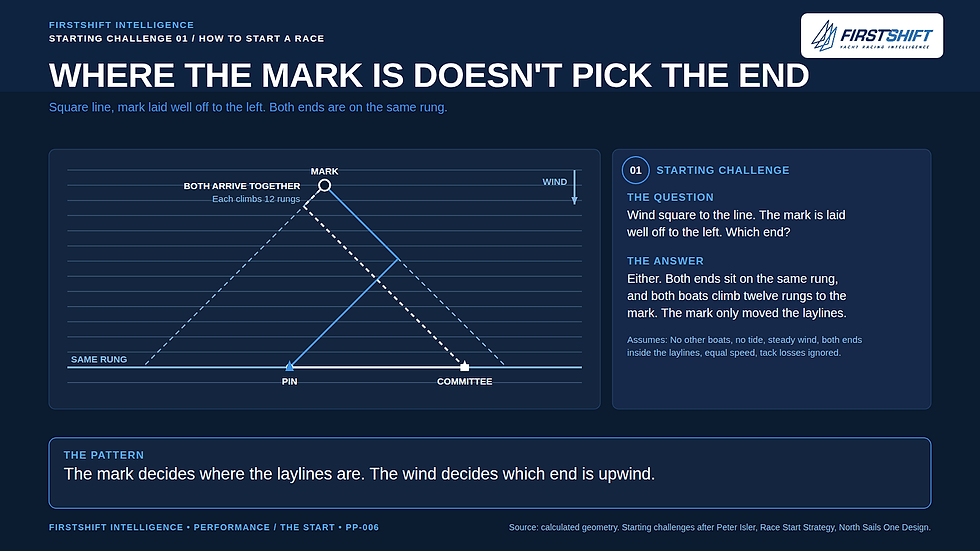
Here is the counter-intuitive part. In a steady, uniform wind with no current, with the same close-hauled angle and speed on both tacks, every route to the windward mark that stays inside the laylines is the same length, if you ignore the cost of the tacks. Tack once or ten times, go left or right, the distance to windward is the same number of rungs and the distance sailed is the same. Move the mark to the left or right and nothing changes except where the laylines lie. One tack becomes longer than the other; the total does not change.
So in those conditions, the position of the mark does not create gains. It defines the box you can play in. What creates gains in real conditions is everything that breaks those assumptions: wind shifts, differences in pressure, differences in current, boat speed, sea state and how cleanly you manoeuvre.
That is why a skewed course is not, on its own, a reason to go one way. It is a reason to know where the edges are. In a steady but uncertain wind, the traditional advice is to sail the longer tack first, which keeps you nearer the middle of the box with the most options left when the wind moves.
The mark matters more as you approach a layline. Once you are on it, most shifts can only cost you: a lift means you have overstood, a header means you now need two more tacks. Stay off the laylines until you are close enough that the next shift is unlikely to change the answer.
Pressure against shifts
The ladder is about direction. Pressure is about speed, and more wind often matters more than a better angle.
The question is always the same: will the extra speed from the new pressure, for as long as you will be in it, gain more than the angle or the extra tack you give up to reach it? As a directional guide, in light air pressure usually wins: a boat in more breeze can be much faster, and it is often worth sailing a worse angle or paying for a tack to get there. In a moderate breeze, with the boat fully powered, shifts usually matter more. In heavy air, more wind may add little speed and a lot of work. Look upwind for darker water, for boats heeling more, for the lanes where the fleet is moving. Then decide whether it is worth the price.
Knowing when to tack
For an oscillating breeze the rule is well known and often ignored: sail the lifted tack, tack on the headers. The detail is in the word header. You are headed when the wind has gone past its average direction, not when it has merely stopped lifting you. If you are ten degrees up and it heads you five, you are still five up. Keep going.
That means you need the average. Take compass headings on each tack from the moment you are on the water and keep taking them. A trimmer or navigator calling “up five” or “down three” is worth more than any amount of instinct.
Then weigh the shift against the price of a tack on your boat, today. That price varies widely: it is usually highest in light air, lowest in a moderate breeze and can rise again in heavy air and waves. A small header in light air may not be worth a tack; the same header in a moderate breeze may well be. Measure it in practice rather than trusting anyone else’s number, including mine.
A persistent shift is a different animal. If the wind is swinging steadily one way, as it can when a sea breeze builds or a front approaches, go towards the side it is swinging to, even if that means sailing a header first. The boat on the inside of the swing keeps gaining on boats outside it. The mistake is to treat a persistent shift as an oscillation and tack back into the middle every time you are headed.
And remember the third starting challenge from Part 1. The first shift will rarely be the last, and the one that matters most is often the one in which the boats finally come together. If you have gained, cash some of it in before you run out of room, and expect a good rival to protect her side rather than let you cross.
Tide on the first beat
A spatially uniform stream adds the same drift to every boat. On its own it does not create separation, but it does change two things that matter: the wind over the water, and each boat’s track over the ground towards a mark that is fixed to the ground. Tide makes gains and losses in three ways.
First, differences in stream across the course. Less foul tide on one side works like more wind on that side. In many tidal venues the stream is weaker in shallower water and turns at different times in different places; in the Solent those differences can be large. Use a tidal atlas and local knowledge rather than a rule of thumb.
Second, a change in stream changes the water wind. A cross-stream alters the direction of the wind over the water, as Part 1 described, and that shift rotates the rungs like any other. The size depends on the numbers. As an illustration, if a two-knot cross-stream reverses to an equal stream in the opposite direction while a ten-knot ground wind stays the same, the water wind changes direction by about 22.6 degrees. Real tides rarely turn that neatly, and the local turn need not coincide with high or low water.
Third, the ground track. On one tack the stream may be setting you towards the mark, on the other away from it. That can make one tack clearly better over the ground. It is not because the tide pushes on the lee bow and lifts the boat. It is because the tide changes where the boat goes over the ground and the wind the boat sails in, at the same time. My essay Should you stop trusting Lee Bow until you know which wind your instruments are showing? sets this out in full, including which wind your instruments are showing you.
Pointing and footing
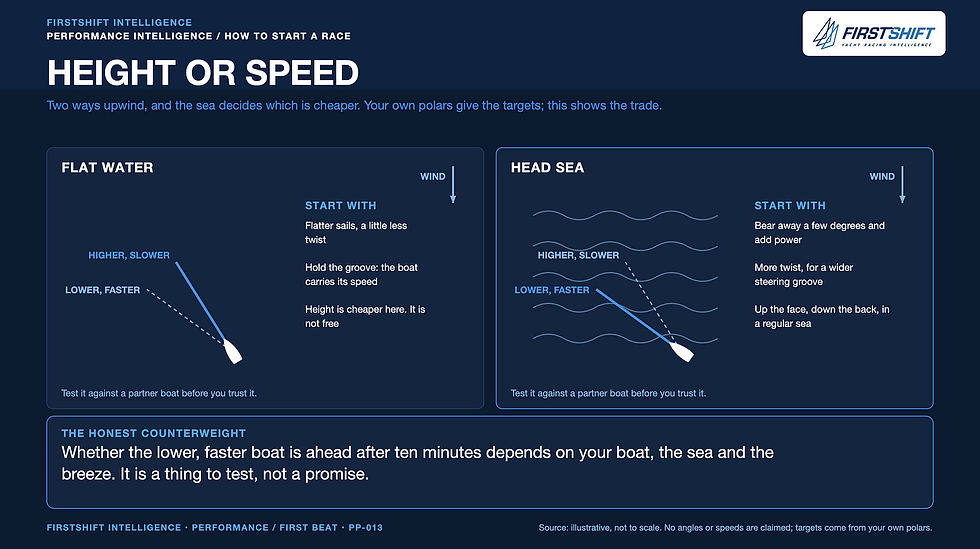
Every boat has two ways to go upwind: higher and slower, or lower and faster. The target is the angle that gives the best velocity made good, and your polars give you a target speed and angle for each wind strength. Beyond that, pointing and footing are tactical choices, and each has a cost. Height is traded for speed and, on some boats, for more leeway.
Point when you need to hold a lane with a boat close to leeward, when you need to squeeze round the mark or across a layline, or when the water is flat and the boat carries its speed easily.
Foot when you need to reach pressure you can see on the water, when you need to break clear of backwind, when there is a sea running, or when the breeze is light and the boat is struggling to keep flow attached.
Sea state
In a head sea the flat-water angle is often wrong. Each wave slows the boat, and a boat pinching into a sea can stop. So bear away a few degrees, add power, and keep the boat moving. In a regular head sea, steering up the face of a wave and bearing away down the back is a useful place to start; the right technique depends on wave direction, spacing and how your boat responds. Ask the trimmers for a little more twist, so the steering groove is wider. Whether the lower, faster boat is ahead after ten minutes is something to test against a partner boat, not assume.
In flat water you can usually point higher and carry speed, with flatter sails and a little less twist. Height is cheaper in flat water. It is not free.
Twist
Twist is how much the top of the sail opens compared with the bottom. It works together with sail depth, sheeting angle and overall power; change one and the others need checking.
As a starting point, more twist when the boat is overpowered, because it spills power from the top of the sail; in a sea, because it widens the groove and lets the helm steer through waves without stalling; and in very light air, when the flow needs an open leech to stay attached. Less twist in medium, flat-water conditions, when you want height and the boat has the power to carry it.
The physics behind this, and why angle of attack matters as much for the keel as for the sails, is in Understanding how hydrodynamics and aerodynamics work together. Once that is understood, the memorable version holds as a first check: when the boat is fighting the water, open the leeches; when it is gliding through it, close them.
Putting it together
Off the line, the first question is not where the mark is. It is where the next shift and the next pressure are coming from, and where the tide is kinder. Sail the lifted tack, stay off the laylines, keep your leverage in proportion to your confidence, and consolidate when you are ahead. The mark will still be there when you arrive. The wind may well not be the same.
Stuart Greenfield FirstShift — Yacht Racing Intelligence From first shift to first place.
Offshore racing is never just about the boat, the forecast, or the routing software.
It is about decisions made under pressure, in changing conditions, by tired people trying to keep the boat moving fast and safely in the right direction.
That is where races are won and lost.
At FirstShift, my aim is simple: to help owners, skippers and crews race offshore with more clarity, more confidence, and better preparation whether that is a RORC Channel race, a Fastnet campaign, or your first serious step into offshore racing.
Thanks for reading Firstshift - yacht racing intelligence! This post is public so feel free to share it.


Comments