
Is there a battle between IRC and ORC?

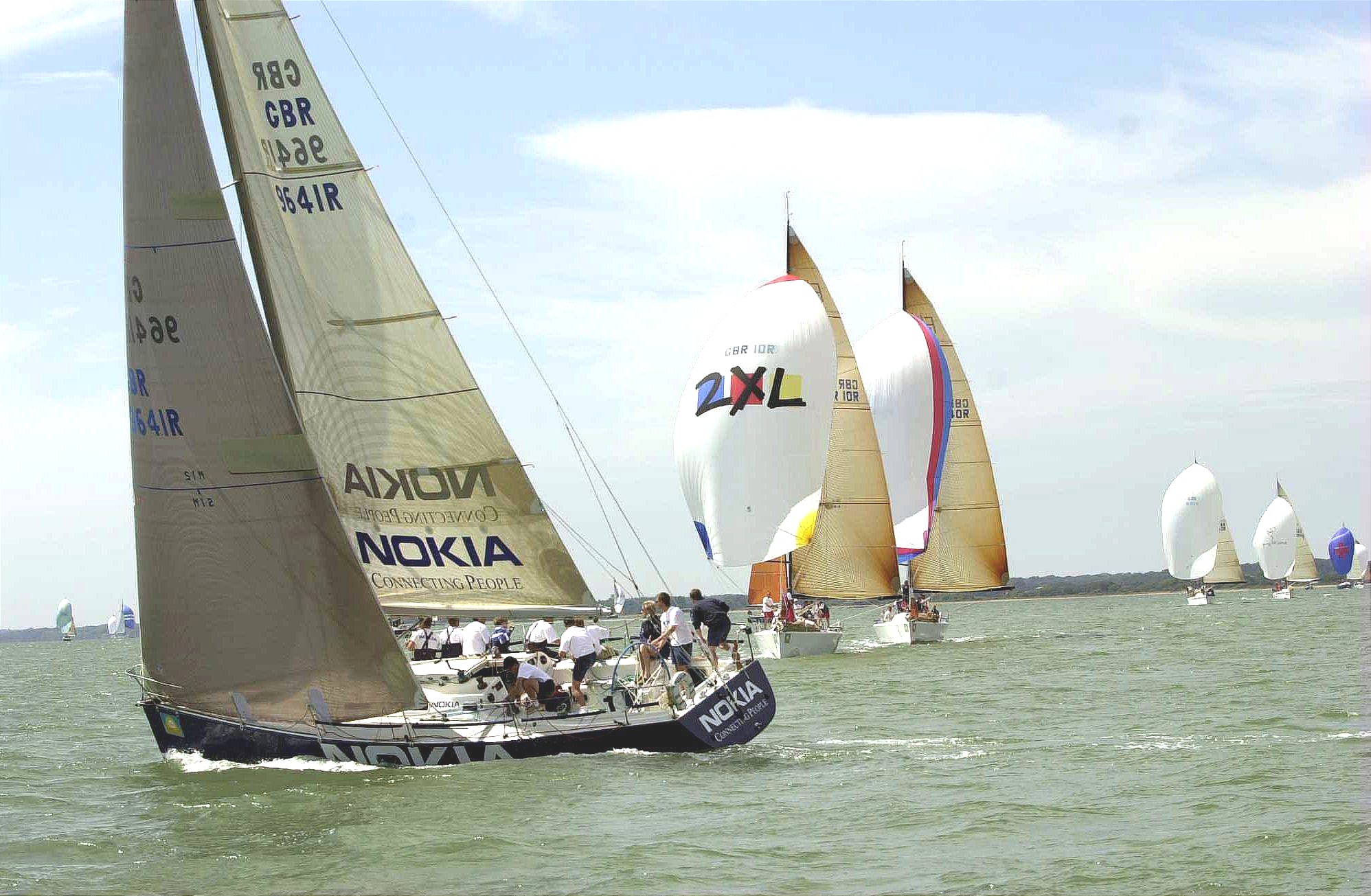
2XL the Farr 40 competing in the Commodore’s Cup 2000
The first time I understood how completely a handicap rule could shape offshore racing, I wasn’t in a committee meeting.
I was trying to win the Commodore’s Cup.
At the time, David Murrin and I owned the Farr 40 2XL together. It was a serious commitment for both of us, which made the uncertainty surrounding the competing rating rules far more than an abstract committee debate. We were not choosing a paint colour. We were placing a bet, with real money, on which rule and which events would still be standing in five years.
I had owned Barking Mad, the Swan 40, also at the time and I knew the reality of funding a campaign yourself, assembling a large crew and trying to stay competitive against ever better-funded programmes. It was exciting. It could also be expensive and lonely. The Farr 40 was different. It wasn’t only a boat. It was an idea. Around the world, owner-drivers were buying into a genuinely international one-design with strong fleets, professional organisation and close racing. The attraction wasn’t just the hull and rig design. It was the confidence that came from joining something with momentum, and knowing there would be a fleet to race against and a market if we ever sold.
Looking back, that confidence turned out to be the whole point. At the end of the 1990s it was in short supply, because nobody knew with confidence which rule the sport was going to keep. A quarter of a century later the fog has cleared, and offshore racing has arrived somewhere none of us predicted. It now has two thriving international rules, and the one that rates the most boats in the world is not the one that rates its most famous races. How we got there, and whether it can last, is a story about confidence far more than mathematics.
The names changed faster than the uncertainty
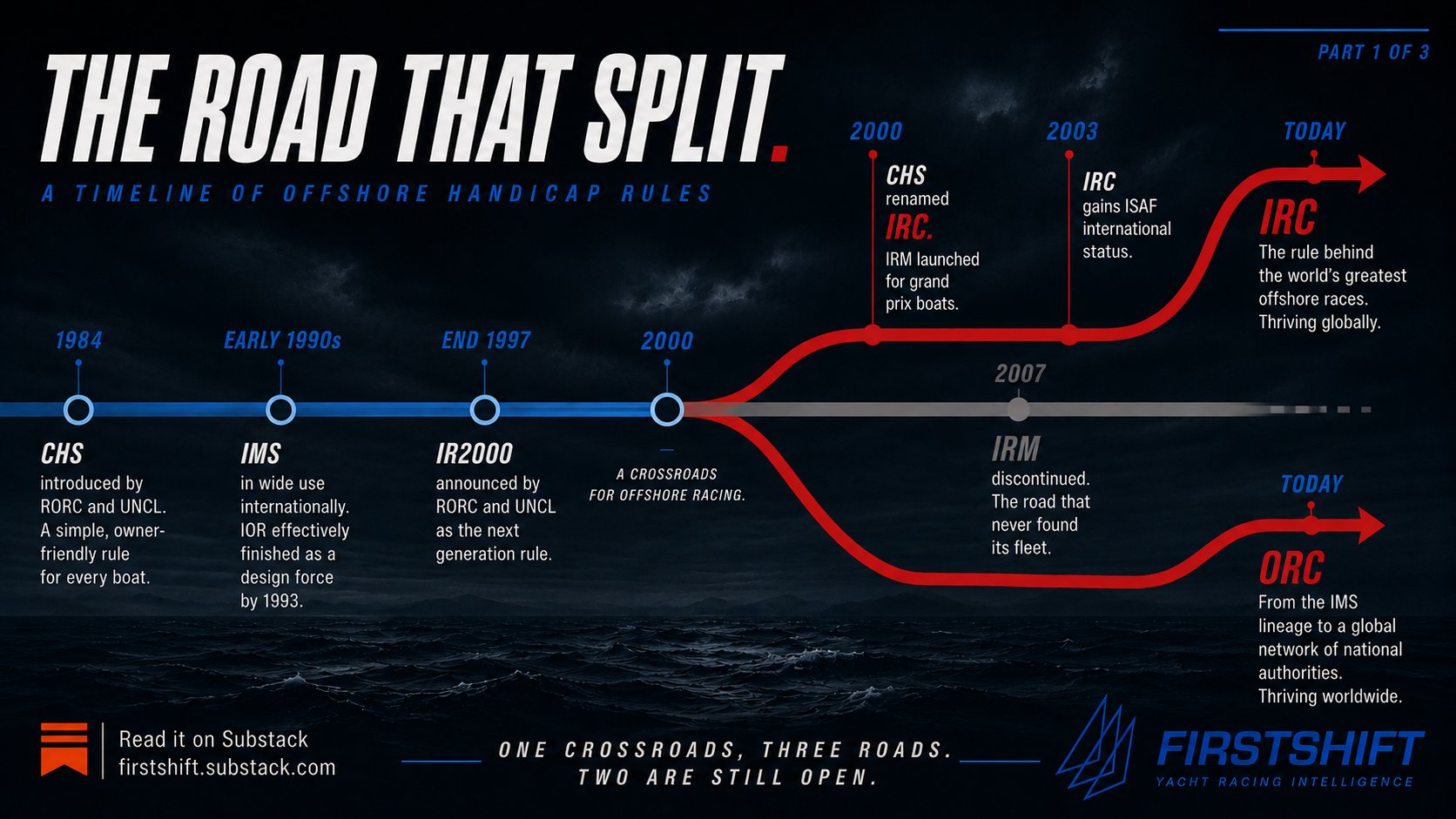
The Royal Ocean Racing Club and France’s Union Nationale pour la Course au Large introduced the Channel Handicap System, CHS, in 1984, a deliberately simple, owner-friendly rule that could rate almost any shape of boat. Through the 1990s the RORC also ran the International Measurement System, IMS, the scientific, measurement-and-VPP rule that had grown out of the American tradition. The old International Offshore Rule (IOR) was, in practice, finished as a design force by 1993. At the end of 1997 the RORC and UNCL announced IR2000, and in 2000 the picture changed again: CHS was renamed IRC, and a brand new published rule, IRM, arrived for grand prix boats. IRC took international status from ISAF, now World Sailing, in 2003. IRM was discontinued at the end of 2007, having never gained much support beyond a relatively small Solent-based fleet.
I remember it, honestly, as IMS and IRC competing for the future, though the truth was messier. When I first became involved, the real choice was usually IMS or CHS. Then CHS became IRC, IRM arrived for the grand prix boats and IMS had not yet gone away. From an owner’s seat, the names changed faster than the underlying uncertainty. You were not tracking a rule. You were tracking a moving target, and trying to guess where it would come to rest.
Around this time I joined the RORC Committee. People imagine committee members spent their evenings arguing over handicap formulas. The reality was less dramatic. The Rating Office, quite rightly, owned the mathematics. Those of us on the Committee worried about the direction of the Club. What I saw was not a war between visionaries and traditionalists. It was a group of intelligent people, all wanting the same thing, and none of them certain how the story would end. That uncertainty was not confined to committee rooms. It was on every dock in Cowes, and it had a simple practical form: should I build, should I wait, and will this rule still exist when I want to sell.
When the Admiral’s Cup was gone
If one event captured that period for me, it was the Commodores’ Cup.
The Commodores’ Cup began in 1992, a three-boat international team event run under IMS, conceived as a more Corinthian answer to the Ton Cup format, with strong owner-driver involvement and a more attainable level of spending. It was never formally created to replace the Admiral’s Cup, which was still running when it started. But to those of us who remembered the Admiral’s Cup at full strength, with nineteen national teams and serious selection trials just to be chosen, the newer event could never feel like an equivalent. It carried some of the structure and much of the camaraderie. It did not carry the same weight. That’s the way it was, however, it was the achievable ‘top of the game’ in the UK at the time so I went for it.
I skippered 2XL at the 2000 Commodores’ Cup, which happened to be the first edition ever run under the newly introduced IRM. The event’s last IMS edition had been 1998, and by 2002 the same regatta had already moved on again, this time to IRC. So I took a grand prix campaign to a major championship under a brand new published rule, and then watched, within a couple of seasons, as the event dropped that rule in favour of the confidential club rule that would shortly bury IRM altogether. Few things teach you the instability of that era faster than watching the rule you have just optimised for get discarded while you are still paying for the sails.
A grainy picture of Farr 40’s racing in the Solent. 2XL is obscured by the orange sails!
IRM is the part of this story that history has quietly buried, and it is the most instructive. Where IRC kept its mathematics confidential, IRM did the opposite. The rule text and the rating spreadsheet were published openly on the RORC website. Anyone with a home computer could download it, see exactly what it rewarded and design towards it. It deliberately favoured a lighter, stiffer, more powerful boat, the sportboat-influenced style then coming into fashion, and the Farr 40 fitted it well. It was transparent, modern and openly racing-oriented. On paper it looked like the future, and clever people said so. Writing a primer on the new rules in December 2001, the designer Mark Mills judged:
“Whatever rule enters widespread use internationally in future, I would be surprised if it didn’t integrate many of the core elements of IRM.”
He was describing a simple, transparent, spreadsheet-based, time-on-time rule, and it is a fair description of a good rating system. Reading those words today is fascinating, because history chose a different path. IRM never established itself and was withdrawn at the end of 2007. The rule that grew into the handicap system used across the world was IRC, whose defining feature was the opposite of transparency: its mathematics stayed secret, and stays secret still. Nobody at the time thought they had backed the wrong horse. You rarely do. You find out later.
The facts of where the rules are today
Twenty-five years on, offshore racing is not searching for a rule. It has two mature, thriving, international ones. They have not settled into a neat hierarchy, though. They have settled into a paradox.
By population, ORC is now much the larger, with more than 14,000 certificates issued to some 9,600 boats across 45 countries, and still growing. It descends from IMS but has evolved a long way from it, running a modern velocity prediction program, offering full measurement through ORC International and an easier route through ORC Club, with several ways of scoring a race depending on the conditions expected. Its size is not one homogeneous racing fleet. Most of it is club, cruiser and short-handed racing rather than the grand prix end, as the breakdown below makes clear.
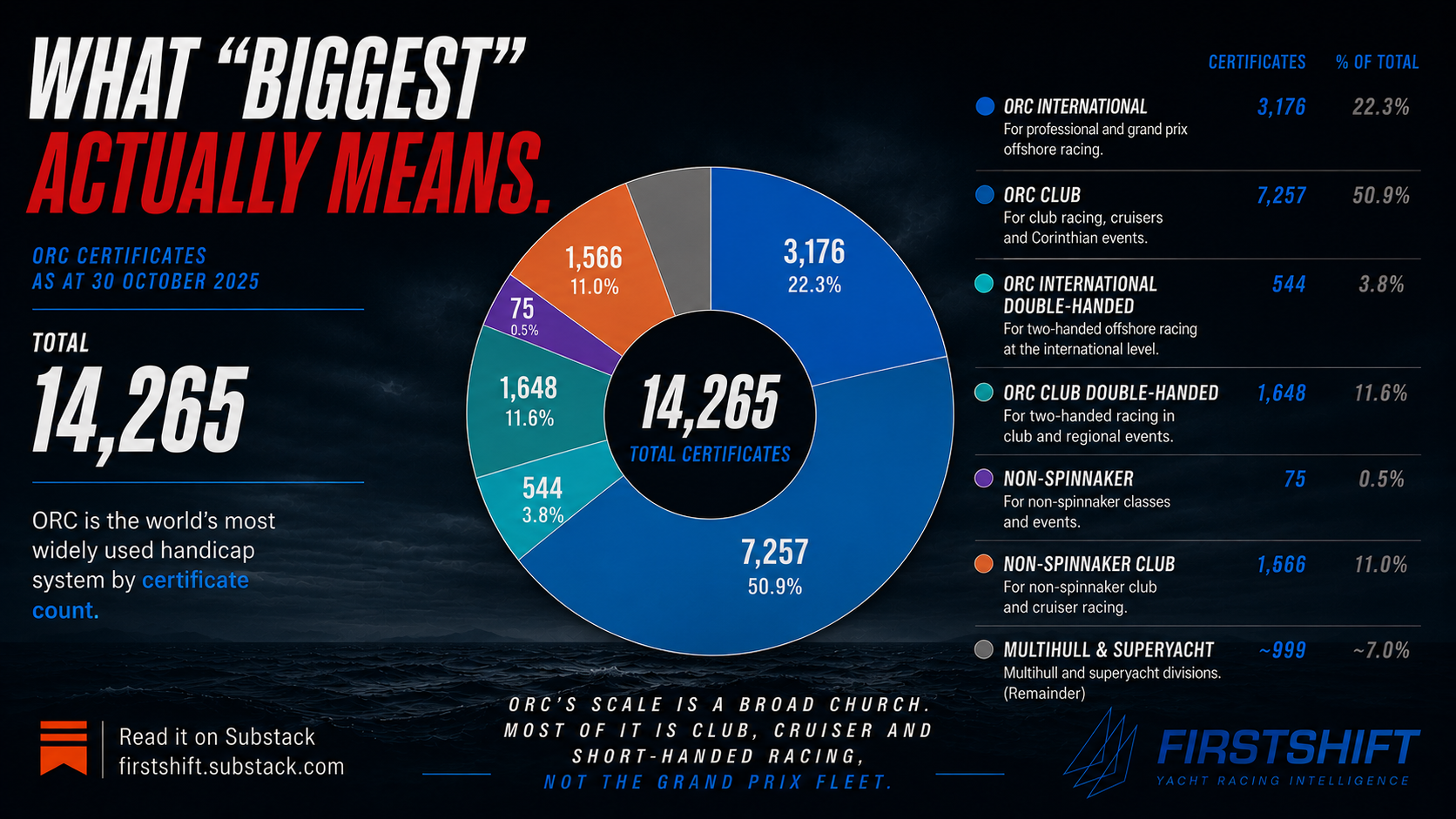
ORC’s scale is a broad church. Most of it is club, cruiser and short-handed racing, not the grand prix fleet.
By comparison IRC is smaller, and at the moment slightly shrinking: around 3,500 boats in 35 countries, down a little on the year. It keeps its formula confidential to discourage designers from optimising against it, issues a single number, and is deliberately simple to administer.
So ORC is almost three times the size of IRC by rated boats. That is not a close-run thing. And yet, if you list the offshore races a sailor most wants to win, you are largely listing IRC events: the Rolex Fastnet, the Rolex Sydney Hobart, the Rolex Middle Sea Race, the RORC Caribbean 600, the Rolex Giraglia, the Maxi Yacht Rolex Cup, Cowes Week, and the revived Admiral’s Cup, which returned in 2025 under IRC.
This is the paradox at the heart of the rating world today. The most widely used international rating system and the rule behind many of the sport’s most prestigious trophies are not the same rule. A newcomer would assume the biggest rule owns the biggest races. It does not.
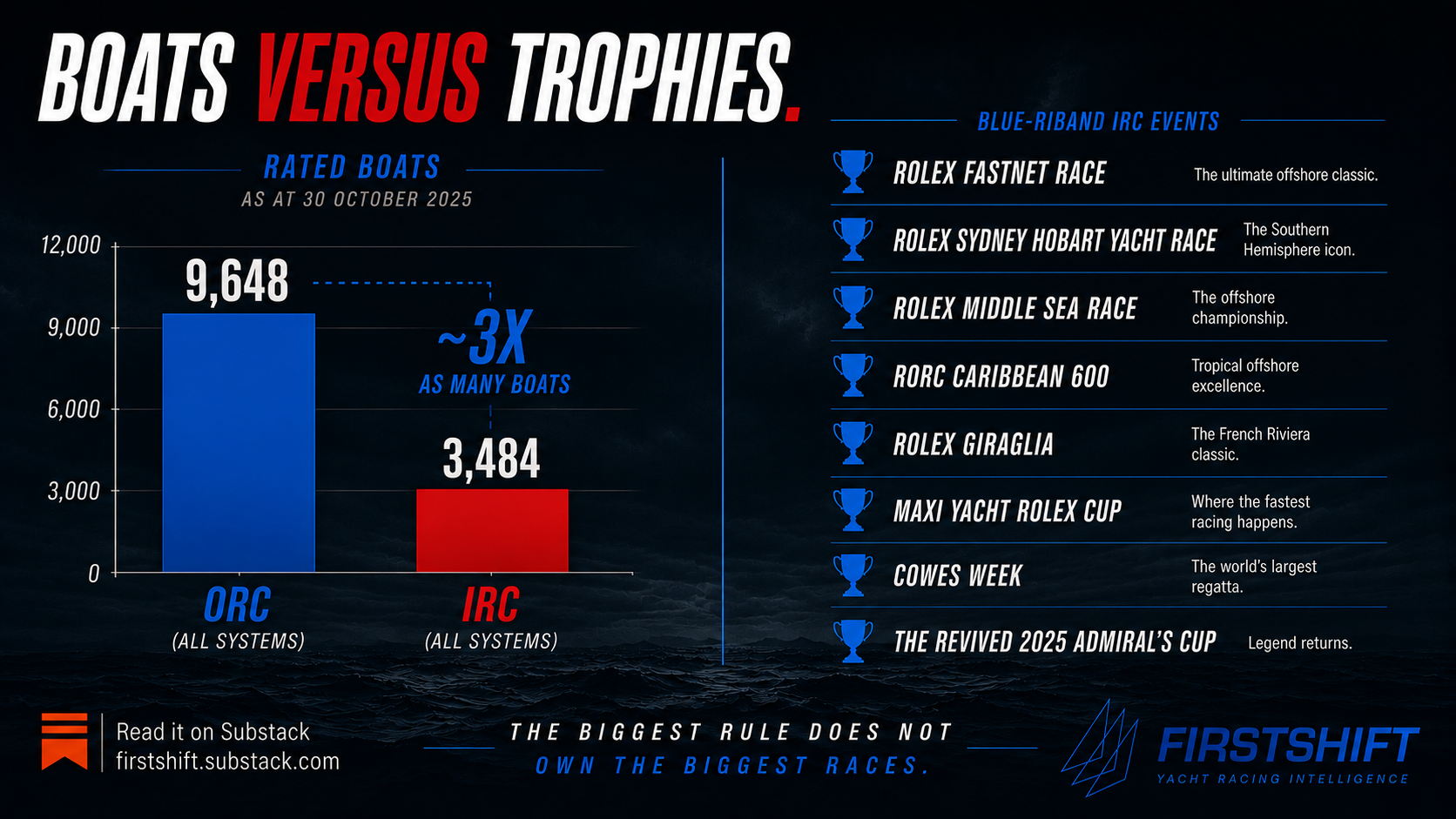
The biggest rule does not own the biggest races.
The map beneath the numbers
ORC owns continental Europe, most of the Mediterranean and the Baltic, and it has grown steadily in the United States alongside the domestic rules. IRC owns the United Kingdom, the great offshore classics, and a belt of territory that surprises people who still think of it as a parochial British system. It is strong in Hong Kong, Singapore and the major South East Asian regattas, it rates the Rolex Sydney Hobart in Australia, and from 2025 it scores the Caribbean’s marquee events in partnership with the local CSA rule.
The granular detail is where it turns political. Germany runs essentially no IRC events, yet German owners still take out IRC certificates so they can race abroad. Italy, a deep ORC stronghold, had only around 157 active IRC certificates at last count. France, IRC’s own co-parent through UNCL, has slipped slightly. Ireland’s leading events have declined dual scoring even after ORC offered free club certificates to encourage take-up, and there has been similar free-certificate pressure from ORC in Turkey. None of this is dramatic in isolation. Together it sketches a world in which the two organisations are not so much sharing the sport as quietly contesting its borders, region by region and certificate by certificate. The single figure of “almost three times larger” is true, but it is an average laid over a patchwork, and the patchwork is where owners actually live.
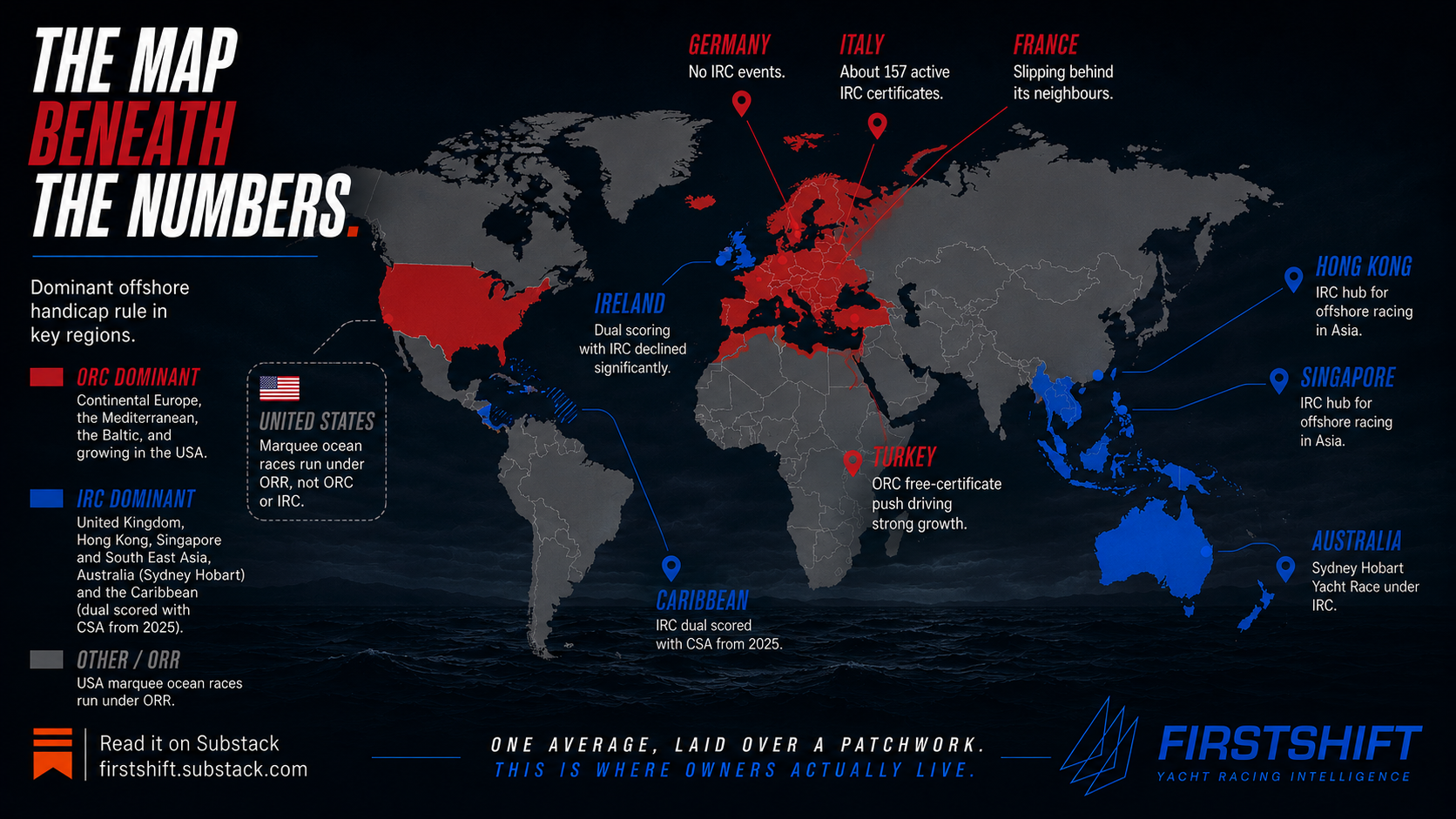
One average, laid over a patchwork. This is where owners actually live.
The American complication, which makes the point sharper
For American readers, all of this will sound familiar, because the United States has lived with rating pluralism longer and more deeply than Europe. US Sailing administers not two systems but several, including IRC, ORC, PHRF and, above all, the Offshore Racing Rule. And the rule behind America’s greatest ocean races is neither of the two this piece compares. The Transpac, Newport Bermuda, the Chicago to Mackinac and the Pacific Cup all run under ORR, increasingly with forecast-based scoring that adjusts each boat’s handicap for the weather it is actually expected to meet.
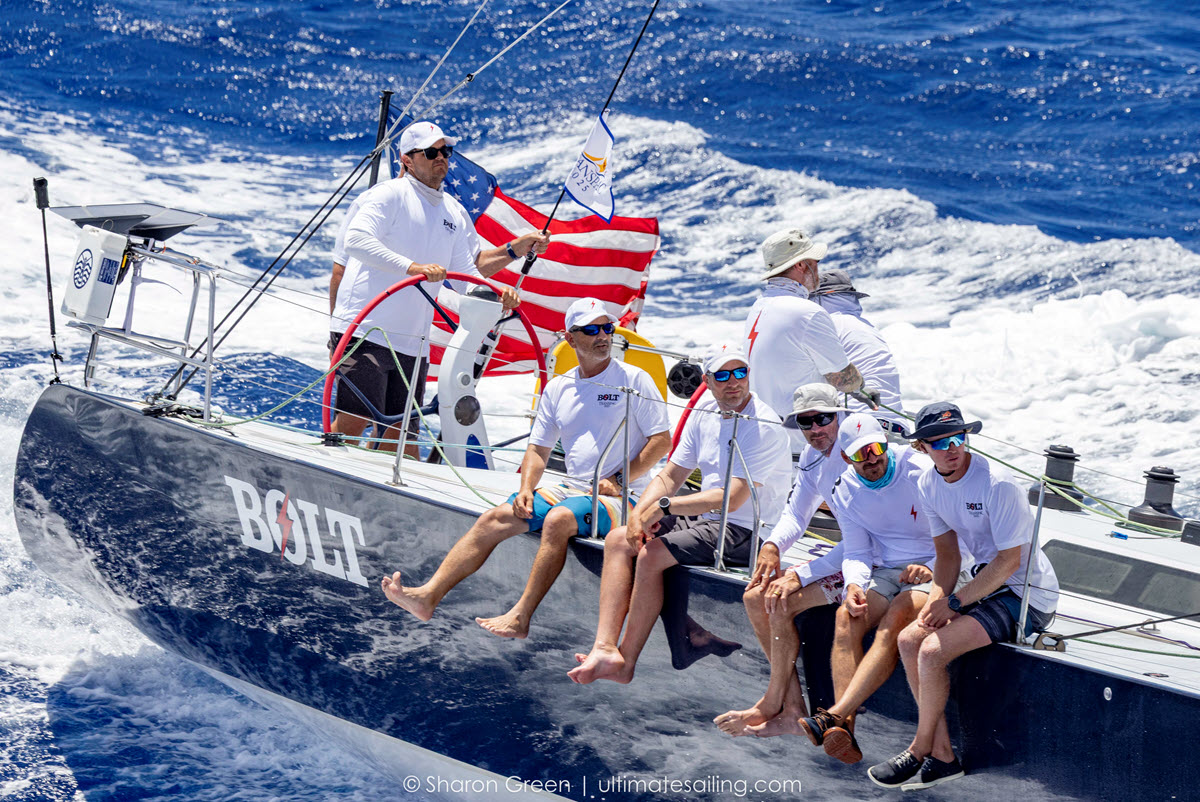
America’s greatest ocean races, the Transpac and Newport Bermuda among them, are run under neither IRC nor ORC, but ORR.
So the American sailor already knows in the bone what the rest of the world is learning: one sea does not mean one rule, and the rule with the most boats is not the rule with the most silverware. The United States is living proof that a sport can carry several rating systems at once without collapsing. Whether that is reassuring or exhausting rather depends on how many certificates you are paying for.
Two philosophies, honestly compared
The two main international rules embody a genuine disagreement about how to be fair, and there is a lot of friction between the two.
An ORC certificate
ORC trusts the model. It measures the boat thoroughly, runs the numbers through a published velocity prediction program, and produces performance predictions across a range of wind speeds and angles. Its promise, in the organisation’s own words, is “an equal chance to win”, built on physics you can inspect and challenge. That transparency is its strength and its burden. An owner who feels wronged can interrogate the calculation. A designer who wants to optimise can study the same document.
IRC trusts the outcome. It measures selectively, keeps the formula closed, and hands you a single number. Its promise, in the phrase the RORC likes, is a rule “made by sailors for sailors”, judged less on theoretical perfection than on whether the racing it produces feels fair across a mixed fleet of different ages and types. Its opacity is its strength and its vulnerability. Because you cannot design straight to the rule, extreme optimisation is discouraged. But an owner who thinks his number is wrong has little external recourse, and no spreadsheet to argue with.
Both work. Both produce close, competitive, hard-fought racing. Neither is a con, and the tired dock wisdom that one is honest and the other a fix says more about the speaker’s last result than about the rules. The honest summary is that they solve the same problem from opposite ends, and a boat optimised hard for one will rarely be optimised for the other.
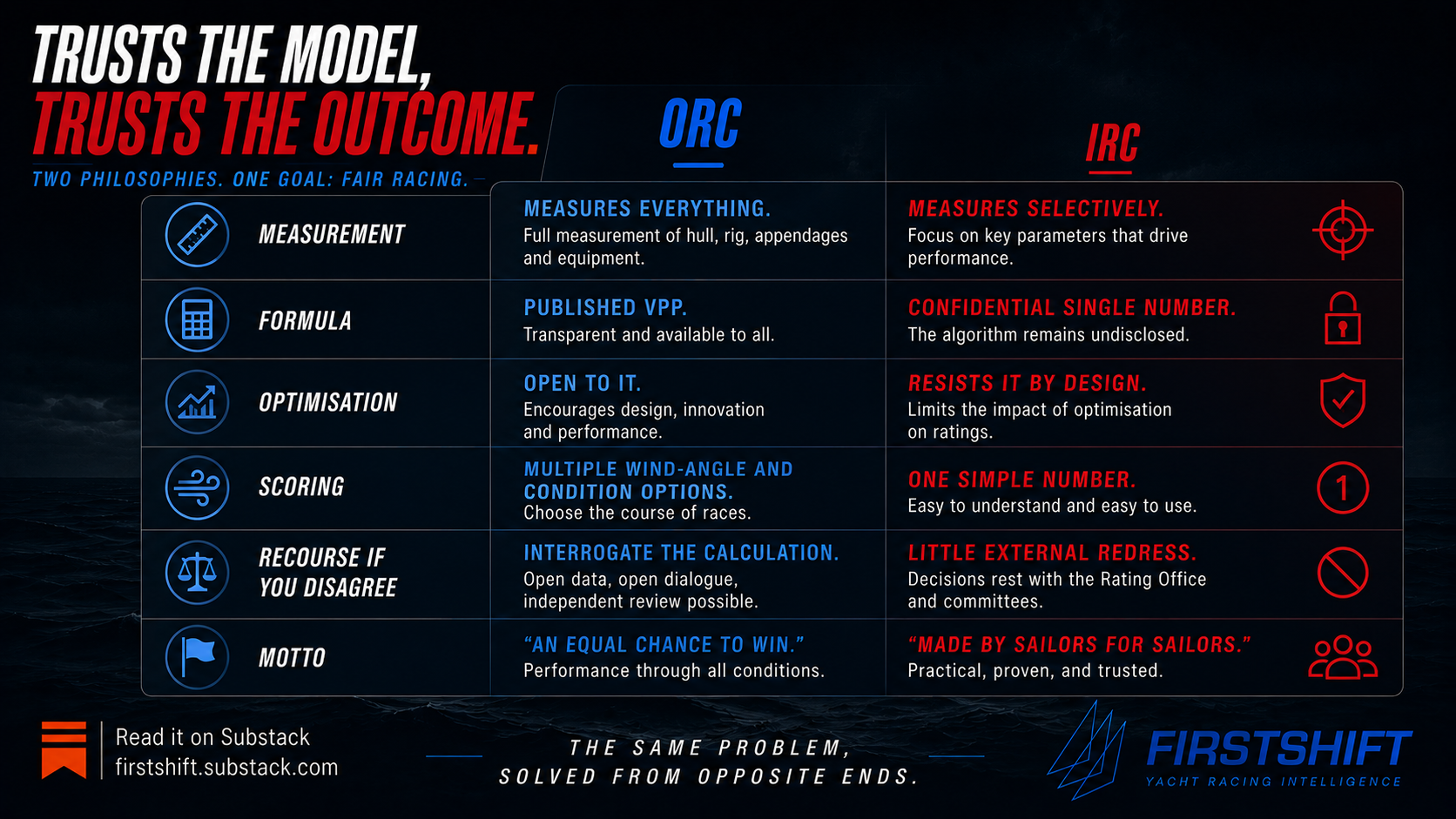
The same problem, solved from opposite ends.
Is the sport drifting together, or apart?
The interesting question is not which rule is better. It is whether their continued separation still serves the sport, and there is real evidence pointing both ways.
Convergence is not a fantasy. It has been tried at institutional level before. At ISAF’s urging, the RORC and ORC opened merger discussions in February 2010, aimed at forming a single company to manage both rules. In 2012 the ORC, US Sailing and the RORC Rating Office went further and explored a Universal Measurement System, a common measurement passport from which different rating rules might draw. Neither produced a merger. But they prove the idea of a shared foundation is old, serious and institutionally respectable, not the daydream of a man writing in a marina bar.
And dual scoring, once a curiosity, is now spreading. The Aegean 600 has scored under both major rules. In October 2025 IRC formalised a dual-scoring partnership with the Caribbean Sailing Association across the region’s marquee inshore regattas. Jason Smithwick, Director of the RORC Rating Office, framed the direction of travel like this:
“The dual-scoring system at the RORC Caribbean 600 and Nelson’s Cup has already shown how well the two rules can complement each other. Together we’re giving sailors more ways to compete while keeping the essence of Caribbean racing front and centre.”
He was speaking about IRC alongside the Caribbean’s own CSA rule rather than ORC, which is telling in itself: the instinct now is to let rules coexist and score twice, not to force a single winner.
But dual scoring is an experiment, not an answer, and its own advocates know it. The RORC’s committee minutes record the obvious problem: at a dual-scored event the rule with the larger local fleet tends to dominate the trophies simply by weight of numbers, which, given the regional patchwork above, is precisely why some countries have kept their distance. And scoring one race under two philosophies can hand you two different overall winners from the same fleet on the same course, both mathematically correct, which is a strange thing to explain at a prize-giving.
The case each way, without bias
The argument for keeping two rules is stronger than the tidy-minded like to admit. Competition between systems drives development in a way a monopoly never would. The two rules genuinely serve different markets, one built on published physics, the other on closed simplicity. And a single global rule authority would carry a real systemic risk: one serious error, one political falling-out, one bout of type-forming, and almost the entire international fleet would feel it at once. Plurality is insurance.
The argument for greater unity is just as real. An owner who races internationally increasingly needs both certificates, IRC for one classic and ORC for a national championship, and pays and measures twice for the privilege. Much of the underlying boat data is the same, yet the formats, declarations and assumptions differ. The sport now routinely communicates two versions of the word “overall”, which does nothing for the newcomer or the sponsor trying to understand who actually won. And underneath all of it sits the point I felt personally in 1999: fragmentation quietly taxes confidence. Two systems today do not recreate the chaos of the late 1990s, when four names were in play and the great team events were losing their identity. But they do reproduce a slice of the same strategic hesitation, and hesitation is exactly what keeps an owner from commissioning the next boat.
Each rule also carries its own strategic danger. IRC’s strength is concentrated in the prestige events and its historic territories while its worldwide boat count slipped a little in 2025. A rule can hold the greatest trophies and still, slowly, lose the ordinary club fleets that feed them. ORC’s danger is the mirror image. Volume does not automatically confer prestige or simplicity, and a system offering full measurement, multiple wind-angle predictions and several scoring options can look intimidating to the very amateur it wants to attract. Its challenge is to turn certificate growth into a story an ordinary sailor, and an ordinary sponsor, can tell in one sentence.
Back to how it was for the punter!
When David and I owned 2XL, we thought we were buying into the future we were both young just 40 years old and probably wanted to trust the system more than we shoukd have. We did not pick the winning rule. We could not have. IRM, the rule most in fashion for a boat like ours, no longer exists. What we actually bought was insurance of a different kind. The Farr 40 was a recognised international one-design, so the boat had a purpose and a value that did not depend on any single handicap formula surviving. The rating landscape could shift around it, and it did, and the boat still had a fleet to race in and a market to sell into. That, far more than any clever rating bet, is what protected us.
Which is why the rule has never been the thing I lose sleep over. Whether I have been racing Silver Shamrock, Morning After or coaching owners to get the best from their own boats, the challenge has been the same. Understand the boat. Prepare properly. Build the right team. Make fewer mistakes than everyone else. Those principles have survived IOR, CHS, IRM, IRC and ORC alike, and I suspect they always will. The certificate has never once sailed the boat.
So I will not tell you which rule should win, because I do not think that is the real question, and I do not think it has a single answer. Both IRC and ORC work. Both are trusted by thousands of owners. The sport has arrived, without anyone quite deciding it, at a settlement where the biggest rule and the grandest trophies belong to different systems, and where the United States runs most of its great races under a third rule entirely. That is not chaos. It might even be healthy. But it is worth asking, honestly and without tribal loyalty, whether two parallel systems, two certificates and two versions of “overall” still serve offshore racing better than a shared measurement foundation with a choice of scoring on top.
The rule was never what made offshore racing great. What made it great were the owners who kept buying boats, the crews who turned upon deck cold and wet at three in the morning, and the clubs and volunteers who somehow held the whole improbable thing together. They are the people who still believe that days at sea, chasing an invisible finish line against boats they may never even see, is one of the finest tests there is. The sea has always been big enough for more than one good idea, and it clearly has room for two rating rules, or three, or five. The only thing offshore racing cannot afford is to give the next owner one more reason not to race.
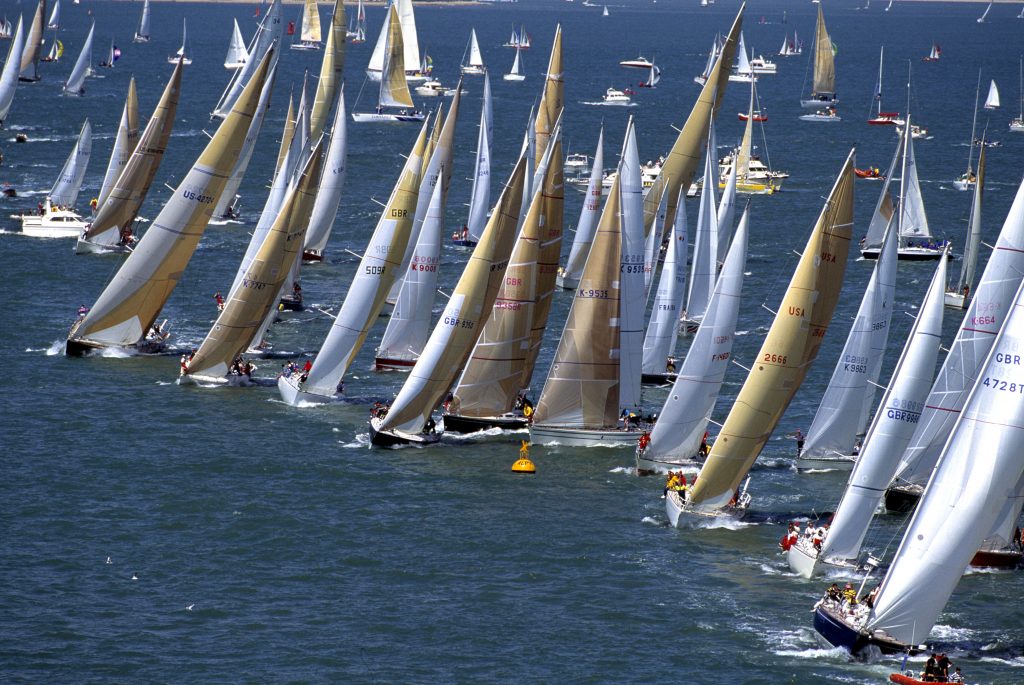
Handicap rules do not make great offshore racing. Owners, crews, clubs and volunteers do. Fastnet start 1980’s


Comments