
RORC Cherbourg race: Just 75 miles, how complicated can it possibly be?

There is a particular danger with the RORC Cherbourg Race and I don’t mean the shipping, the Channel tide or arriving at the French coast in the dark. It simply looks too easy. It is only about 75 miles from Cowes; start off the Royal Yacht Squadron, get yourself out of the Western Solent, cross the Channel and finish inside Cherbourg. outer harbour. Compared with St Malo, the Fastnet, the Myth of Malham or the Round Britain and Ireland Race, there are not many corners and apparently not that many places to get it horribly wrong. So how difficult can it possibly be? Quite difficult, actually, and perhaps more importantly it is one of those races where a fairly small error in timing can change the race you are sailing altogether.
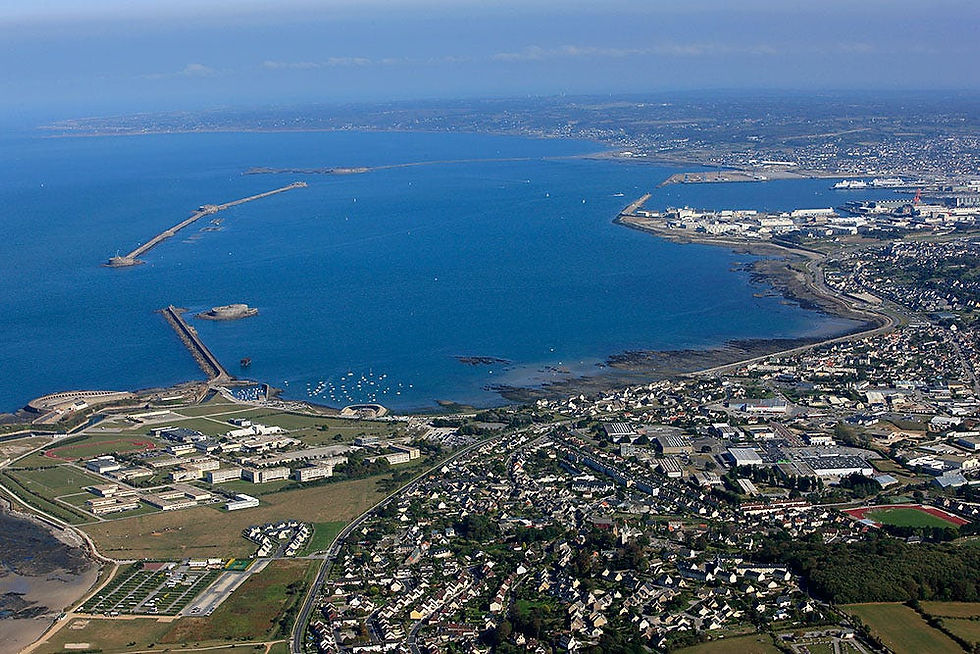
Cherbourg’s Grande Rade and inner harbour: a vast artificial roadstead and enclosed port system, begun under Louis XVI, driven forward and completed under Napoleon III — built over more than a century to give France a fortified deep-water refuge opposite England, and today one of Europe’s most remarkable harbour landscapes.
I remember one Cherbourg Race particularly well because we spent most of the night believing we were doing a reasonably competent job and then, with the harbour almost in sight, discovered that the most complicated part of the race was still ahead of us. Some of the exact detail has inevitably blended with plenty of other Channel crossings over the years, but the underlying story is real and, more importantly, so is the navigational problem.
It was about 1730 on Friday evening and we were motoring out of Cowes Yacht Haven towards the Squadron line. It was drizzling, the sky was already fairly dark even though there were still a couple of hours of daylight left, and the wind was somewhere around 240 degrees at perhaps 10–12 knots. There was also a lumpy sea left from rather more wind earlier in the day and the forecast suggested the breeze might get lighter during the evening. At least the tide was beginning to turn in our favour down the Western Solent, so at that stage there was nothing particularly unusual about the race at all.
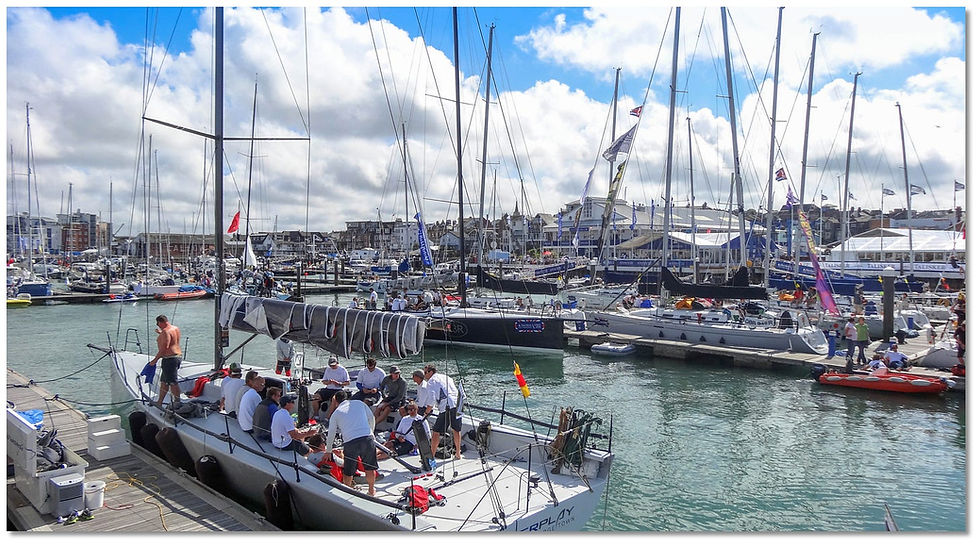
Cowes Yacht Haven - getting ready to race
Getting out of Cowes is only the beginning
The first problem was the normal Cowes one. The tide was beginning to turn nearer the Island while there was still less helpful water farther out, so there was an obvious attraction in starting reasonably inshore, except that if you get too close underneath Cowes you can quite easily trade the tidal advantage for less wind. We compromised, although there was the normal bit of pushing and shoving on starboard after the start and we ended up slightly farther inshore than intended, tacked onto port, dipped a couple of boats and then came back onto starboard to work down towards Gurnard.
Nothing particularly exciting had happened, but in reality two races were already going on. There was the obvious race against the yachts around us, where we were thinking about clear air, boat speed, crosses and trying not to do anything stupid, but underneath that was another race which was eventually going to matter rather more: the race against time. In a heavily tidal race, when you arrive can matter almost as much as where you arrive, because the time determines which tidal stream you get when you reach the next part of the course.
By Newtown and then Yarmouth the breeze was still patchy. We were on the J2 and full main, trying to keep the boat powered through the leftover chop, and it was one of those situations where crew weight is constantly moving around, the boat can look perfectly respectable while quietly sailing several per cent below the number the polar says it should be doing. That might not sound terribly significant, but over several hours it becomes important.
For those newer to offshore routing, this is the one basic explanation I think is worth making because it underpins almost everything that follows. A polar is not really telling you how fast the boat will sail; it is telling the routing program how fast you have told it the boat should sail at a given true wind speed and angle. If the routing assumes 100 per cent of that number and the sea state means you are actually achieving 94 or 95 per cent, you are not simply travelling a little more slowly. Your ETA changes, and on a tidal race that change to ETA may put you into a different part of the tidal cycle. Anyone who races and routes offshore regularly knows all this, but the interesting part at Cherbourg is how quickly a modest performance error can propagate into a completely different final solution.
At Hurst we worked in towards the Castle and then back towards the Needles Channel, with another fairly unpleasant rain squall going through and a little more breeze. It was getting dark and there was plenty of tide taking us down passed the Shingles, so the first significant offshore question was no longer simply how quickly we could get through the Needles an to Fairway buoy, but where we actually wanted to do when we got there.
The Needles and the first real decision
Once over the Needles ‘bridge’ you know Cherbourg is obviously southeast, but that does not necessarily mean immediately sailing southeast. We carried on west with much of the fleet, using the remaining stream. The shortest geographical route and the fastest route through moving water are obviously not the same thing, but the more interesting question for an experienced navigator is how far west, for how long, and how much does that answer change if our ETA farther down the course is wrong by thirty or forty minutes? That is a much more useful Cherbourg question.

Simplicity itself - what could possibly go wrong?
In the Channel
Once we were properly into the Channel the fleet spread out, the navigation lights became increasingly difficult to identify in the rain and AIS started doing what AIS does particularly well offshore: showing you what everybody else appears to think is happening. The wind began going north and eventually the apparent angle opened sufficiently for us to consider the #Code Zero, so there was the normal disturbance on deck getting the sail ready, changing over and getting everybody settled again. Once it was up the boat accelerated, we bore away and everything immediately felt considerably better.
Around us were several broadly similar boats solving the same problem in slightly different ways. Some stayed higher with jibs, others were sailing hotter or lower under Codes and, viewed simply on AIS, a few looked as though they were making a much more sensible course towards France than we were. That can be very seductive, particularly now that AIS gives us such a good picture of the fleet. I have written before about the way routing software has encouraged offshore boats to converge on the same answers and AIS adds another layer to that because you can now see another competent boat doing something different and immediately start wondering what they know that you don’t. Sometimes they know something, sometimes they are simply wrong, and sometimes they have a different sail inventory, polar, performance level or strategic objective and their solution is perfectly sensible for them but not necessarily for you.
I covered the broader limitations of GRIBs and routing in The ‘route’ of all evil or why GRIB files are barking mad, and the performance side in How to build a polar for the boat you actually sail. I do not want to repeat those arguments here. What Cherbourg adds is something more specific: arrival-time sensitivity. A relatively small error in either the wind model or the boat-performance model can move you into a different tidal phase at the French coast, and once that happens the optimum route itself may move.
Our #Code Zero illustrated this quite nicely. For a while it worked extremely well, but as the sea became more awkward the sail started loading and collapsing, the boat would accelerate and then lose momentum again as the next lump took the apparent wind out of it. Eventually the real advantage had disappeared and we went back to the J2. That was not simply a sail-selection issue; it meant the performance model we had used earlier was no longer describing what the boat was actually achieving, and if that difference persisted for long enough I wanted another routing. I did not particularly care that our original purple line might now be half a mile away. What mattered was whether our revised ETA meant that we were no longer going to arrive at Cherbourg in the same tide. (Then you couldn’t get a new grib, today with Sat systems so much easier and costs effective the game has changed again)
The middle of the Channel was not actually the difficult bit
Somewhere later in the night another gust came through and the wind went back towards the south-southwest, so we were suddenly beating again in something like 15–20 knots. It was properly dark by then, the moon had more or less disappeared, the sea was quite uncomfortable and boats began making different decisions. A couple tacked while some carried on and we carried on with them.
At that stage I think we felt we had largely understood the race. We had got out of the Solent, survived the first major tidal decision, gone through the Code Zero phase, returned to the J2 and were now well across the Channel. There was still racing to do, obviously, but France was not very far away and subconsciously the race felt as though it was beginning to resolve itself.
Then dawn started appearing and eventually the Cherbourg peninsula emerged through the murk. A little later we could see the cranes and bits of the harbour, and that is one of the slightly dangerous psychological moments in offshore racing because nothing has actually become easier but the destination is now visible. You have stopped thinking quite so much about crossing the Channel and started thinking about getting into the harbour.
We had not finished. In fact we were about to spend nearly another two hours discovering why Cherbourg is not remotely as simple as it looks on the chart. The wind went soft, what had been 15–20 knots became perhaps eight and it was now much closer to southerly, coming off the land. The visibility continued to come and go, there was still a residual sea from the stronger breeze and at almost exactly the wrong moment the tide began setting west again. Our neat approach to the harbour became progressively less neat until it was fairly obvious that we were not going to make the outer breakwater on the track we were sailing.
So we tacked, then tacked again, and continued looking at a perfectly visible Cherbourg while making remarkably little progress towards it. This was the bit of the race that became interesting when we looked back afterwards because the big boats had already finished and all had reached the French coast before the tidal transition became a serious issue, so they had effectively sailed into the harbour. We arrived later and got another race, while boats behind us got another version again.
There is not one Cherbourg Race
For me this is probably the most important technical point in the whole piece because we tend to think of a slower yacht as sailing the same race as a faster yacht and simply taking longer to do it. Across strongly tidal water that is not always true. Imagine a Class Zero boat reaching the Cherbourg approach at 0430, a Sun Fast 3600 arriving at 0600 and a lower-rated Class Three or Four boat getting there at 0730. They have all left the same starting line, raced through broadly the same weather system and will cross exactly the same finishing line, yet they may experience three materially different tidal states near France. The first boat may sail almost straight in, the second may arrive as the stream is changing and the third may need an entirely different final approach because the water is now running strongly across the course.
In other words they have not simply sailed the same race at different speeds; they have effectively sailed three versions of the race, and this is where the polar becomes much more interesting than simply a set of target boat speeds. If my baseline routing at 100 per cent of polar says we arrive at 0425, that produces one tidal solution. Run the same routing at 95 per cent and perhaps the ETA becomes 0505. If that forty-minute difference moves the boat across a significant tidal transition, the final approach can move considerably. Run it at 90 per cent and perhaps the geometry changes again. At that point I am not particularly interested in debating whether the “correct” performance number is 95 or 96 per cent. The valuable discovery is that the solution is sensitive to a relatively small change in realised performance, because that tells me where the race requires attention.
I would route the uncertainty, not just the boat
This is where I think offshore routing has become much more interesting, because producing a single optimum route is now very easy whereas understanding whether you should actually believe it is considerably harder. For Cherbourg I would want what is effectively a small performance and weather ensemble. I would run the normal 100 per cent polar, then 95 and probably 90 depending on the boat and predicted sea state, and I might also run a slightly faster case if the boat has historically exceeded the base polar in the particular conditions expected.
I would then compare the final 15 miles rather than getting too excited about small separation between routes in the middle of the Channel. If all the performance cases arrive at Cherbourg in broadly the same place and the geometry remains similar, that is useful because the route is relatively robust to performance error. If they separate dramatically approaching France, I have found something much more interesting than another colourful line on the chart.
I would do much the same with the weather models, not because there is some clever way at Cowes of knowing with certainty which model is going to be right nine hours later, but because I want to understand where the models disagree. If the principal global models and the relevant higher-resolution products all produce roughly the same middle-Channel solution but begin separating around the Cherbourg peninsula, then that is where the forecast uncertainty is concentrated and consequently where I want to pay much more attention to what is actually happening on the water.
The GRIB was not necessarily wrong, we may simply have been asking too much of it
After we eventually finished we did what most navigators do and went back through the track trying to identify the moment at which we had supposedly lost the race. Should we have tacked earlier? Did we go too far west? Had we carried the Code too long? Could we have anticipated the change close to France? There was no wonderfully neat answer because some of the boats that tacked early appeared to have done well and some that went later had also done well, which rather suggested that local wind differences were contributing to the result.
There is a tendency after a race to announce that the GRIB was wrong, and sometimes it certainly was, but that description can also be rather too crude. A model may have described the gradient pattern across the Channel perfectly competently while being incapable of telling us whether we were going to have eight knots or twelve knots four or five miles north of the Cherbourg peninsula at exactly 0615. Those are not remotely the same forecasting problems.
Close to land, particularly in relatively light or unstable conditions, coastal geometry, atmospheric stability, cloud, rain, differential heating and the relationship between the gradient wind and the peninsula can all matter. The more interesting issue is that the errors can compound. If the model gives us twelve knots and the boat actually has eight, that is not simply four knots less wind; our speed falls, the ETA slips, the tidal state at arrival changes and the optimum approach may move as well. A meteorological error has become a tidal-routing error.
This is where the information outside the boat becomes disproportionately valuable. What headings are the boats ahead actually sailing? Has a boat closer to France suddenly slowed? Is the fleet being lifted or headed coherently? Does AIS show another yacht two miles to windward making a very different COG? Can we see a pressure line, a change in cloud or a different texture on the water?
The organisers have been warning us all along
There is a rather nice description of the race in RORC’s own material which, when I found it, made me smile because it essentially summarises the whole argument of this article. The club says the race “can be won and lost in the escape from the Solent, in the strong tides on the approach to Cherbourg and finally on the last mile along the inside of the breakwater of the Grande Rade.” (This quote was when the finish linwe was inside the breakwater)
That is about as concise a description of the race as you are going to get, and it is difficult to improve on because it identifies exactly the three areas where a race of only 75 miles can unravel: getting out of the Solent, arriving in the correct tidal window and then actually completing the final approach.
The results rather prove the point

Mike Moxley’s HOD35 Malice won overall after taking 16 hours 11 minutes 50 seconds!!!
The history of the race is worth looking at because the numbers demonstrate how completely different one edition of Cherbourg can be from another. In 2017 the Ker 46 Lady Mariposa completed the race in 6 hours 18 minutes 8 seconds and won overall under IRC, while Ino XXX finished only eleven and a half minutes later and after correction was just 29 seconds behind. In 2022, by contrast, Mike Moxley’s HOD35 Malice won overall after taking 16 hours 11 minutes 50 seconds, with the Sun Fast 3200 Cora, sailed two-handed by Tim Goodhew and Kelvin Matthews, second overall after 16 hours 39 minutes 8 seconds.
Six hours and a bit compared with sixteen hours and a bit is nominally the same Cowes-to-Cherbourg race, but tactically and tidally it plainly is not the same race at all.
The overall winners also represent a rather wonderful collection of boats, which is one of the reasons I still enjoy IRC racing. Big fast boats can win Cherbourg, but relatively modest boats can also win if they arrive in the right part of the tidal cycle and execute the race properly.
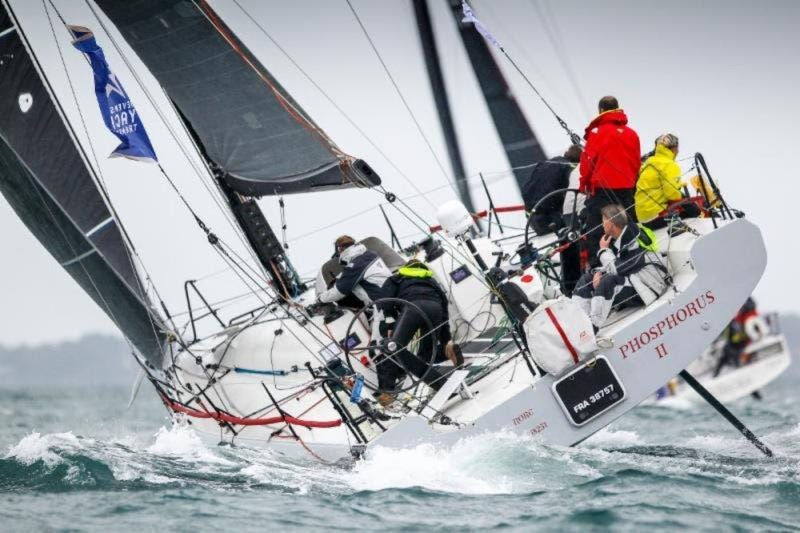
Mark Emerson’s A13 Phosphorus II won overall in 2019
The 2019 results make another useful point. Mark Emerson’s A13 Phosphorus II won overall, while the class winners included the JPK 11.80 Sunrise in IRC Two, the JPK 10.80 Raging-bee² in IRC Three and Two-Handed, and Noel Racine’s JPK 10.10 Foggy Dew in IRC Four. The IRC Two result was decided by just 17 seconds corrected between Sunrise and Pascal Tuffier’s Figaro II Tuf…tuf…tuf, with Géry Trentesaux’s Courrier Recommandé only another 27 seconds behind.
Seventeen seconds after an overnight Channel race rather puts the usual “it won’t make much difference offshore” argument into perspective, because it could have been one tack, a minute below target, the wrong sail for ten minutes, a little less favourable tide or one badly executed manoeuvre. You are unlikely ever to know which individual incident represented the seventeen seconds, but somewhere in the race there was certainly seventeen seconds available.
The two-handed fleet is also particularly interesting becaus the Cherbourg race is almost designed for them. Seventy-five miles is long enough to require proper offshore navigation, sail-management and tactical decisions, but short enough that two competent sailors can stay intensely involved in the race almost throughout. There is relatively little of the strategic downtime of a Fastnet or Round Britain and Ireland Race and normally not enough time for serious sleep deprivation to become the dominant performance problem.
In 2019 the top four boats in IRC Three were all racing two-handed, and then in 2024 Cora won the entire race overall as well as IRC Three and IRC Two-Handed, despite Tim Goodhew and Kelvin Matthews being called OCS and having to return at the start. I rather like that result because being OCS is an extremely obvious mistake and everybody sees it, whereas sailing five minutes too far into the wrong side of a wind or tidal transition at three in the morning is almost invisible and can cost considerably more.
Why the last ten miles can matter more than the middle fifty
That brings me back to our own rather tedious final approach, because offshore navigators naturally spend a great deal of time thinking about the large geographical decisions: which side, when to tack, where the pressure is, which model has the shift first and how much tidal displacement to accept. Quite right too, but there is a peculiar asymmetry near the end of an offshore race. Forty miles from the finish you can make a poor decision and still have quite a lot of racecourse on which to repair it. Five miles north of Cherbourg with eight knots of wind and a strong stream carrying you west, the number of viable options has collapsed and there is almost no distance left in which to recover the loss.
The mistake itself may not be any bigger; the opportunity to undo it is simply much smaller. That is why the last ten miles can become disproportionately important and why seeing the harbour is not remotely the same thing as having finished the race.
What I would actually do this Friday
The Nautical Cloud Cherbourg Race, with JOG, starts on Friday 4 September. The first warning signal is scheduled for 1750, with the first start at 1800 BST. Forty IRC boats and two multihulls are entered, including 16 two-handed boats, and this little overnight race is simultaneously the final event of the RORC Season’s Points Championship, the seventh and final race of the Cowes Offshore Series and the deciding race of the 2026 IRC Double Handed National Championship. rorc.org
The double-handed championship has an extra edge because Cherbourg is not a standalone final. Cowes Dinard St Malo was the opening round in July, when Bellino, sailed by Rob Craigie and Deb Fish, won the two-handed fleet with Nick Martin’s Diablo second, and Cherbourg is the second and deciding race. There is therefore no opportunity to throw away a poor first-round result and start again; what happened at St Malo remains part of the championship equation. rorc.org
For the race itself I would begin with the normal serious preparation: the best GRIBs I can get, proper tidal data, a polar I believe rather than one describing a fictitious perfect yacht, and several routing runs. What I would spend rather more time doing, however, is looking for where the answer becomes sensitive rather than trying to identify one supposedly perfect route.
I want to know where the 100 and 95 per cent performance runs separate, what another thirty or forty minutes of ETA does to the Cherbourg tidal stream, where the principal weather models begin to disagree materially and whether that disagreement is mainly wind speed, direction or timing. Most importantly, I want to know whether one relatively small change produces a genuinely different French-coast approach, because if it does that is not an irritating modelling anomaly; it is probably one of the tactical features of the race.
I would also have proper decision triggers before leaving Cowes rather than simply rerouting whenever somebody feels nervous. If the expected shift has not occurred by a particular point, rerun it. If actual performance has been materially below the polar for an hour, rerun it. If the revised ETA has moved through a critical tidal transition at Cherbourg, stop worrying about the old route because it may no longer describe the race we are actually sailing. And if the yachts ahead begin showing a coherent wind pattern that the GRIB does not, I want to understand why before assuming the computer must know better.
I use routing software extensively, I trust good GRIBs and I want the best tidal model I can find together with a polar built from the boat we actually sail, because the quality of all of those tools is now extraordinary. But they remain descriptions of what we think is going to happen, while the water and the wind are what actually happen. The trick, particularly at Cherbourg, is noticing when those two versions of the race have started to diverge, and preferably noticing it before the boat alongside does.
What weather and current data would I actually use?
For those navigating the race rather than simply reading about it, there is one final question worth addressing because Cherbourg is exactly the sort of race where saying “I downloaded the GRIB” is not really enough. I would not ask one model to solve every part of the problem. I would use the large-scale models to establish the atmospheric situation, the higher-resolution British and French products to interrogate the coastal detail, and the best tidal data available to understand what the boat is actually going to arrive in.
For the broad Channel picture I start with ECMWF, then look for a genuine second opinion. That means GFS, ICON and the Met Office model, all built and run independently. It does not mean AIFS or ARPEGE, whatever the model list on your weather app implies: AIFS runs from ECMWF's own starting snapshot, and ARPEGE is ECMWF's model wearing a French hat. Neither can tell me ECMWF has got the setup wrong. Even with three independent models agreeing, agreement is not the same as confidence, because they all feed on the same observations and can share the same error. The number I trust is the ensemble spread, the fifty-one ECMWF runs started from slightly different conditions. Bunched together means a scenario I can plan around. Fanned out means options, not a route. And whatever they say, no global model at 9 to 13 km resolves the Wight, the Cotentin or the afternoon sea breeze, so for the later part I look to UKV and AROME. Gradient from the globals, confidence from the ensemble, detail from the high-resolution models.
At Cowes, Hurst and the Needles I would look particularly at the Met Office UKV solution because the geometry of the Isle of Wight and Western Solent is precisely the sort of detail a global model cannot resolve properly. At the French end I would take Météo-France AROME very seriously. AROME runs at around 1.3 km over metropolitan France and is designed to represent much smaller-scale phenomena than the global models, which makes it particularly interesting around a peninsula such as Cherbourg where local direction, pressure, rain and stability may be important.
The important qualification is that higher resolution is not the same thing as greater certainty. AROME may be able to resolve the Cherbourg coastline far better than a coarser global model, but if the synoptic timing is wrong it can still give you a beautifully detailed version of the wrong answer. What I want is large-scale agreement first, then high-resolution detail to show me what local effects may be plausible.
Tides
For the French side I would use SHOM data as the authoritative reference against which to sense-check whatever current model is inside the routing program. I am interested not simply in whether the stream is broadly east-going or west-going, but in the timing of the reversal, the spatial structure of the flow approaching Cherbourg and how much that picture changes if our ETA moves by twenty, forty or sixty minutes. That is where the interaction between polar performance and tidal routing becomes particularly important.
In practice most of us are not downloading every raw model directly from ECMWF, Météo-France, NOAA and the Met Office before casting off. We are usually receiving them through Expedition-compatible services, PredictWind, Squid, Weather4D or another GRIB provider, and that is perfectly sensible, but it is worth knowing what sits underneath the label. Several products which appear separately on a menu are not necessarily completely independent forecast families, and some commercial high-resolution models begin from one of the major global-model initial states. Five model buttons agreeing on the screen is therefore not automatically the same thing as five independent modelling systems reaching the same conclusion.
By race morning my objective is therefore not to have the greatest number of GRIB files on the computer. I want to understand which parts of the solution are robust and which are fragile. If ECMWF, AIFS, GFS, ICON and ARPEGE broadly agree on the Channel-scale evolution, UKV gives me a plausible Western Solent structure and AROME shows a repeatable local signal around Cherbourg, I have a coherent forecast story. I can then run the boat at several realistic performance percentages and examine how those changes move the final tidal solution.
If the routes remain close, excellent. If they suddenly bifurcate in the last fifteen miles, that is probably where I want the navigator awake, watching the actual boat speed, the headings of the boats ahead, the cloud and the sea rather than simply admiring the original route.
That is really the whole point of the exercise. The best routing is not the line which looks most convincing before the start. It is the process which tells you soonest when the assumptions behind that line have stopped being true.
Have a good race - I’ll be out there too!
Stuart Greenfield FirstShift — Yacht Racing Intelligence From first shift to first place.
Offshore racing is never just about the boat, the forecast, or the routing software.
It is about decisions made under pressure, in changing conditions, by tired people trying to keep the boat moving fast and safely in the right direction.
That is where races are won and lost.
At FirstShift, my aim is simple: to help owners, skippers and crews race offshore with more clarity, more confidence, and better preparation whether that is a RORC Channel race, a Fastnet campaign, or your first serious step into offshore racing.
Thanks for reading Firstshift - yacht racing intelligence!


Comments