
Round the Island Race 2026: Why the smallest boat can still beat the biggest

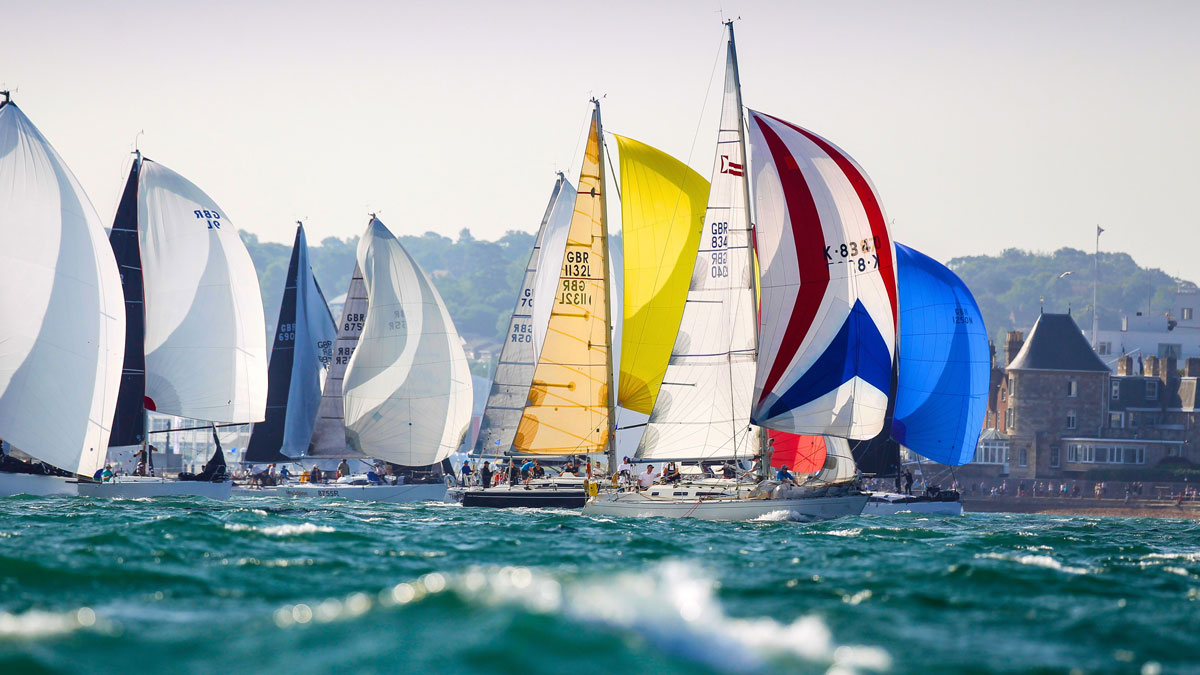
On Saturday 11 July 2026, the Island Sailing Club’s Round the Island Race will send hundreds of boats west from Cowes, out through the Solent, round The Needles, down the back of the Isle of Wight, round St Catherine’s Point, past Bembridge Ledge and back into the Solent to finish off Cowes.
The first Round the Island Race was held on 11 July 1931. The 2026 race starts on 11 July, to the date, ninety-five years on, the fleet crosses the same line on the same morning of the year. The boat that won that first race was one of the smallest in it. Hold that thought, because the Island has been quietly repeating the trick ever since.
To anyone who measures offshore racing in night watches, Fastnets and long cold beats past Portland, the Round the Island Race can look like a giant inshore spectacle. It is certainly that, one of the great days in British sailing, with family boats, charter boats, classics, multihulls, professional crews and people who race once a year and would not miss this one for anything. But do not mistake the crowds for simplicity.
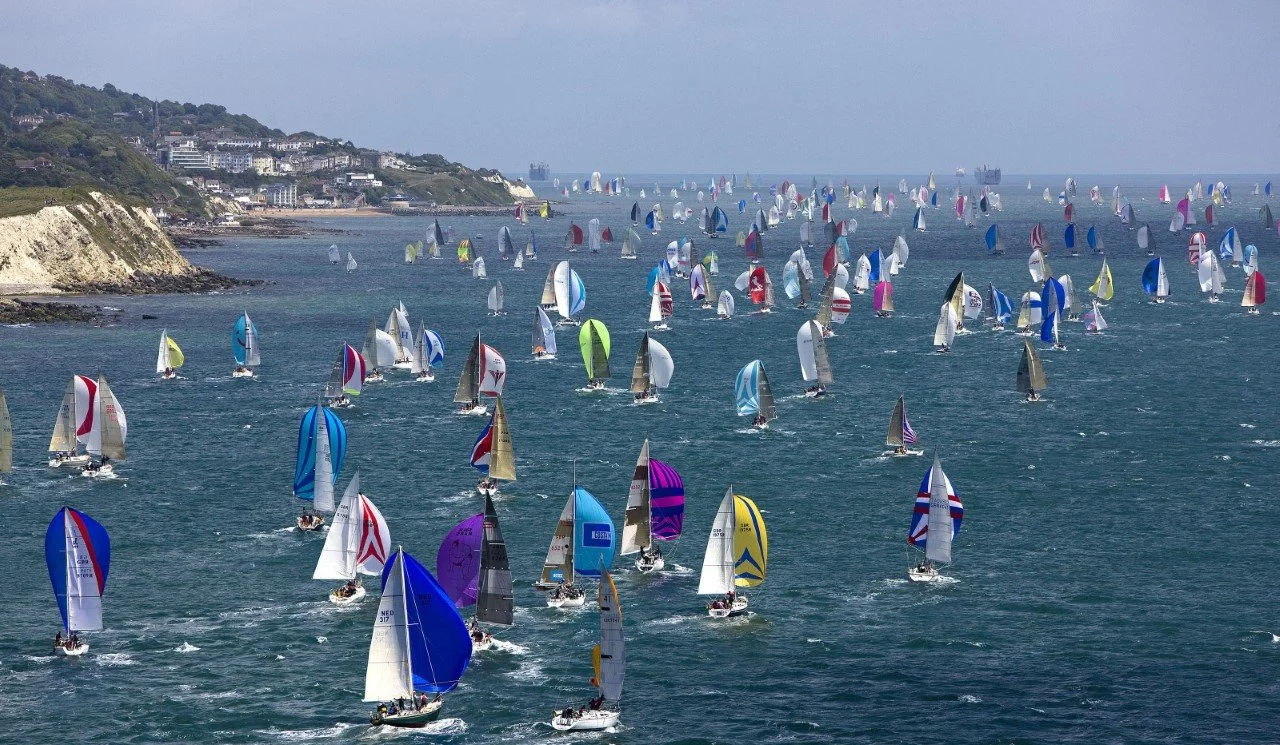
This is a 50-mile tactical course compressed into a single day and wrapped around some of the most tide-sensitive water in the country: headlands, compression zones, overfalls, wind shadows, tidal gates, layline traps, a wreck that eats keels for breakfast, and a finish that can still ruin a perfect day. It is one of the few races where the best boat, the biggest boat and the most expensive boat all routinely lose, and the fastest hull on the water can finish the day a long way down on corrected time.
That is why it belongs on FirstBeat. Almost everything that decides it is an offshore skill: preparation, route planning, tidal strategy over a long course, sail handling under pressure, crew management, and knowing when the chart, the model and the water in front of the bow are telling three different stories. Which is also why, the day before the race, I will publish a FirstBeat routing and tactical brief for the IRC fleet, because this is exactly the kind of race where a small decision made early becomes a large result six hours later. Or a large hole in the side when you are T boned on the start line - yes it has happened many time!
IN THE BEGINNING IT WAS A RACE BUILT FOR SMALLER BOATS
The history is part of the charm, but it is also part of the tactics.
The race was the idea of Major Cyril Windeler, an Island Sailing Club member who in 1930 proposed a handicap race round the Island for smaller boats — five to twenty-five tons. He found his trophy before he had his race, spotting a Roman-style drinking bowl dredged from the Thames in a London goldsmith’s window and having it copied. That copy became the Gold Roman Bowl, and it is still the prize every serious crew in the fleet is chasing.
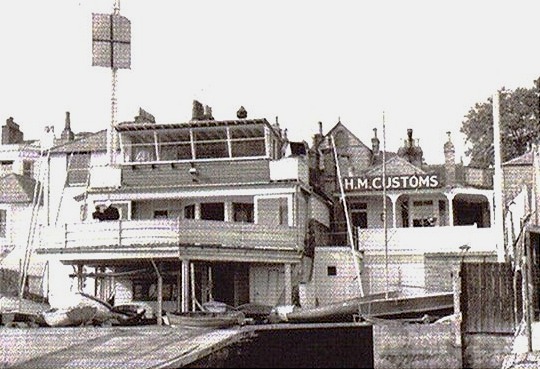
The first race, in 1931, drew 25 entries and was won by Peter Brett in Merry Conceit, a 22-foot Cornish fishing boat he had bought for £45, one of the smallest boats on the line. The precedent could not have been set more cleanly on day one, and the thread has never gone away.
The Bowl has gone to some very serious boats and some very small ones. Sir Edward Heath’s Morning Cloud won four times, three of them consecutively in the 1970s — though the Folkboat fraternity will cheerfully remind you that Heath was not aboard for the first two, which is a useful reminder that boats do not win this race; crews do. Against the TP52s and the modern grand-prix machines stand the Folkboats, the Contessa 26s, the quarter- and half-tonners, the JPKs — and, most famously, Jo Richards’ Eeyore: a modified 1964 Alacrity 18 bilge-keeler, 18ft 6in overall and the smallest boat in the fleet, sailed three-handed to the Bowl in 2019 and again in 2021.

Eeyore was no novelty act. Richards is an Olympic Flying Dutchman bronze medallist and the designer of half the dinghies in your club compound; he and two crew simply sailed a tiny boat round the Island in 13 hours 36 minutes without making the mistakes everyone else made. And the small boats keep their names on the Bowl. The Nordic Folkboat, a 25-footer, is the most successful design in the race’s history, four wins in sixteen years and seven seconds in the same span. The Donald family took it four times across two Folkboats: Malcolm in the war-built Celia Mary in 1994, his son Ed in 1999, and Ed again in his Nordic Madelaine, which won outright in 2007 and 2014 and made the top five in ten of sixteen years before losing her mast off St Catherine’s under spinnaker. The Rogers family Contessa 26 Rosina of Beaulieu won three times, 2002, 2003 and 2006. Mrs H. Tobin became the first woman to win, on Barbar in 1954; Julia Dane took it on Glass Onion in 1982.
The economics make the point another way. The overall winner almost always emerges from one of two places, the top of IRC Division 0, or the bottom of the fleet in a division like 3D. A second-hand TP52 in Division 0 costs the wrong side of £500,000. A genuinely competitive small boat in 3D can be found for under £20,000. The Bowl does not ask for your receipts.
A RACE FOR ALL, DECIDED BY THE FAIREST RULE
The quiet genius of the event is structural. A gaff cutter, a chartered Bénéteau, a Folkboat and a TP52 can all start off Cowes on the same morning and every one of them has a real race, because the fleet is split across more than one handicap and dozens of classes. Most of the cruising entry races under the Island Sailing Club’s own ISC Rating System, free, self-measured, no certificate and no measurer, just the boat’s basic details on the entry form. That open door is what makes “race for all” more than a slogan and lets the once-a-year sailor line up alongside the professionals. Add the multihulls under MOCRA and the one-designs racing among themselves and the entry can top 1,000 boats chasing the better part of 200 trophies. Nearly everyone can find a class to win and a reason to come back.
The major silverware, though, the Gold Roman Bowl and the overall prizes, is settled under IRC. You know the rule; the point worth making is why it suits this race so well. Because the formula is unpublished, no designer can draw a boat to beat it, so a 1960s classic, a rebuilt IOR warhorse and a new carbon flyer can all win under the same certificate. On a course that throws every type of boat at every type of condition, that era-blind fairness is exactly what you want deciding the overall. Enter under ISCRS and you are racing for the joy of it and a fistful of class prizes. Enter under IRC and you are playing for the Bowl.
WHY THE SMALLEST BOAT CAN WIN
On most courses the handicap roughly evens things out. Round the Island it does not, because the water is not neutral, and the fleet is not racing in the same conditions at the same time.
A 50-mile loop round the Isle of Wight is a chain of traps that catch different boats at different moments. The quick boats reach The Needles in one tide window; the small boats arrive in another. A maxi may get round St Catherine’s before the breeze softens, or be first into the hole. A Folkboat may be pinned by foul tide, or arrive after a gate has swung fair. A slow boat ghosting along at three knots while a fast boat sits parked at zero is not losing, she is destroying the fast boat on corrected time.
There is a hard reason; the foul tide actually favours the small boat, if she is sailed well. As the Solent pilotage authority Peter Bruce puts it: “Cheating the foul tide is essential in smaller/slower boats, where the adverse tide is relatively a greater negative percentage of your forward speed vector.” A 25-footer punching two knots of ebb is losing a far greater share of her boatspeed than a maxi is, so she has far more to gain by tucking inshore where the stream is weakest. The boat that knows the inshore ladder past St Catherine’s and the Chale Bay eddy that runs fair eight hours out of twelve turns a structural disadvantage into the decisive edge.
So the giant-killing result needs three things. The big boats must fail to convert their rating into distance, too little breeze, too tactical, too tidal. The small boat must keep moving, treating every half-knot as currency while the fleet stops and starts. And the tide must compress everyone, so the lead the class 1 built all morning evaporates in twenty minutes of foul stream and dirty air. When those line up, it is not romance. It is arithmetic, timing and seamanship.
SPRINGS, NEAPS AND THE 2026 TIDE
The smallest boat does not win every year, and the biggest reason is the tide. The race is always set for a fair morning ebb to flush the fleet west to The Needles, so the question is never whether the tide matters but how hard it bites and that turns on where in the springs–neaps cycle race day falls. A big spring runs close to four knots through the Needles Channel and off St Catherine’s; a slack neap gives you less than half of that. Same marks, completely different race.
So read 2026. The new moon falls on 14 July, the previous neaps on the 7th; the race, on the 11th, sits three days ahead of the new moon. The streams will be building towards springs but 5 days short of the top, a making tide, moderate and increasing, with a genuine west-going push down the western Solent in the morning but not the savage four-knot gates of a full spring. Hard enough that the timing of The Needles and St Catherine’s will absolutely matter; forgiving enough that a well-sailed small boat that keeps moving need not be gated out entirely. The shape is already set: a live, tactical tide, neither benign nor brutal.

What the tide really controls is not so much who wins as how cruelly the day punishes a mistake. On a big spring the gates slam, the fleet concertinas, and one mistimed corner costs twenty minutes you never recover; on a neap the same error costs loose change. There is one combination where the tide decides the winner outright, light wind landing on a big spring, when the parked class 1,2 and 3 are pinned in foul stream while a Folkboat creeps up the beach in the back eddy. But that is the exception. For 2026 the gates will bite; whether that helps the small boats or the big ones depends on the one thing the committee cannot set, the wind. And there the record is unusually clear.
WHAT THE RECORD ACTUALLY SHOWS:
It is easy to assert that small boats win in the light and big boats win in the breeze. It is more useful to line the recent Bowl winners up against the conditions on the day, where the pattern is almost embarrassingly clean.
When it has blown, the big boats have won almost every time. In 2022 the race started in a south-westerly around 15 knots and built strongly round the back of the Island; the Bowl went to Ian Atkins’ GP42 Dark’N’Stormy, which took monohull line honours, IRC Zero and the overall win. In 2024, the wet and wild edition with gusts into the fifties, it went to Peter Morton’s TP52 Notorious. In 2025, with 35-knot-plus gusts, to the Botin 52 Jolt 3. Go back and the breezy years keep landing on the big machines — the TP52s 5 West (2012), Manroland Sheetfed (2015) and Gladiator (2016). When the wind is up, the rating-burdened boats convert: they hold their polars, the reaching legs reward sail area and stability, and they sail away far enough to beat the handicap.

Morton’s win is worth dwelling on, because the winner made the argument for me. A lifelong Cowes sailor with fifty years of this race behind him, he stepped off a state-of-the-art 52-footer and said: “It’s 40 years ago since I won it on a little 25ft boat called ‘Odd Job’, so today was very special for me.” Forty years and a 25-footer between his two Bowls. Even the maxi owners learned this race in small boats.

When it has been light, the giant-killers have walked. Eeyore in 2019 and 2021. Ed Donald’s Folkboat Madelaine in 2014. And 2010 gives the whole thesis in one line from the race reporters that year — “a Round the Island race where the wind picks up halfway through always favours the smaller boats” — the day the Folkboat Nordic Bear took the Bowl. In light or building air the big boats cannot make their rating pay, the fleet parks at the gates, and the small boat cheating the foul tide inshore corrects out in front.

So the most reliable predictor of the size of the winner is not the tide and certainly not the budget. It is the wind strength, and the hinge sits at roughly 15 knots:
• 0–15 knots, light early. Advantage small. Below about 12 knots the giant-killers come alive; a low-rated boat that keeps moving and works the inshore tide beats anything. Folkboat, Contessa and Eeyore country.
• Around 15 knots. The pivot — enough for the mid-sized boats to get going without burying the smallest. 2022’s 15-knot GP42 win sits exactly here.
• 15–30 knots. Advantage big. The waterline pays, the reaches light up, the TP52s convert rating into distance faster than the handicap can claw it back.
• Above 30 knots. Still the big boats — but now survival, seamanship and damage-avoidance decide it, and the back of the Island turns genuinely dangerous.
Two things keep this honest. The fast boats only win when they are nearly perfectly sailed, because they carry the rating burden: one bad lane off the start, one poor sail choice at The Needles, twenty minutes stuck in dirty air off Ryde, and a lower-rated boat is banking corrected time behind them. And wind direction sets the shape of the race more than the size of the winner. The prevailing south-westerly gives the classic course, a beat or fetch to The Needles, sheets cracked with kites down the back of the Isaland, a tactical leg home up the eastern Solent. An easterly, rarer, turns it inside out: a reach out and a beat home, slower and more tactical, different cliffs stealing the wind at different moments. Direction tells you where the race is won; wind strength tells you what kind of boat holds the Bowl at the end of it.
I HAVE SAILED BOTH ENDS OF THIS ARGUMENT
I have raced this island across the whole range, and my own results sheet makes the point better than any theory. Below are results from boats I have actually owned, however, from around 1976 I have raced almost every year in many different yachts either as bowman, mastman, trimmer or tatician as I got older and slower and moved further back. Many boats focused on offshore racing still find the time to compete and this is another reason it is relavant for FirstBeat subscribers. I still have never really ever got close to winning this race, maybe I have time left!
2XL, the Farr 40, finished 5th overall in class in 2003, the grand-prix one-design of its era, light and powered-up and built to reward hard crew work. Fifth in a fleet of around 100 is serious for a 40-footer, and the company tells the story: 2003 was a Contessa 26 year, the Bowl going to Rosina of Beaulieu. Barking Mad, my Swan 40, finished 32nd in Class 3 in 2002, a heavier, sea-kindly Nautor cruiser-racer, the all-rounder that does not need a gale to be in the race. And 2002 was the other half of the same story: another Rosina of Beaulieu year, another day for the small and the nimble, and a mid-class result for the bigger, heavier boat. Same skipper, different weather, a very different answer.
Morning After, the S&S 34, took 4th in the Classic Yacht Division in 2022, thirty-four feet of heavy, sea-kindly Sparkman & Stephens, the boat that won RORC Class 4 overall and her class in the Round Britain and Ireland in 2022. Round the Island she raced among the classics rather than for the Bowl, and on a light or building day she is precisely the boat this whole article is about: keep her moving, cheat the tide inshore, let the giants park.
Three boats across the full width of the wind scale, the same fifty miles of water each time. Which one you would rather be on has nothing to do with which is “better” and everything to do with what the forecast says the night before and as my results show its very difficult to do well!
READING THE 2026 RACE
If the race is breezy, open and fast, the advantage runs to the high-end IRC machines. If it is a medium, shifty, look hard at the best-sailed 35- to 45-footers, a JPK, J/112, J/122, Sun Fast, Ker, Corby or First 40. This is the most dangerous place to be under IRC: fast enough to stay connected with the race, not so highly rated that they must vanish over the horizon, and manageable enough for an amateur or semi-pro crew to hold close to target speed for hours. In a mixed breeze, that consistency is lethal. These boats win by doing ordinary things extremely well, clean start, stay in pressure, don’t overstand The Needles, don’t get greedy under the cliffs, manage St Catherine’s, change early not late, come back into the Solent with a plan rather than a prayer. It sounds simple. Most boats will not do it.
And if it is light, unstable and full of holes, the small boats stop being sentimental outsiders. A low-rated boat that keeps moving becomes almost impossible to beat once the quick boats park and the ghosts of Merry Conceit, Rosina of Beaulieu, the Folkboats and Eeyore walk round the Island again. The honest early answer: the fastest-looking boat is rarely the most dangerous one. The most dangerous boat is the one whose rating, crew, sail plan and timing best fit the weather on the day.
THE GRAVEYARD AT THE CORNERS
Here is the part nobody puts on the entry form. The Isle of Wight is ringed with rock, ledge and wreck, and every year the race feeds it.

Start at the worst of them. Rounding The Needles, the tightest hairpin on the course, the whole fleet converging, the tide ripping, the wind bending round the chalk, there is a tempting inside passage between Goose Rock and the lighthouse. Lying across it are the boilers of the SS Varvassi, a Greek steamer that piled onto the Needles in 1947 and never left. They stand about 2.5 metres proud of the seabed, roughly thirty centimetres below the surface at low water springs, close enough that on the lowest tides you can watch them break the surface. The gap to thread between wreck and rock is two and a half to three metres of water, and the short cut has cost real boats real races. In 1990 the French Admiral’s Cupper Xeryus, sailed by the America’s Cup helmsman Bruno Troublé, hit the Varvassi hard enough to be abandoned and sink. In 2016 Alchemist struck the same boilers, took on water and went down off the Needles despite the Mudeford lifeboat’s tow; her crew were lifted off. The experts’ rule is brutally simple: if in doubt go outside, and never change your mind mid-rounding because you have just watched someone else get away with it. As Peter Bruce notes, that is exactly how “you attract the wreck to your keel.”

The Needles keep punishing you once you are round. A third of a mile south-east, in Scratchell’s Bay, Irex Rock waits awash at chart datum for the boat that cuts the corner too fine while staring back at the lighthouse for the photograph. Then the long beat down the back of the Island brings the most seductive trap of all, the inshore tide-cheat past Atherfield. The gains are real; so are the bricks.

Brook Ledges and the Atherfield ledges, Typet Ledge, The Mexon, The Bench, reach as much as five hundred metres offshore and stand vertically out of the seabed. Bruce tells it best: trading tacks with a Farr 40 in a twelve-knot south-easterly, the boat closest to the shore kept gaining until “there was a huge bang” the Farr 40 caught on her exit from a tack, keel onto Typet Ledge, rudder lifting clean out of the water as she stopped dead from seven knots. One greedy tack and a podium boat became a recovery job.
Carry east and the rocks keep coming, Church Rocks and Cat Rock off Ventnor, then Bembridge Ledge where tide, depth and traffic conspire at once. The only buoy on the course to pass to port is Bembridge ledge, so dangerous is this corner of the course.


Even within sight of the finish the eastern Solent has a sting: Ryde Sands shelving from thirteen metres to two in a couple of boat lengths, Norris Rocks off Old Castle Point, the Shrape guarding the run home. None of it is new.
In 1933 the leader, Isaac Bell’s Rosemary IV, lost her mainsail just short of the line, set a trysail and still scraped across 46 seconds ahead — while Dr Cooke’s 32-year-old cutter Enid sprang a leak and sank off Alum Bay. Triumph and disaster in the same hour, on the same course. The cast changes; the script does not. The lesson for the IRC sailor is not to fear the corners but to treat them as offshore problems — brief them, plan the escape before you commit, and decide in cold blood whether the half-knot inshore is worth the keel.
HOW TO WIN IT: SIX PROBLEMS, NOT ONE LAP
You do not win this race by going round the Island. You win it by breaking the course into problems and solving each in the right order.

The start. Not necessarily a dinghy-style port-end flier, in fact almost impossible! A start that lets you sail full speed in clear air toward the first strategic objective maybe but unlikely so in a fleet this size a clean second row can beat a heroic front row that leaves you trapped.
The western Solent. Balance tide, wind angle, shoreline effects and fleet position. The fastest line on the routing screen rarely survives contact with 200 boats and a dirty-air lane. The question is not “where is the tide strongest” but “where can we sail our boat properly while using the tide.”
The Needles transition. Sail handling decides it. Late preparing the next sail and you have lost; crew still debating the change as you round and you have lost; bow team surprised, with the wreck right there, and you have definitely lost.
The south side. Settle the boat and sail percentages. Trim for the sea state, not the brochure polar; steer the waves; change mode early; keep checking that the wind you are in matches the wind you expected. Hours of it, not minutes.
St Catherine’s to Bembridge. Routing, tide and judgement together. The software’s answer is only as good as its inputs, if the wind has shifted, the tide line is visible and the boats around you are behaving differently from the model, the navigator updates the race in real time.
The finish. A beautiful race can still die in the eastern Solent, cruel tide, fleet in the way, the breeze going patchy, the temptation to relax. Good IRC boats don’t relax until they have crossed the line and lodged the declaration.
WHY FIRSTBEAT IS PRODUCING A ROUTING
The routing the day before will not be a magic line to follow blindly, that would be the wrong lesson. Routing software is only useful when you understand its assumptions. It models a forecast, a tide and a set of polars; it cannot see the dirty air from 200 boats, the helm who has not practised the kite drop, the crew already tired before The Needles, the boilers of the Varvassi, or the cloud line building over the Island unless someone is looking out of the boat.
The point is to give IRC crews a better framework for judgement. Where are the gates? Where does the forecast create opportunity? Where might the big boats stretch, and where might the small boats come back? Which legs reward waterline and which reward patience? Where is the obvious route and where does the obvious route become a trap? That is offshore racing intelligence applied to a one-day race.
The Round the Island Race starts and finishes in Cowes, but it is not a Cowes day out. It is a serious tactical race around headlands, tide and weather, where seamanship still matters and a small boat with a good crew can still beat a grand-prix machine when the day opens the door. So if you are racing IRC on 11 July, do not just ask how fast your boat is. Ask what kind of race the Island is going to give you.


Comments