
Yachts that broke the rules - Part 2 - the IOR era
- Stuart Greenfield

- Jun 3
- 16 min read
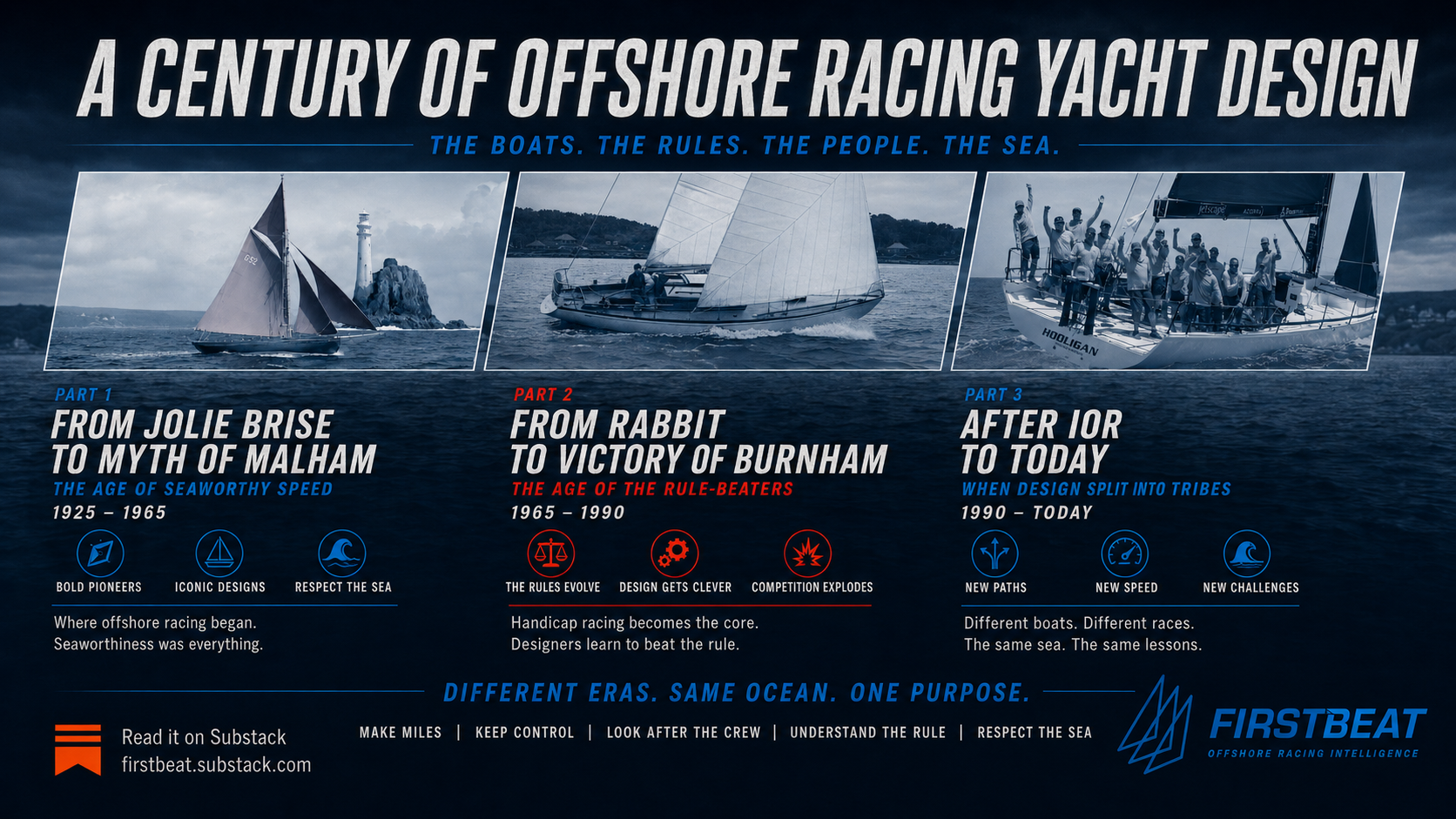
At the end of Part 1, offshore yacht design was still balanced between two old masters: the sea and the designer’s conscience. The boats were becoming faster, lighter and more purposeful, but most of them still carried the memory of working craft, cruising yachts and the older idea that seaworthiness was not an optional extra.
That would change.
From the mid-1960s onwards, the designer no longer had to answer only to the owner, the crew and the sea. He had to answer to the measurer — more accurately, he had to outwit the measurer without appearing to have done so. The rating rule moved from the background into the middle of the design office, and the shape of offshore racing yachts began to reveal not just what made a boat fast, but what made a boat measure so it appeared to be slower than it actually was. In some ways Olin Stephens had achieved this, years earlier, by designing a hull that extended its water line length when heeled thereby increasing its theorectical displacement boat speed. Things were going to get much more interesting however.
This was the age of the rule-beaters.
Not cheats. That is too crude, and mostly unfair. The good designers were doing what designers have always done, reading the rule, understanding the racecourse, studying the competition and trying to find a better answer. The trouble was that under the International Offshore Rule, the better answer was not always the simpler, stronger or more seamanlike answer. Sometimes it was a bump, a hollow, a fat stern, a curious bit of volume, or a shape that made perfect sense on a certificate and rather less sense in a seaway.
IOR produced some magnificent yachts. It also produced some odd ones. More importantly, it produced a generation of designers who had to think in two languages at once: one for the sea, and one for the rule.
THE TON CUPS: IOR’S DESIGN LABORATORY
The Ton Cups were IOR-based international championships organised by rating band. Quarter Ton (18ft rating), Half Ton (21.7ft), Three-Quarter Ton (24.5ft), One Ton (27.5ft), Two Ton (32ft) — they were the primary design laboratories of the era. Cheap enough for serious amateurs and small design offices to enter, prestigious enough to matter on the international stage, and competitive enough to separate the designers who understood the rule from the designers who merely respected it. Almost every designer in this article won or contested them. They were where IOR reputations were made and lost, and where the next generation of ideas arrived before the Admiral’s Cup had seen them.
When the article refers to a One Ton Cup or Half Ton result, it is referring to this world.
DICK CARTER AND THE MOMENT THE OLD ORDER SHIFTED
Part 2 begins with Rabbit.
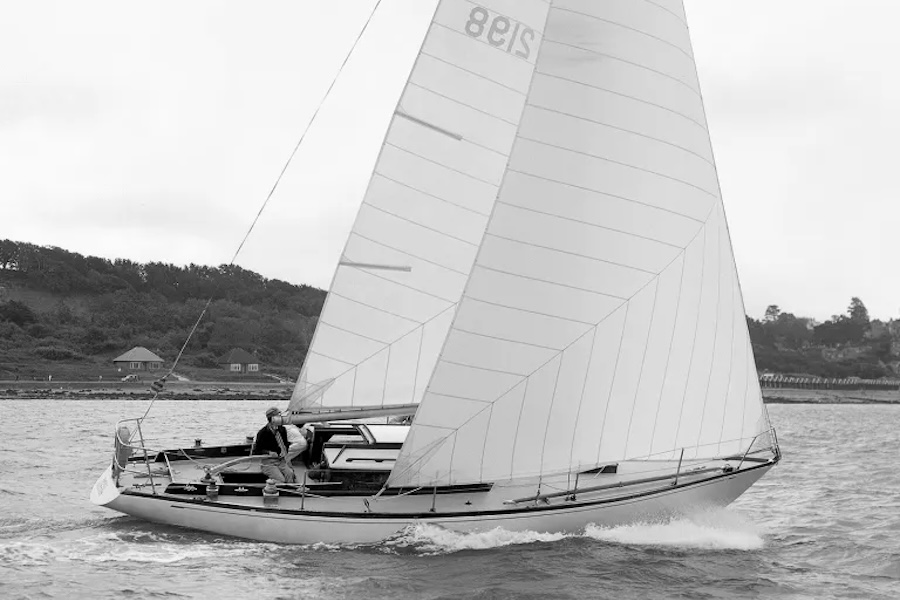
Dick Carter was not a naval architect in the old establishment sense. That is part of his importance. He came into the story with the instincts of a very good sailor, an eye for speed, and a willingness to make orthodox offshore design look suddenly vulnerable. In 1965, Rabbit won the Fastnet Race. One obituary of the era put Carter alongside Olin Stephens as the two designers whose boats most changed the course of offshore racing design in the 20th century: Dorade in 1931, Rabbit in 1965.
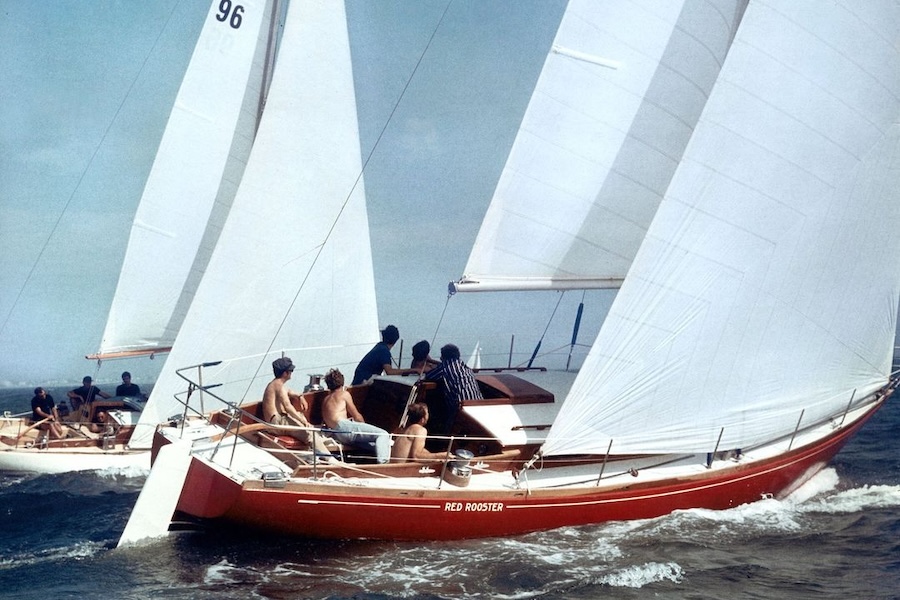
At the time, some dismissed the result as a fluke. Four years later, Carter returned with Red Rooster — a radical design with a two-ton drop keel and a retractable transom-hung rudder — and won the Fastnet again. Red Rooster was also the top points scorer in the 1969 Admiral’s Cup. It had not been a fluke.
Carter was not merely drawing another offshore yacht. He was questioning assumptions about keel configuration, wetted surface, rating, balance and what an offshore yacht was allowed to look like. His Tina, built after Rabbit, won the One Ton Cup in 1966 and opened his contest with Sparkman & Stephens for One Ton supremacy. Carter was also an early supporter of a single international offshore rating rule to replace the separate RORC and CCA systems, and was invited onto the IOR organising committee.
That creates a lovely irony. Carter helped create the world he would then help disturb.
There is a tendency, looking back, to make these boats sound quaint because they were small and simply built. That misses the point. In their day, they were disruptive. They made the establishment uncomfortable, and discomfort is often the first sign that a design argument has moved on.
TABARLY AND THE FRENCH WARNING SHOT
Then came Éric Tabarly, and offshore racing became a little less Anglo-American.
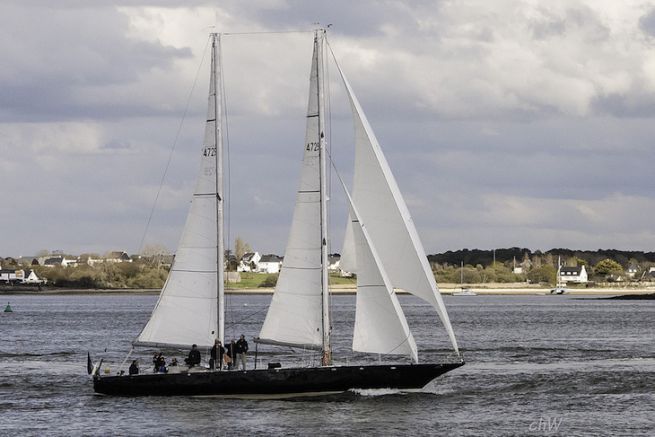
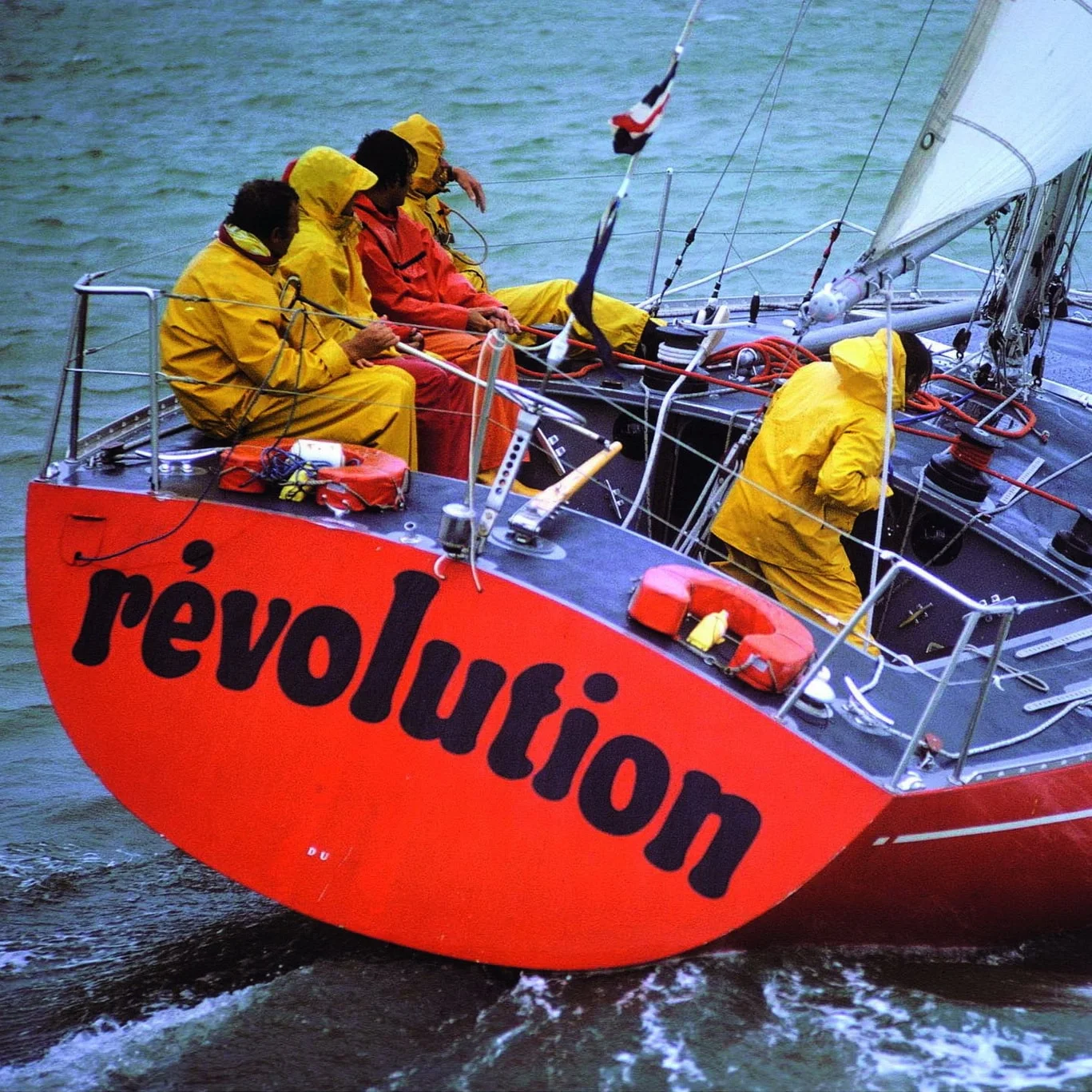
Pen Duick III was revolutionary. She was a chined aluminium French schooner with a clipper bow and a reputation that travelled ahead of her. In 1967, she won the RORC Class I Championship with a perfect score of 100 per cent taking the Morgan Cup, the Gotland Race, the Channel Race and the Fastnet Race among the seven RORC races that season, winning the Fastnet in both real time and corrected time.
The RORC’s response tells you everything about the scale of what Tabarly had done.
They changed the handicap rules effective 1 January 1968, specifically to penalise Pen Duick III. The establishment could not beat her on the water. So they changed the rules to stop her.
That is not merely an interesting historical footnote. It is the key to understanding the IOR era that follows. If a single boat can force a rule change, the relationship between design and rules is closer and more political than most people want to acknowledge. Tabarly had not just won a championship. He had demonstrated that a boat built with genuine, unconventional intelligence could make the measurement system irrelevant. The only answer the establishment had was to rewrite the exam.
There is also a useful distinction between Tabarly and Carter. Carter was reshaping the mainstream design argument from within the international rule world. Tabarly felt more like an invasion from a parallel culture. Pen Duick III was not merely a boat to be admired. She was a warning.
The French were coming.
THE BIRTH OF IOR
The International Offshore Rule was born from a sensible idea.
Before IOR, the offshore racing world was divided between the RORC rule in Europe and the CCA rule in North America. International racing was complicated. The solution was obvious: create one international rule so boats from different countries could compete under a common system.
In 1966, the IYRU asked RORC and the CCA to frame one international rule. By April 1967 an International Technical Committee had been established, with Olin Stephens as chair and Dick Carter as the other American representative with Europe represented by Gustav Plym, Ricus van de Stadt and Paul Spens. IOR was announced in 1968 and was ready in final form by spring 1969.
In principle, it was an admirable project. It helped make the Admiral’s Cup, the Ton Cups, SORC and other international contests feel like part of the same design universe. It encouraged designers to think internationally and owners to commission boats for serious global competition.
But any rating rule does something more than score boats. It designs them.
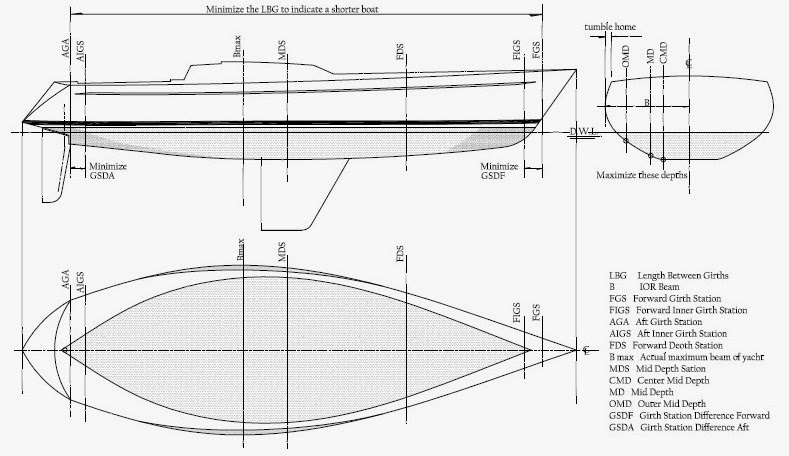
That is the point many sailors still miss. A rating rule does not merely sit outside the boat as a piece of administration. It seeps into the hull. It enters the sheerline, the stern sections, the rig proportions, the ballast arrangement and the interior. Once the rule rewards certain shapes and punishes others, the rule has become a silent naval architect.
IOR was no exception. It encouraged brilliance. It also encouraged distortion. Designers learned to give the rule what it wanted to see, while trying to preserve what the boat needed to sail well. Sometimes the result was beautiful. Sometimes it was fast. Sometimes it was peculiar. Often it was all three at once.
DOUG PETERSON AND THE CALIFORNIAN PRECISION OF IOR
If Carter opened the door, Doug Peterson walked through it with a draughtsman’s knife.
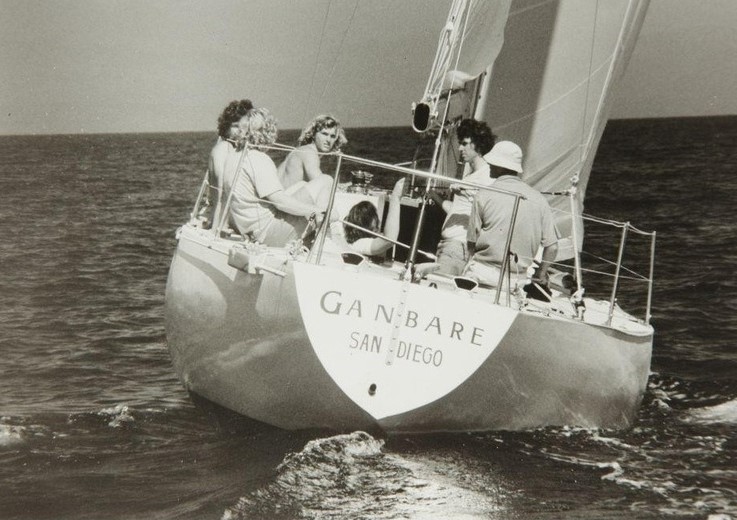
Peterson’s breakthrough was Ganbare, the One Tonner built on a shoestring for the 1973 One Ton Cup in Genoa. He won the first four races of the series. Then, in one of the final races, he was penalised for rounding a mark incorrectly and finished second overall. He had lost the championship, but he had not lost the argument.
The following year, Peterson’s Gumboots won the One Ton Cup outright. Not a near-miss — a win. The two results together told the story clearly. Ganbare had not been lucky. Peterson had understood the rule at a level that other designers had not yet reached.
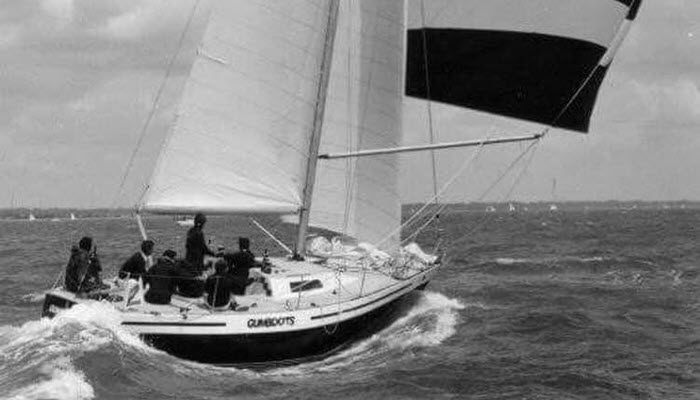
Almost immediately, Doug Peterson became the designer in demand for IOR racing sailboats around the world, for more than a decade.
His particular genius was not theatrical. His boats were not famous because they looked outrageous. They were famous because they worked. He found the disciplined middle ground between rule advantage and sailing efficiency. His record in the Ton classes reflects that. He was the only designer to win four of the five Ton Cup classes in a single year — 1975 — and one of only two designers (alongside Bruce Farr) to win all five classes across their career.
That is not a footnote. It tells you that Peterson understood the rule across scale. Quarter Ton, Half Ton, Three-Quarter Ton, One Ton and Two Ton were not simply different sizes of the same problem. They were different design puzzles. To succeed across them all required more than one lucky hull.
Peterson was the IOR designer as chess player. Not flamboyant, not conservative, not sentimental — but precise, observant and ruthless about the problem in front of him.
RON HOLLAND AND THE BOAT THAT LOOKED FAST BEFORE SHE HAD FINISHED THE RACE
Ron Holland brought a different energy. His boats had flair — not a technical term, but anyone who has looked at the best Holland IOR boats will know what it means. They had a sense of attack. They were rule-aware, but not dull. In the middle of an era when many designs were beginning to show the strained expressions of rule optimisation, Holland produced yachts that looked as though they wanted to go sailing.
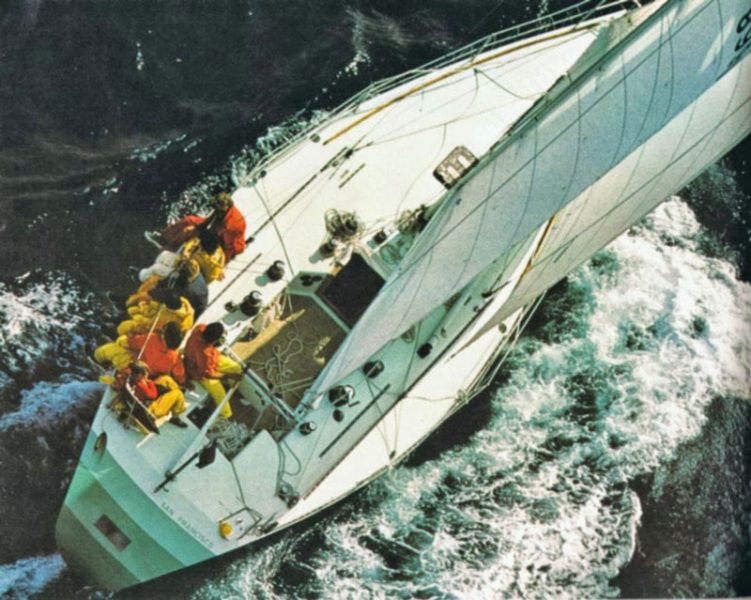
Imp is the obvious example.
Built in Plant City, Florida, in 1976 for American owner David Allen, Imp was a 40-footer that became one of the great IOR race boats. She was built as light as possible, with wider stern sections than were popular at the time — moving deliberately away from the symmetrical “pintail” hull forms that the rule had been encouraging. That was not a casual decision. It reflected Holland’s understanding that the rule was taking boats in the wrong direction on power and pace, and that the way back was through the stern.
She won the 1977 Fastnet Race outright. She was the top-scoring individual boat in that year’s Admiral’s Cup, finishing ahead of the Frers-designed Scaramouche — six feet longer — by six minutes. Britain won the 1977 Admiral’s Cup; the USA, with Imp as their standout performer, came second.
A boat such as Imp did not just win silver. She changed expectations. She showed that IOR did not have to mean slow-looking compromise. It could still produce a boat with life, power and pace. The trick was to take what the rule allowed, avoid what the rule tempted you into doing badly, and leave the crew with something they could actually race.
THE UNCOMFORTABLE LESSON OF 1979
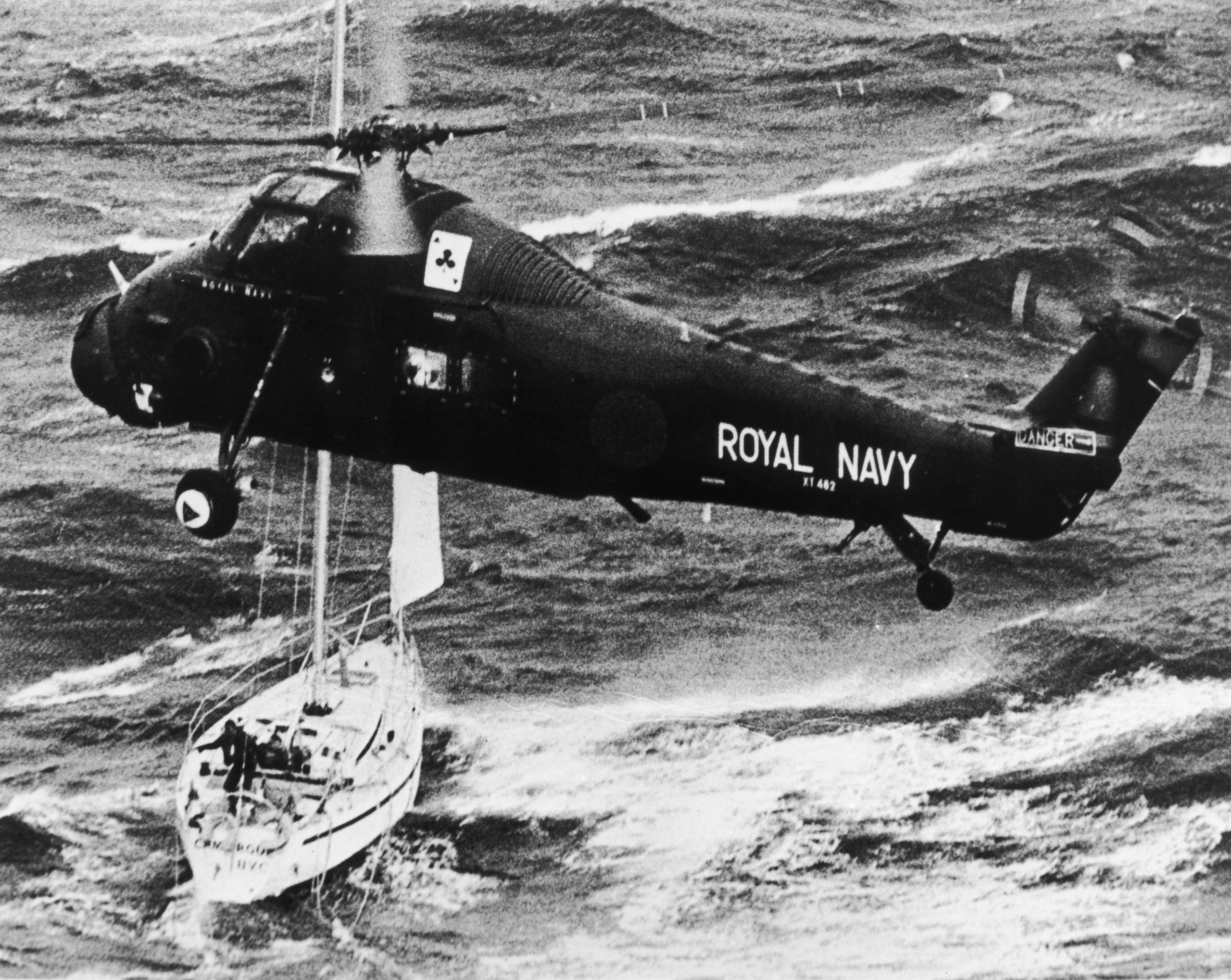
No history of offshore design in this period can ignore the 1979 Fastnet.
It should not be used lazily. It is too easy to write as if the disaster was simply “caused by IOR boats”. That is not fair and it is not serious. Weather, forecasting, communications, race management, safety equipment, crew experience, stability, abandonment decisions and rescue organisation all formed part of the tragedy. But it is equally wrong to pretend that design played no part in the questions that followed.
The facts are starkly recorded. A 303-boat fleet was struck by an unexpected Force 10 to Force 11 storm and a vicious cross sea. Fifteen sailors died. 75 yachts capsized. Five sank. 194 retired. Only 85 of the starters completed the course.
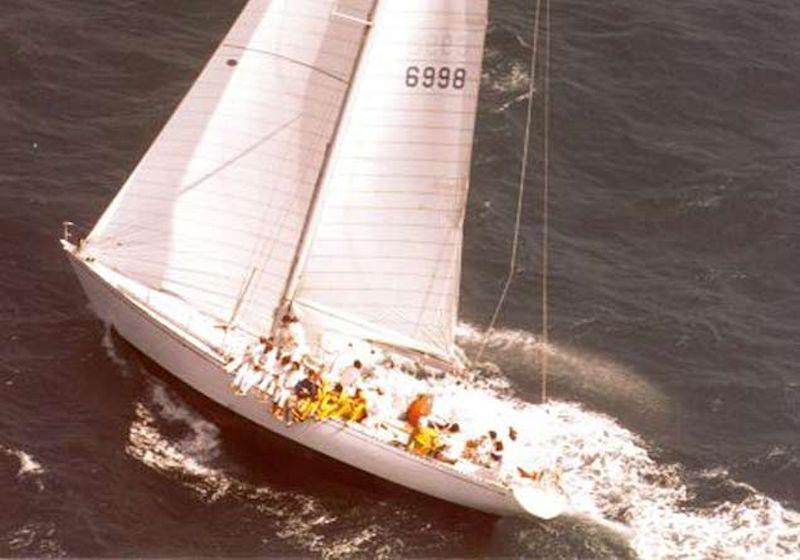
Tenacious — a Sparkman & Stephens design sailed by Ted Turner — won on corrected time, which is itself a warning against simplistic claims about IOR boats and seaworthiness: S&S, the firm that designed Dorade, won the 1979 Fastnet. Line honours went to Condor of Bermuda, a Ron Holland design skippered by Peter Blake — Blake’s first prominent offshore appearance, before the Whitbread campaigns that would make him famous.
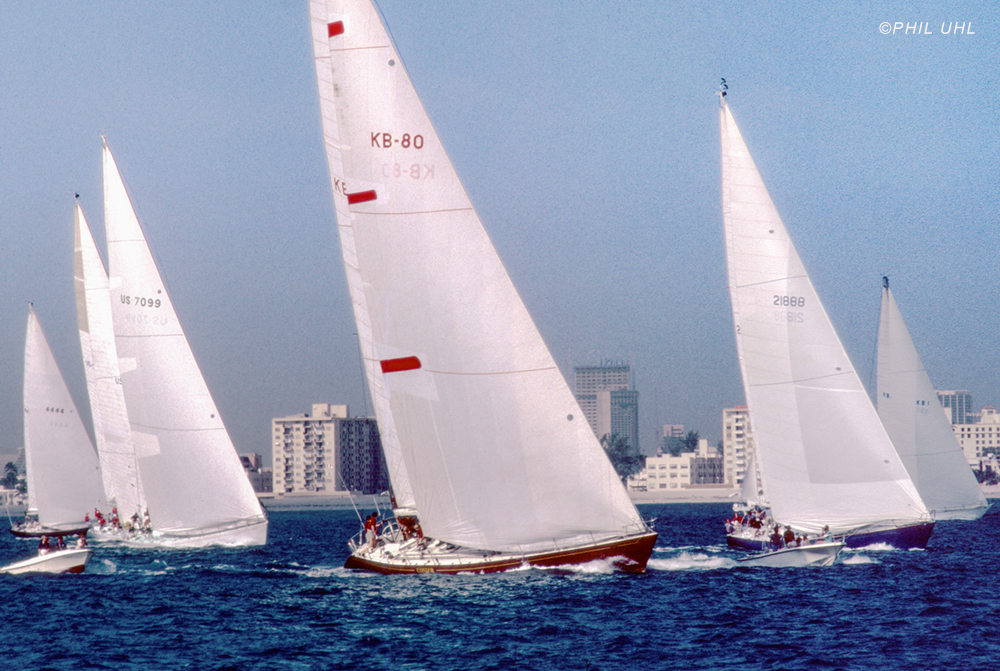
But the disaster forced the offshore world to think harder about stability, knockdowns, downflooding, crew security, hatches, heavy-weather tactics and the suitability of some racing shapes for extreme conditions.
The design lesson was not that rating rules are bad. It was that a rating rule is never a substitute for seaworthiness.
That lesson would need to be learned again.
BRUCE FARR AND THE SOUTHERN HEMISPHERE ANSWER
While IOR was producing highly refined northern-hemisphere rating boats, another influence was arriving from the south with increasing force.
The Whitbread Round the World Race had started in 1973. The first edition was won by Sayula II — a Swan 65 designed by Sparkman & Stephens, skippered by Mexican amateur Ramón Carlin. S&S, the firm that had dominated offshore design since Dorade, won the first offshore race to encircle the globe. The second Whitbread in 1977-78 was won by Flyer, another S&S design. The old order was still holding.
But not for much longer.
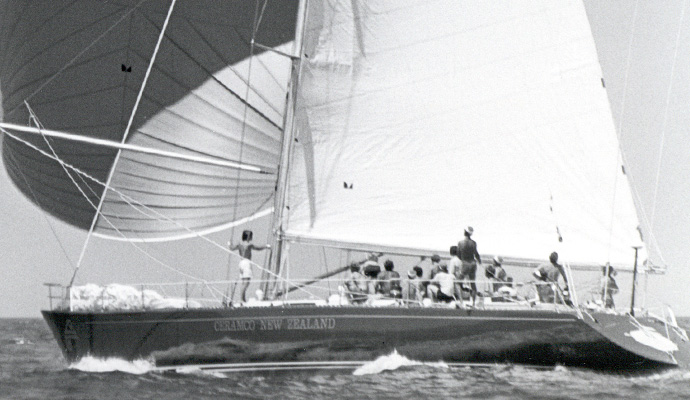
Bruce Farr’s importance is not confined to the Whitbread world, but his 1981-82 campaign is where the argument becomes visible. Peter Blake commissioned Farr to design Ceramco New Zealand — a 68-foot sloop — for the third Whitbread. Ceramco began with a win in the 1980 Sydney-Hobart Race. In the Whitbread itself, she lost her mast on the first leg between Southampton and Cape Town — dismasted mid-South Atlantic, sailing another 4,000 miles on a jury rig to reach port. Blake kept a crew motivated through the kind of offshore disaster that breaks most programmes. They completed the race in 11th overall.
That sounds like failure. It was not how it felt.
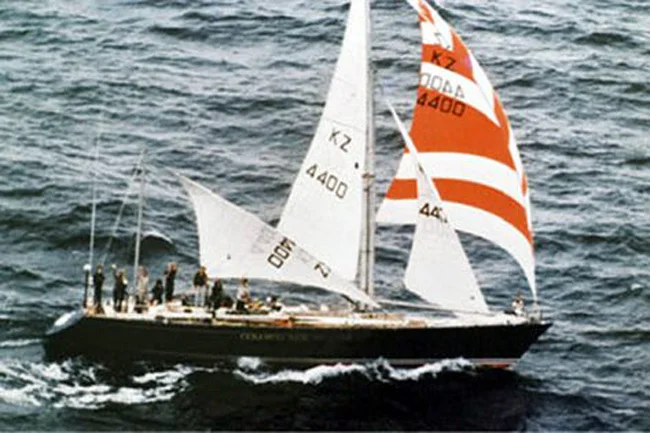
The way Blake handled Ceramco’s dismasting made him famous in offshore racing circles before he had won a Whitbread. And the underlying speed of the boat, before the mast went, had been noted. Blake subsequently commissioned Farr to design Lion New Zealand for the 1985-86 Whitbread, and then Steinlager 2 — winner of the 1989-90 Whitbread line honours and overall.
Farr’s approach — lighter displacement, powerful reaching and running performance, an open acceptance that offshore boats could be driven hard at speed — gradually shifted the design conversation. The Whitbread world was not constrained by IOR in the same way that Admiral’s Cup boats were. In that freedom, Farr found his full range.
FRERS, ELEGANCE AND THE INTERNATIONAL HIGH END
German Frers belongs here as a reminder that IOR design was not only an Anglo-American-New Zealand argument. The Argentine line brought elegance, proportion and international sophistication into serious racing yachts.
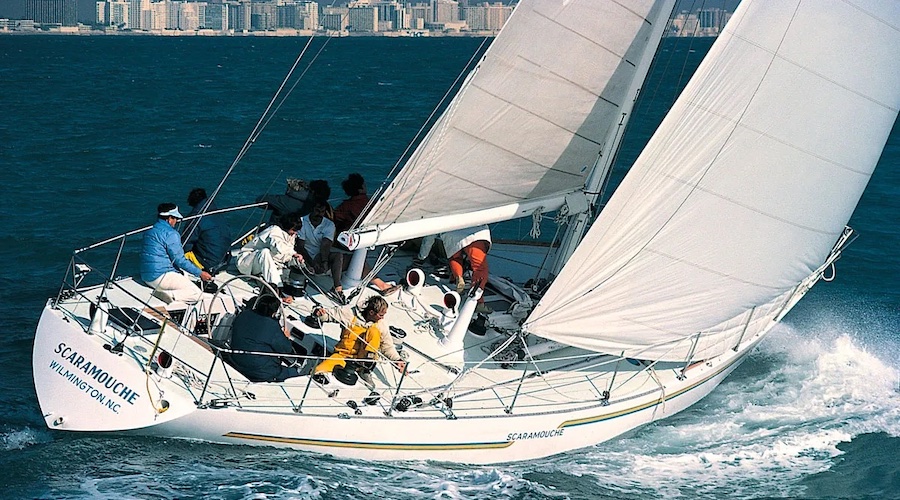
Scaramouche — a 55-footer from 1973 — was the breakthrough IOR design that placed Frers at the top of the profession, winning the Port Huron-Mackinac Race, taking a class win at SORC and winning every race in the Onion Patch series including the Bermuda Race. Acadia, a 50-footer from 1978, was US Yacht of the Year and dominant on the international circuit, including Class A at SORC for three successive years. That Imp — a Holland 40, a decade newer and six feet shorter — beat Scaramouche in the 1977 Fastnet is one of the era’s telling competitive moments.
Frers boats carried a kind of authority that was different from Peterson’s precision or Holland’s spark. They looked drawn rather than manipulated, yet they were not innocent of the rule. The best of them had a rare quality: seeming both sophisticated and purposeful at the same time. In an age when some IOR boats began to look as if their sterns had been tortured by the certificate, Frers showed that rating intelligence and elegance did not always have to be enemies.
Shape carries confidence. Sailors feel it. Owners buy it. Rival crews notice it. A boat that looks composed can still be a weapon
DUBOIS, JONES, EVERITT, HUMPHREYS AND THE BRITISH DESIGN ARGUMENT
By the late 1970s and into the 1980s, the British offshore design scene was more varied and more interesting than a simple “old establishment versus foreign innovation” story.
Ed Dubois, Stephen Jones, Julian Everitt, Rob Humphreys, David Thomas, Tony Castro all belonged, in different ways, to a British design culture shaped by IOR, Admiral’s Cup selection, production racing and the hard practicality of owners who wanted boats that could actually be campaigned across multiple seasons.
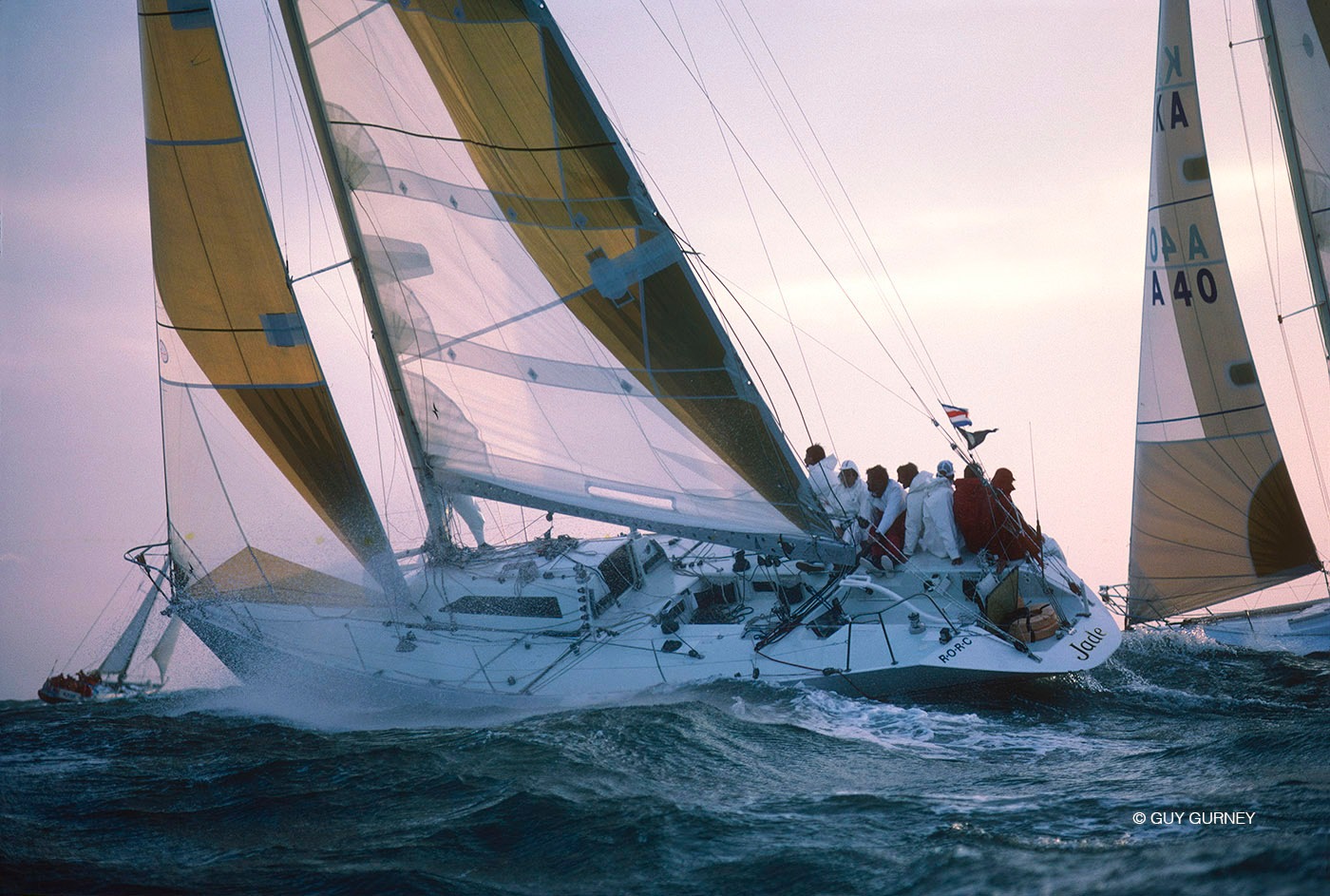
Dubois moved increasingly into the serious Admiral’s Cup world, with powerful race boats and a later career in large custom yachts. Stephen Jones produced designs that were fast, attractive and seamanlike, an unusual combination in the IOR era, when those three qualities rarely appeared together. His reputation still rests on it. Julian Everitt’s own account of 27 years of Half Ton designs captures the designer’s dilemma of the period precisely: the choice between a pure race boat, a dual-purpose boat, and the third option of simply ignoring the rule and designing the fastest boat possible. Rob Humphreys founded his practice in 1974, took Jade II to the One Ton Worlds and the British Admiral’s Cup team in 1985, and later served on the ORC International Technical Committee from 1987 to 1995, a rare combination of design office and rule-making influence.
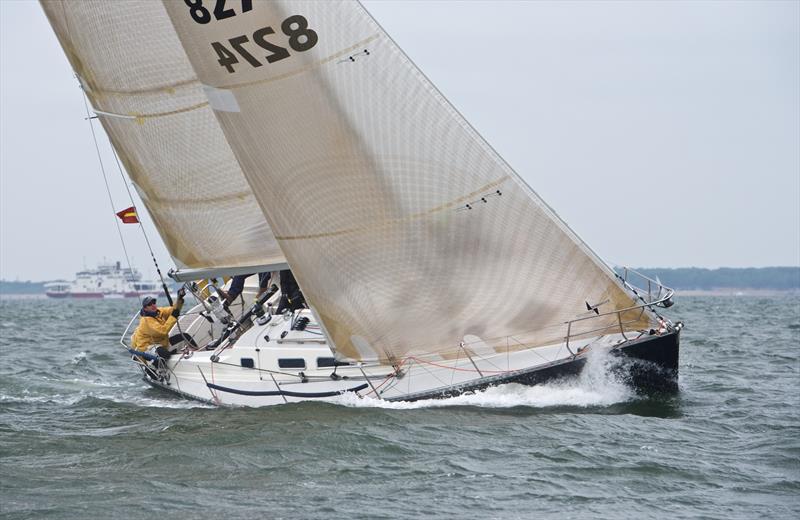
David Thomas reminds us that offshore design history is not only made by glamorous custom yachts. The Sigma 33, Sigma 36 and Fastnet-capable Sigma 38 carried racing knowledge into boats that ordinary sailors could own, race and maintain without a full professional team behind them. Not every owner could commission an Admiral’s Cup machine. Many wanted a boat that could race offshore, sleep a crew, get home, and not require a banker and a private measurer to keep it alive.
The clever designers understood the difference between those two briefs. The best ones could serve both.
VICTORY OF BURNHAM AND THE MEASUREMENT PROBLEM
The story of Victory of Burnham belongs here because it captures the strange genius and vulnerability of the IOR world.
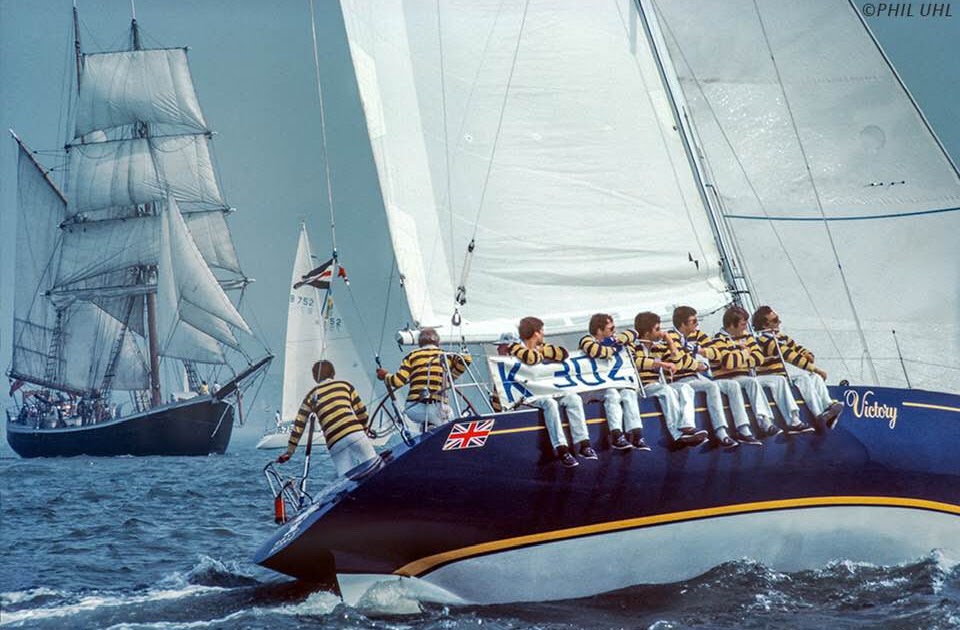
She was an Ed Dubois-designed Admiral’s Cup 44-footer from the 1981 season. She made the British Admiral’s Cup team, was the top scorer in the British campaign, and finished second overall on individual points behind Ron Holland’s Swuzzlebubble. Later, after she was sold and remeasured, her rating became the centre of a serious controversy. Her original April 1981 measurement came out at 33.3ft. After ballast relocation and Dubois’s recommended action to force a complete remeasurement, a later measurement produced a rating of 33.1ft. Victory was selected for the British team and raced successfully.
After the Admiral’s Cup, remeasurement found the rating had been too low throughout.
This has to be written carefully, and fairly. The interesting part is that Dubois himself appears to have recommended the action that would force a remeasurement, a sign of concern rather than concealment. The stronger and more useful interpretation is that Victory of Burnham exposed the fragility of a measurement system in which tiny details could have large consequences, and in which a serious race boat could pass through selection, race for a national team, score heavily, and only later become the subject of a rating crisis.
That is more interesting than scandal.
When a rule becomes too intricate, the rule itself becomes a competitor. Owners compete against owners, crews compete against crews, designers compete against designers and then everyone competes against the rule. Eventually the sport has to ask an uncomfortable question: are we still measuring performance, or are we rewarding the most successful interpretation of the measuring system?
Victory of Burnham is not just a Dubois story. It is an IOR story. The boat did what IOR boats were designed to do. The controversy came later because the whole structure depended on measurement confidence. Once that confidence cracked, the result was not merely one disputed certificate. It was a challenge to the trust on which handicap racing depends.
1987: THE WORLD CHANGES AT COWES
Before the article moves to the unravelling of IOR, one more moment deserves its place in the record.
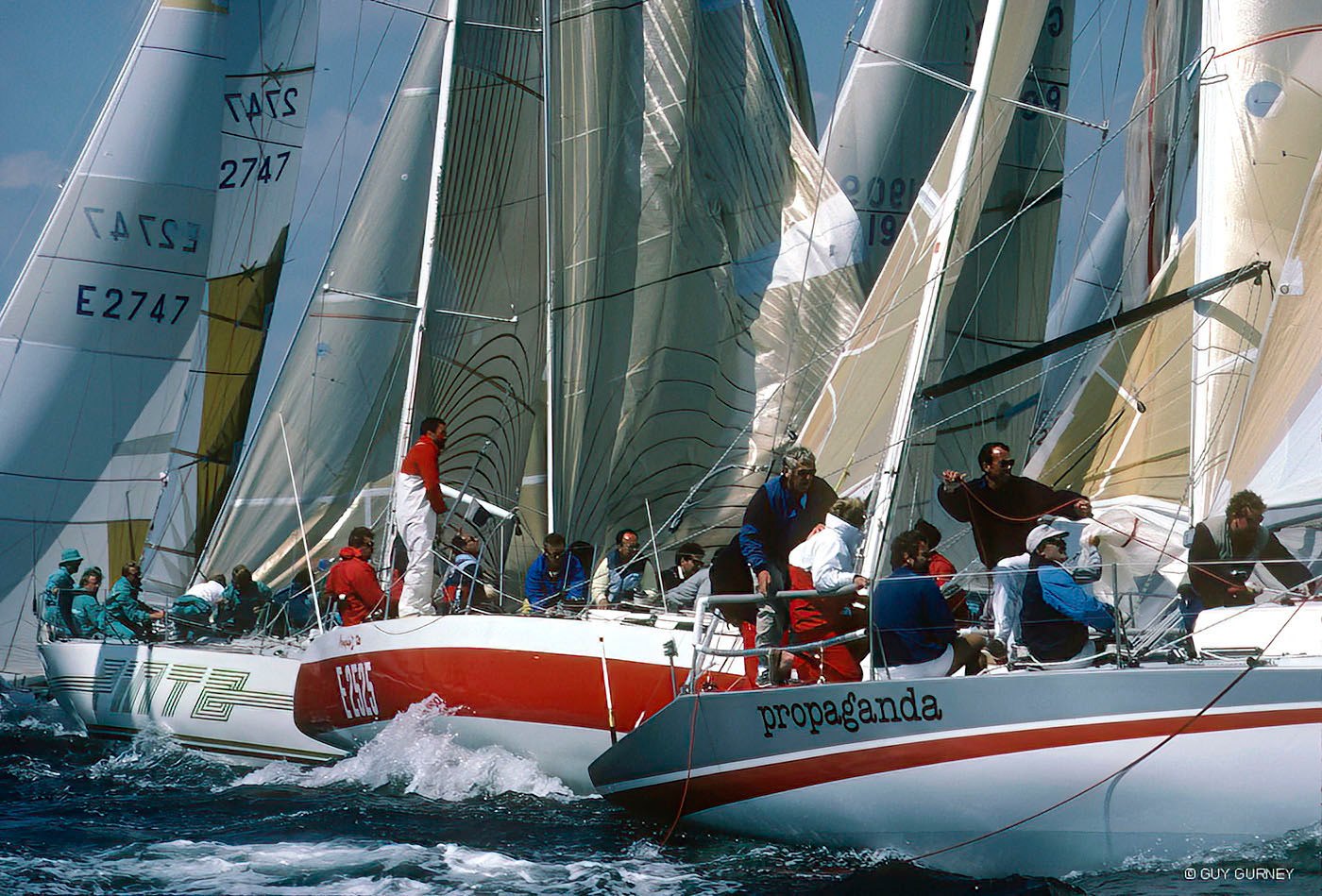
In 1987, the Admiral’s Cup went to New Zealand for the first and only time. The Kiwi team — Propaganda, Goldcorp and Kiwi — won by 84 points from Britain. Their boats were Farr designs: lighter, faster off the wind, built around a philosophy that a serious offshore yacht should be driven hard and driven constantly. They did not look like Admiral’s Cup boats in the old Cowes sense. They were something newer.
The New Zealand win in 1987 was not merely a result. It was a statement. The design centre of gravity had shifted south. What the Southern Hemisphere had been developing through Whitbread campaigns, offshore ocean racing and lighter displacement thinking had arrived at the Admiral’s Cup and beaten the northern establishment on its home water. After 1987, nobody sensible was going to dismiss the Farr school as merely a Whitbread phenomenon.
The IOR era was still alive, but it had begun to lose confidence in itself.
WHAT IOR GAVE, AND WHAT IT TOOK AWAY
It is fashionable to look back at IOR as a period of distortion and absurdity. There is truth in that, but it is not the whole truth.
IOR gave offshore racing a common international language. It helped create extraordinary competition across the Admiral’s Cup, the Ton Cups, SORC, the Whitbread and international campaigns where designers, builders, sailmakers, owners and crews were all forced to raise their game. It gave young designers a way to become famous quickly if they could read the rule better than the established offices. It made measurement, tank testing, materials and sail plans part of a serious design conversation.
It also took something away.
It made some boats less honest. Not dishonest in a moral sense, less honest in that the visible shape of the boat no longer spoke plainly about the way she wanted to sail. Sterns were pinched. Bustles appeared. Bumps and hollows became part of the language. Freeboard, overhangs, girths and measurement points acquired a significance no ordinary sailor could easily see.
That is the heart of the IOR age. It produced genius because it made the problem difficult. It produced nonsense because it made the problem artificial. Often it produced both in the same boat.
A good IOR designer had to be more than an artist. Part naval architect, part lawyer, part gambler, part weather analyst, part psychologist. He needed to know what the rule measured, what the sea would punish, what the owner would fund, what the crew could handle and what the competition had not yet understood.
By the late 1980s, the IOR world was still glamorous but carrying too much weight of its own making. The boats were expensive, the measurement games increasingly arcane, and confidence in the rule was no longer what it had been. The Admiral’s Cup remained important, but the sport was already looking for other answers.
Some would come through IMS and later ORC. Some through CHS and IRC. Some through one-design and box-rule racing. And in France, a parallel offshore universe had been growing through solo and short-handed racing, quietly, patiently, waiting for its moment.
Before moving on, IOR deserves a fair final judgement.
It did not ruin offshore racing. It made offshore racing more technical, more international, more competitive and, at times, more ridiculous. It produced wonderful boats and strange boats. It created an offshore design culture in which the best people became very good at seeing both the boat and the certificate at the same time.
The problem was that, eventually, the certificate began to rule!
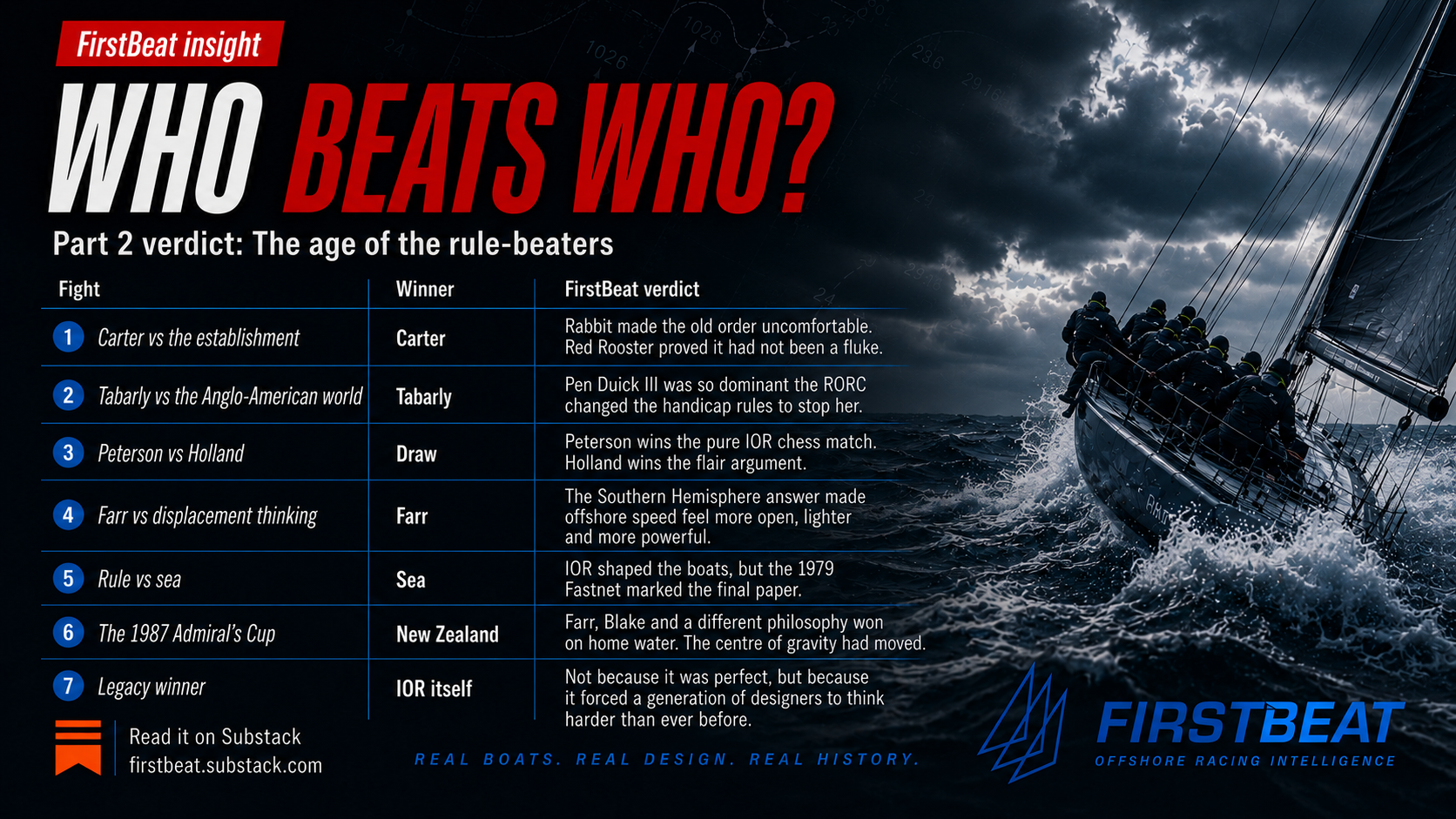
FIRSTBEAT: WHO BEATS WHO?
1965 TO 1990
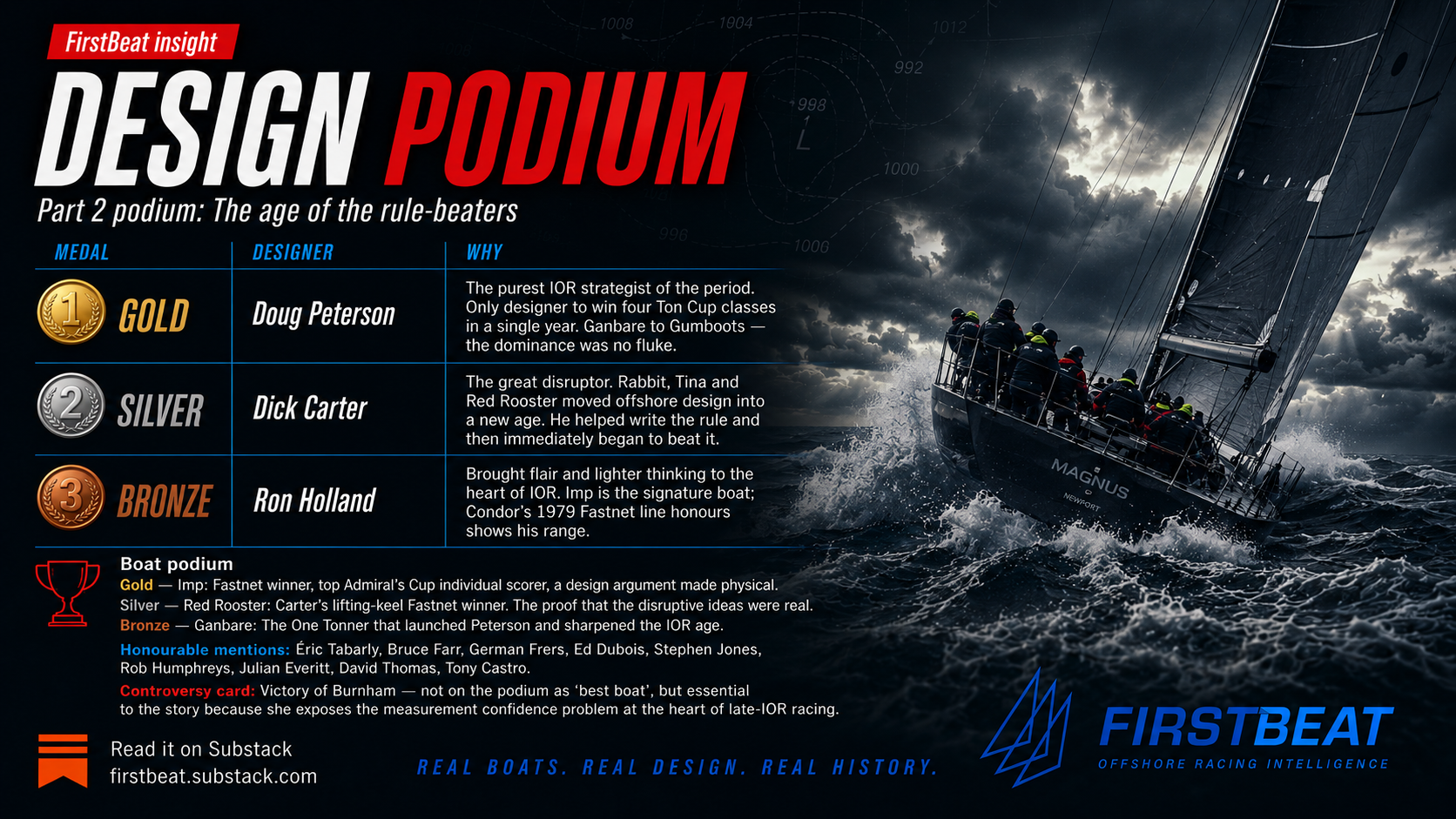
FIRSTBEAT DESIGN PODIUM
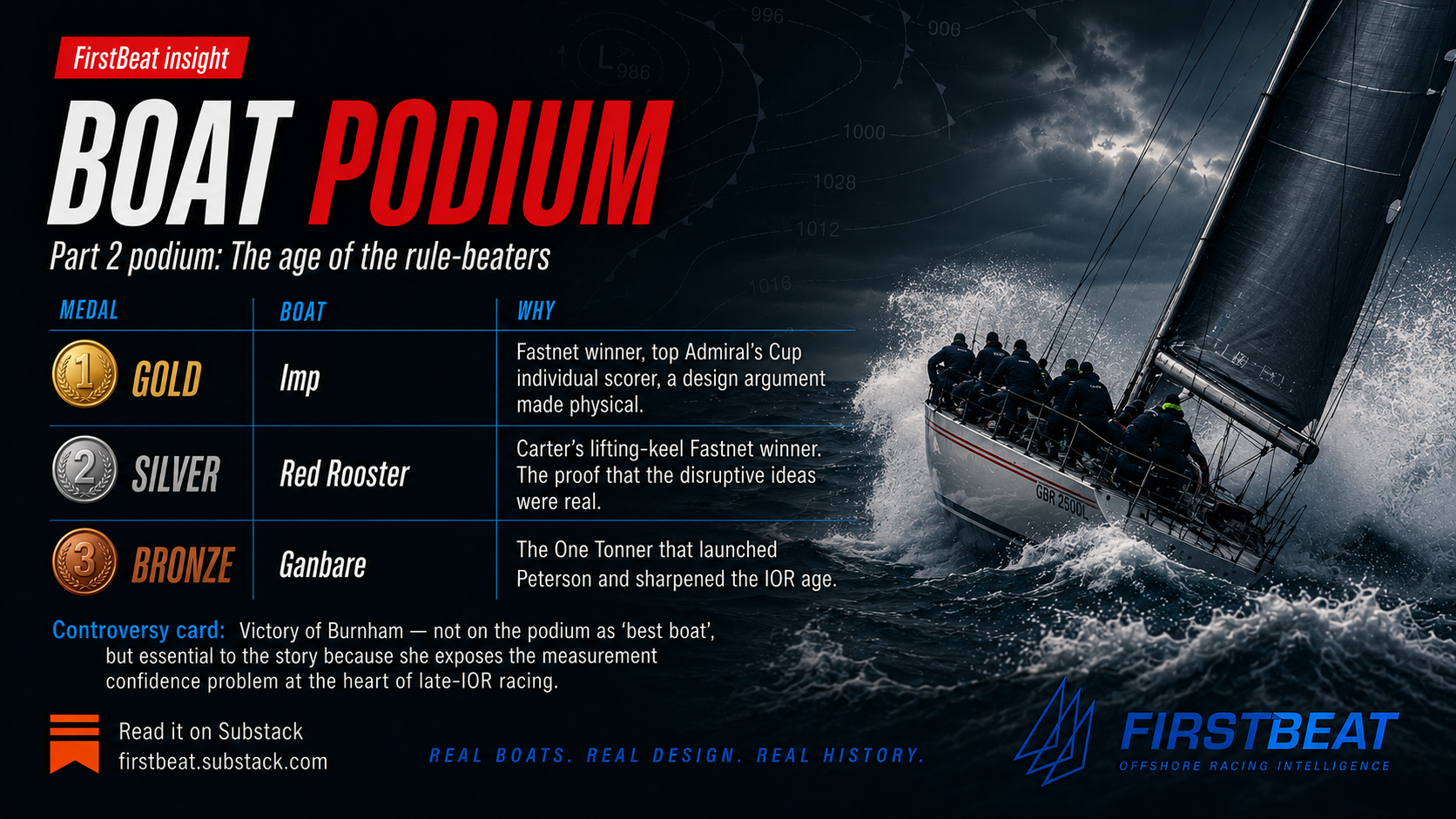
FIRSTBEAT BOAT PODIUM
FINAL FIRSTBEAT VERDICT
The IOR era was not a clean story of progress. It was a brilliant, awkward, sometimes absurd argument between design intelligence and rule exploitation. It gave offshore racing some of its most memorable boats and designers, but it also proved that when the rule becomes too clever, the boat can become harder to trust.
The best designers of the period did not simply beat the rule. They survived the rule. They found enough rating advantage to win without losing the qualities that let a tired crew drive the boat offshore.
That was the hard part.
Part 1 belonged to seaworthy speed. Part 2 belongs to the rule-beaters. Part 3 is where the sport begins to split apart — IMS, IRC, ORC, TP52s, the Whitbread, Volvo, IMOCA, Class40, Ultims and the French offshore revolution that nobody in the Cowes establishment had quite expected.
The future would not be one design story. It would become several.


Comments